
Six Infamous Sacks of Eternal City — Rome
Looking back at six historic and infamous sacks of Rome that damaged the Holy City beyond repair
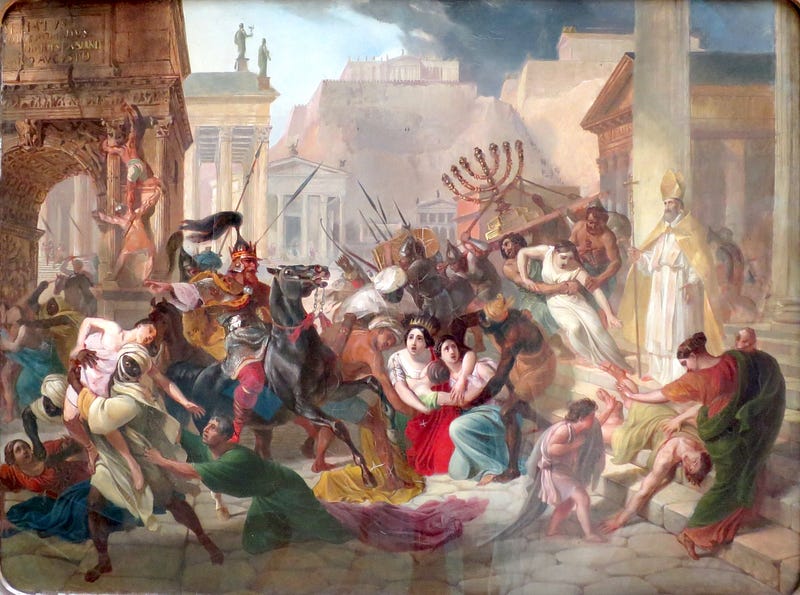
#/media/File:Genseric_sacking_rome_456.jpg)
The Roman Empire rose to its glorious heights by sacking and conquering great cities and lands throughout Europe, the Middle East, and Africa.
However, history took a turn when White Huns reached Europe in 370 A.D by crossing the Volga River and unleashed their terror of death that forced the Germanic tribes to seek refuge within the borders of the Roman Empire. The Barbarians experiences with the Romans were far more horrifying and degrading.
The Barbarians highly resented the ill-treatment received at the hands of the Romans, and thus they have resolved to take revenge once they revive their force and strength. Once they assembled enough force, these Germanic tribes focused more and more on taking down the entire Roman Empire and soon started sacking the Eternal City. But even before that, the Gauls had shown the face of defeat to the Romans which they least expected.
Here are the six legendary sacks that took place by various Barbarian tribes that damaged the Eternal City beyond repair:
1# The Sack of Gauls
The first of the infamous clashes began when the Romans were sacked by the Celtic Gauls led by a warlord Brennus.
Rome was a thriving city and its famous legions hadn’t yet perfected the art of fighting when they met the bare-chested and wild-haired army probably on July 18, 387 B.C. The scene for the battle was set on the banks of the River Allia and a fierce fight was pursued.
The Gallic Army easily crushed the Roman soldiers and went to the city unmatched, unhindered. Upon reaching the city, they have killed men, mass- raped women, looted the valuables, and burned the buildings.
When the Gauls were plundering the city, some of the Romans fled to the Capitoline Hill, fortified by the remaining soldiers. The siege took several months before the Romans agreed to pay 1,000 pounds of the gold as ransom to Brennus to leave the city.
When Brennus and his army left the city, the Romans rebuilt it, but the defeat of 18 July permanently entrenched the wounds of the defeat in their chests from which they never recovered.
2# The Sack of Visigoths
Although the Romans flourished for almost 800 hundred years after the Gallic attack, it was not an end. The Romans faced yet another siege when the Visigothic King Alaric raided the Holy City once again.
The second sacked happened in 410 A.D. when one of the Germanic tribes, the Visigoths, led by King Alaric tried for a third time to sack the city and was successful. The success of the third attack is attributed to the rebellion of a few Roman slaves who opened the Salarian Gate and let the Goths enter the city.
Once in the city, they burned buildings and hoarded valuables, killed aristocrats, and stole anything that came their way. However, after the plundering, the Visigoths quickly withdrew and vanished along the Appian Way.
The Goths themselves were Christians and didn’t damage the city much, neither they killed unscrupulously. They didn’t burn the religious and famous buildings and allowed people to take refuge inside the St. Paul and St. Peter Church. However, the horrifying news of the fall of the city quickly reached the Mediterranean, which the Roman resented.
3# The Sack of the Vandals
The Vandals were notorious for their wanton destructions and killings of whosoever they raided.
They sacked Rome in 455 when the Roman Emperor Valentinian III was assassinated. Before that, the Roman Emperor signed a peace treaty with the Vandal King Genseric and also pledged to give his daughter Eudocia in marriage to Genseric’s son.
When the Emperor was assassinated, the Vandals marched towards the holy city claiming that the emperor’s death invalidated the agreement, hence he was no free of any pledge not to invade. Since the Roman army couldn’t match the Vandal army, they sent Pope Leo to negotiate the terms with the king.
The Pope and Genseric reached an agreement that the Vandals will not kill the citizens of the city, neither will burn the buildings, and were allowed to walk over the city without resistance.
As agreed, the Vandals didn’t burn or killed anyone but they took gold, silver, furniture, and looted the imperial palace and the Temple of Jupiter Optimus Maximus. They also took a few prisoners with them along with the emperor’s daughter, Princess Eudocia, who, per the earlier agreement, was married to Genseric’s son.
4# The Sack of Ostrogoths
Various Germanic and Ostrogoth kings ruled Italy, after the last emperor of the Western Empire was ousted in 476 A.D..
The Byzantine or Eastern Emperor regained the lost regions by defeating the Ostrogoth in the mid-Sixth Century and established Roman rule again. However, the Romans’ success didn’t last long when the Ostrogoth great leader Totila laid another siege to Rome.
He was successful in capturing the city in 546 when the Goth army scaled the walls of the city under the cover of darkness and opened the Asinarian Gate to have open access to the city. After the Goths entered the city, the small imperial garrison was easily defeated and the city laid bare and open to plunder.
However, despite vowing to destroy the city, Totila didn’t demolish the buildings and only looted the valuables. The majority of the population fled the wrath of the Goths, and the once glorious city’s population decreased drastically. Totila departed the city in early 547 causing significant damage to population and the city.
5# The Sack of the Normans
Pope Gregory VII invited the Norman warlord Robert Guiscard to cover his escape when the Holy Emperor Henry IV put Rome under siege.
The Pope and Robert Guiscard had friendly relations, and he came to the Holy City in 1084 A.D. to release his friend from the bondage. Guiscard quickly captured the city and rescued the pope, however, the citizens supported their emperor and resisted the Normans.
When the people revolted against Guiscard, he easily crushed them and ordered his men to rape and plunder on a mass scale. The Normans raped and plundered the entire city for three days. They killed people and burned and demolished many valuable monuments of the city.
6# The Sack of Roman Army
When the Holy Emperor Charles V fought against the League of Cognac, an allied force of the Kingdom of France, the Kingdom of England, the Republic of Venice, Pope Clement VII, and the Republic of Florence, the Duchy of Milan, the Imperial Army was not paid for months.
The Duke of Bourbon, Charles III, commanded the Imperial Army during the war. However, the impoverished army forced the Duke to allow them to pillage the city of Rome to get the booty of war.
The Duke rallied them and allowed them to assault the Holy City on May 6, 1527. To distinguish himself from his troops, the Duke wore his famous white cloak. This was a tactical mistake as the white cloak made him visible to the defenders. The Duke was shot down on the same day by Benvenuto Cellini during the battle.
However, his leaderless army quickly breached the walls, entered the city, defeated the Vatican’s Swiss Guard, and forced Pope Clement to flee to the Castel Sant’Angelo.
Once in the city, the Imperial Army killed men, women, and children. They raped women and didn’t spare the Catholic nuns. The nuns were raped and auctioned in the public market.
When the army left, Rome was in shambles and littered with naked dead bodies. Half of the 55,000 population perished or fled the city.
Many great artworks and priceless monuments were stolen or destroyed. Many important scholars were killed. Historians agree that the rampage of 1527 was the final deathblow to the Renaissance bloom of Italy.