
6 Japanese Philosophies To Transform Your Life
Philosophies that will challenge your current beliefs and routines

First shameless promo — I am all about finding healthy and sustainable ways to live a more productive and meaningful life. Therefore, I have completed 18 30-day challenges to build sustainable habits so far. Here is the plugin if you would like to read any of my challenges.
I have never been to Japan. However, I am always curious about the Japanese way of life.
This article is a part of my upcoming trip to Japan to explore, learn, and understand the culture at a much deeper level. Let’s dive in.
Ikigai
Your Ikigai is a work in progress because you are a work in progress. Knowing your Ikigai, then, takes patience and, insight, and courage, honesty. — Rob Bell
Ikigai is translated as “your purpose in life to live and reason’.
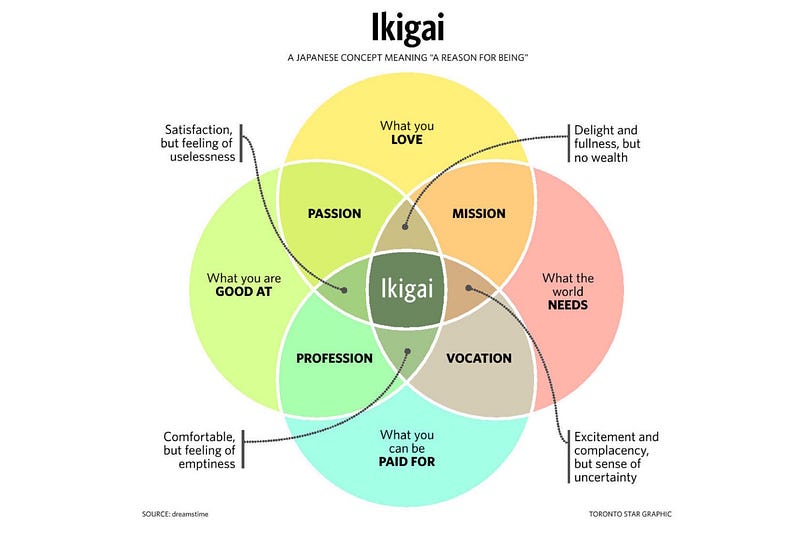
As mentioned in the image, there are 5 pillars of Ikigai: start tiny, reason of being, sustainability, the happiness of tiny things, and being in the present moment.
I highly recommend using the 5 pillars in your daily life to find clarity in your life purpose.
The world is full of finding the next big thing, mostly inclined to your professional life. However, in Japanese culture, it’s all about finding your essential journey.
Shikata ga nai — Acceptance and letting go
“Shikata ga nai” is a Japanese phrase that means “it cannot be helped,” and there is nothing that can be done about it.
However, it is really about acceptance.
The phrase refers to the idea of accepting what we cannot change but accepting it and moving on.
Kintsugi
The Japanese art form known as “kintsugi,” which translates as “golden path,” and “Kintsukuroi,” which translates as “golden repair,” is most commonly associated with the repairing of broken pottery with gold or silver lacquer.
Kintsugi is based on another Japanese concept of wabi-sabi, which holds that imperfections are admirable.
This perspective can help us accept our flaws as embellishments that make things and people even more beautiful.
The concept has inspired many artists, and they have incorporated it into their work.
Kaizen
Kaizen is Japanese for “improvement.”
Although technically invented by an American businessman, the Japanese adopted and popularised it after WWII.
Rather than making drastic changes overnight, the Japanese take a long-term approach that seeks to achieve small, incremental changes in processes to improve efficiency and quality.
Kaizen views productivity improvement as a gradual and methodical process that can be applied to both professional and personal settings.
I always say that there is no such thing as a magic bullet or overnight success.
Instead of attempting radical life changes, begin with small, daily improvements.
Every day, strive to improve yourself by 1%. The changes will appear insignificant at first.
Nothingness
In Japanese philosophy, they are more interested in the concept of nothingness.
The Japanese view nothingness positively, associating it with being awakened or enlightened.
Nothing exists that isn’t connected. But connectedness doesn’t exist. It shows itself through things that are connected, but connectedness itself doesn’t exist. You can’t point to it. So, which is more fundamental? Connected things, or connectedness? Connectedness is more fundamental. — Kitaro Shishia, Founder of Kyoto School of Philosophy
Tsundoku (let things pile up)
I love books. I actually scheduled a weekly-biweekly visit to the second-hand books stores in the neighborhood.
I always walk away with 2–5 books that I never knew existed. I primarily read non-fiction. Therefore, that section always grabs my attention.
Back to the Tsundoku — it’s a Japanese word that means a stack of books you have bought but haven’t read yet.
All those books you haven’t read are indeed a sign of your ignorance. But if you know how ignorant you are, you’re way ahead of the vast majority of other people. — Stillman
Let me explain why the Tsundoku concept is very powerful. Many studies show that children who grew up with many books at home (80–300) showed numeracy, literacy, and great information communication skills.
The bottom line
To sum up, the powerful philosophies of Japanese culture can guide us to live a happy and purposeful life. Let’s recap the Japanese philosophies.
- Ikigai: Find your reason for being
- Acceptance of what we cannot change or control
- Kintsugi: To join with gold
- Kaizen: Change for the better
- Nothingness
- Tsundoku: Stack of books you have bought but never read
Book recommendation: Ikigai: The Japanese Secret to a Long and Happy Life (Amazon affiliate link)
Thank you for reading; follow me and clap a couple of times. Thanks
To get access to unlimited stories, you can also consider signing up to become a Medium member for just $5. If you sign up using my link, I’ll receive a small commission (at no extra cost to you). Thank you a million times!


