
6 Books on Roman History
Let’s Talk About the Roman Empire
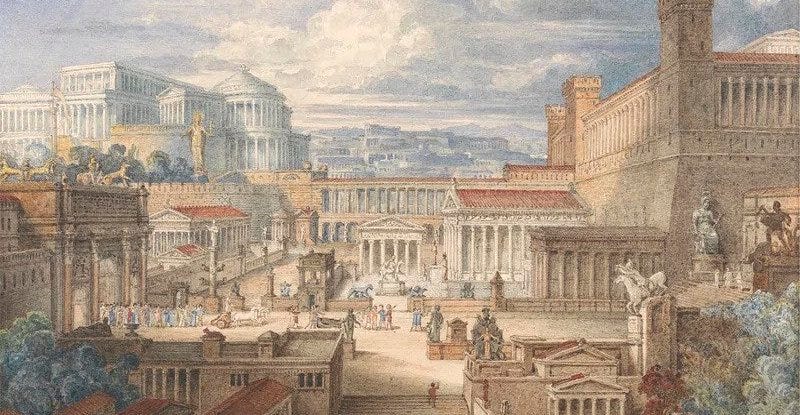
After writing about the fall of the Roman Empire, I thought readers might appreciate links to a few books on the Roman world.
First, let me say that in line with my thesis that the Empire fell over the course of the 7th century CE, I’ve drawn my line around 650 CE. These books cover the period before 650 (note: the “bonus” Wickham book is an exception, because he does such an excellent job tying together the late Roman and medieval European worlds).
The books I’ve chosen represent a wide range of perspectives and a diverse range of authors. I think all readers should find something they enjoy!
Mary Beard — SPQR
Beard is a well-known UK classics professor. And here she writes a general survey of Roman history from the founding of the city to the early 3rd century CE. This means she covers a thousand years!
As with any broad history of Rome, the boundaries Beard draws reveal much of what she wants to say.
So, what’s so special about the early 3rd century CE? It’s when Emperor Caracalla gave citizenship rights to all free men in the Empire. Beard wants to show the Romans’ evolving understanding of what it means to be Roman.
In their very founding myths, Romans thought about themselves as foreigners. As they expanded their sphere of influence, Romans folded others into the Roman order. This culminated with Caracalla, who bestowed ‘Romanus’ on all its free men.
I think Beard succeeds at what she sets out to do. A reader should finish the book with a sense for how Rome built and rebuilt its notion of being a Roman. And readers will learn a great deal about the Republic and the Empire along the way.
Averil Cameron — The Mediterranean World in Late Antiquity
Cameron provides an overview of the Roman Empire from the split of the empire after Theodosius in 395 up to the end of the 6th century. Tackling this period in just 200 pages is a challenge. But Cameron performs the task nicely.
As with any book on late antiquity, Cameron contributes to the question of the fall of the Roman Empire (at least in the West). Her book, unlike most books published before the 1990s, emphasizes the role of continuity and change over decline and fall.
Cameron points out how late antiquity gradually transitions into the medieval world. She stresses how the actors involved — Roman officials, German tribes, the emerging Arab world, and so on — adapt to their situations. They don’t behave as passive figures succumbing to the decline of civilization.
And so, Cameron avoids the trap of talking only about doom and gloom and loss. She points to how people created the world anew.
Kyle Harper — The Fate of Rome
Harper, too, writes about the fall of the Empire. But he approaches it from a different angle. Harper emphasizes the role climate change and disease played as factors. Other authors discuss disease, though they rarely center it to the extent Harper does. And climate change stands out as a much more recent and innovative topic.
Harper lays out the background climate patterns during the major events of imperial history. A warming period coincided with the expansion of the empire across the Mediterranean in the first centuries BCE and CE. And then more challenging climates — plus serious diseases and plagues — struck the Empire at the worst times a few centuries later.
I think Harper makes a solid case that both climate change and disease were factors in the fate of Rome. Especially during the Justinian resurgence of the 6th century.
However, I also think he exaggerates their importance. For example, Harper tries to argue for climate change as a major cause of the crisis of the third century. But to get there, Harper has to date the start of the crisis to 248, which would more closely coincide with climate issues. But the much more widely accepted start of the crisis is the end of the Severan dynasty in 235, and many factors in the crisis predate even that. And so, the crisis likely began before climate entered as a major factor.
Overall, though, Harper provides us with a great book and much to consider. It’s very well written and breaths new life into a well-worn topic.
Bronwen Riley — The Edge of the Empire
Riley zooms in on a particular time and place: Roman Britain in the early 2nd Century CE. She does so using a novel literary device. Riley reconstructs the journey a new governor would take from Rome all the way to Hadrian’s Wall, at the border between the Roman Empire and the northern Caledonian tribes.
Along this journey, a new governor would encounter a slice of most of the Empire. To get there, the governor passes through the Empire’s divisions, contradictions, and unities. He sees urban and rural life. He sees the oldest parts of Roman history and its most recently built cities. Near the end of the journey, he crosses the English Channel into a world of recently conquered Celtic tribes and Roman migrants.
Riley brings the second century to life. She also makes extensive use of relevant Latin sources. And, finally, she draws compelling links between Roman Britain and how British cities currently operate.
Edward J. Watts — City and School
Nearly 20 years ago, I took a course on the fall of the Roman Empire at Indiana University that this author taught! So, I was excited to read his book.
Watts discusses the role of education in the life of the late Roman empire, focusing in particular on Athens and Alexandria. Much like the contemporary U.S., the Roman education system provided skills and job training, a network of contacts, and an underlying code of culture and behavior.
In his chapters on Athens, Watts describes a still largely pagan system and its challenges in a Christian world. Pagan teachers of Athens navigated this system successfully until the 6th century. They became pillars of the community, funding civil projects and taking on administrative roles in the city, especially after the Christians began neglecting such things. And they used Neoplatonic philosophy to fulfill the desires of students for more spirituality in the curriculum. As Watts tells the story, political infighting eventually cost them this world, with the closing of the Athenian Academy in 529.
In his chapters on Alexandria, Watts traces an emerging split in Christianity between intellectual traditions and asceticism. A backlash against philosophy by Christian leaders eventually led to the Christian subsumption of pagan philosophy in Alexandria. Watts interprets Christianity as sympathetically as possible, but it’s difficult to escape the conclusion that Christian extremism was the main problem here.
Watts discusses his sources carefully and presents a plausible account. Insofar as I might quibble, I think he overstates the role of Emperor Julian in ‘encouraging’ a Christian reaction that would’ve happened anyway. And his blaming of the closing of the Academy on internal forces stands in tension with the much more restrictive anti-pagan laws that emerged a few years later.
Bonus: Chris Wickham — The Inheritance of Rome
Finally, I’d like to recommend Wickham’s book as a follow up to these books that focus on the Empire.
Wickham ambitiously tells the story of Europe from 400 CE to 1000 CE. That is to say, it’s a sweeping history from the final century of the Western Roman Empire through the Dark Ages and up to the beginning of the High Middle Ages.
Wickham effectively balances the general and the specific, a balancing that stands out as the book’s greatest strength. He focuses mainly on economic history, telling us about Mediterranean trade, the increasing localization of economies, and the challenges of European states. This includes everything from the hybrid Romano-German kingdoms of the West to the Byzantine Empire of the East. Wickham even covers the Arab conquests and the early Arab states.
I think the book balances lots of newer trends in the history lit. Newer authors like Harper, for example, posit climate change and disease as major movers of history. By contrast, Wickham focuses on economic history and underlying causes. I suspect we find the truth in the middle (but closer to Wickham).
N.B.
This article contains affiliate links.