
5G — Fifth Generation of Mobile Networks
5G — An Introduction about the evolution of networks
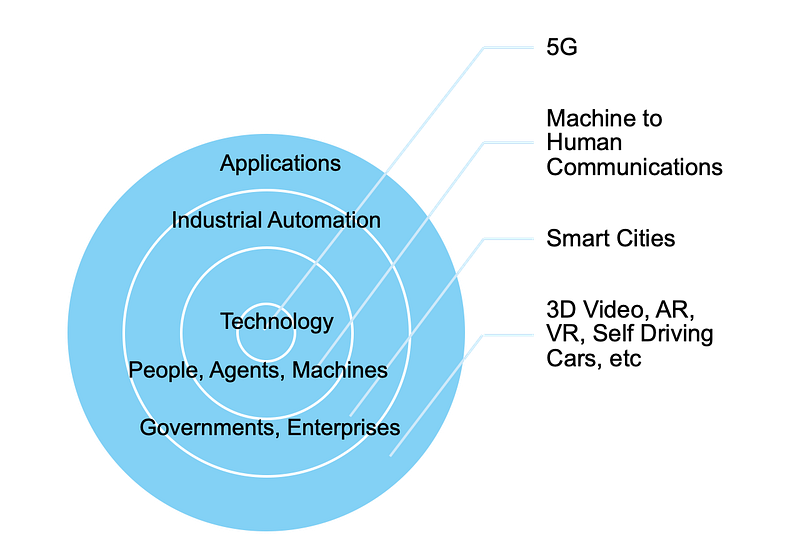
In this post of the series, I will discuss fundamental concepts about 5G (5th generation of mobile networks), how mobile technology works, and how has this technology evolved from one generation to another, over the years. How much speed enhancements will be achieved by 5G. In the next part of this series (part 2), I will discuss the impact of 5G on our lives and other fields.
Background:
We are hearing a lot about 5G these days, but the question is what is it and how it will change our life? 5G is not something that will replace 4G completely at once, and will continue to exist, rather it is an organic phenomenon that will evolve and change over time. This should also clarify the perspective that why there are already some efforts going on for 6G. We need to recognise the fact that there are more promising developments to come, ahead of this.
All smartphone companies are doing their level best to launch 5G enabled devices and connections. These devices will operate in different frequency bands such as from 3 to 300 GHz. Let’s put those promising opportunities aside for now and start with actually introducing 5G and how the mobile technology has evolved from 1G to where it stands today.
What is 5G?
This is the next generation of mobile technology which will be very fast compared to current generation (4G). It will enable ultra reliable and low latency communications. It will introduce new opportunities for everyone, especially for businesses to become more agile, data driven and competitive by offering and enabling new business models. At its minimum, it will decrease the need of face to face meetings as the participant would have the feeling of being in the same place, thanks to the technologies such as Virtual reality, Augmented Reality in addition to 5G.
As the mobile network changes its generation, the tower and its components get updated, as well as sims and mobile phones. To understand this better, we need to understand how the mobile works and how the radio waves around us, enable us to communicate with other people. Various instruments / equipments are used to make these signals work, namely:
- Mobile Phone
- Regional Tower
- Main Tower
- Main Controller (Master Switching Center-MSC)
The traffic flows between them starting with a user dealing the number, then it goes to the regional tower, which tries to connect with the main tower. The main tower in turn as the MSC to try to get connected the user 2 by following the same procedure in reverse. If all channels are occupied, the new user is put to wait otherwise he gets connected with its intended user. I’ll skip further details on this but in case you are interested to dig deeper, please have a look at [1].
“5G will enable ultra reliable and low latency communications. It will introduce new opportunities for everyone, especially for businesses to become more agile, data driven and competitive by offering and enabling new business models”
Evolution of Mobile Network Technology: From 1G to 5G
There has been four generations of our mobile technology as illustrated in the figure below, and the fifth is on the horizon. We will briefly discuss each of them in the following paragraphs.
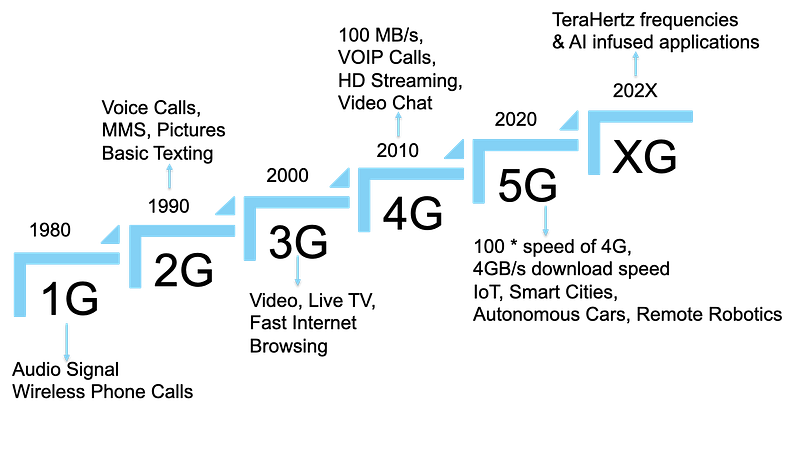
All of the different generations of mobile technology followed a very evolutionary path, starting with a baseline of standards, which were further enhanced by the developments over time.
- 1980s: Mobile Technology Wireless, 1G- Using Analog technology which started for the first time to send a message using audio signal (wireless). For example walkie talkie. 1G had issues like call drop, battery life and call security issues. This technology remained in use until 1990.
- 1990s: 2G came in 1990 which offered digital CDMA (Code-Division Multiple Access), GSM (Global System for Mobile Communications) and other mobile communication standards. Good voice calls, picture messages and MMS (Multimedia Messaging Service) were also introduced with the introduction of this generation of mobile technology. Later on, fast speed GPRS (General Packet Radio Service) [2] was introduced which is known as 2.5 G. This was used from 1990s to 2000.
- 3G: With the introduction of 3G, fast speed (relative, back then that was fast, believe me) internet was offered to the users. Through this technology, video, live television , video call, fast speed internet browsing. Evolutionary and wax are based on 3G. 512KB/s to 3.1 MB/s speed of internet can be offered through which most social media services were made possible to be accessed. This was used during the period of 2000 to 2010.
- 4G: To date, this is the most fast speed technology, 100 MB/s, VOIP calls, online calls, HD streaming features are included. available in most countries and suers are using mobile internet through this. This made the lives a lot easier. With each new generation of technology, mobile phones and mobile towers are required to be upgraded. If you have a 3G phone, but you cannot use it for 4 G. Since 2010, this technology is being used until now (Nov 2019).
- 5G: Now we are about to enter the era of 5G, which is expected to be available by 2020. The speed of 5G would be 1000 times of 3G and 100 times of 4G. It will control thousands of networks and will further strengthen IoT applications. It has a speed of 4GB/s which means you will be able to download a 50GB file in just one minute. Isn’t it super exciting and a big relief for those of us who have been struggling 20 years ago when they had to download a small file and it took ages. while 100 GB file will be downloaded in 4 minutes approximately. Otherwise, you would be able to download 10 to 15 files of full HD in one minute.
5G in One Square kilometre can connect one million devices. And this is 1000 times faster than present mobile connection and 100 times faster than a home based broadband connection. It will have more features which will change our world. Some of the (five) new things that will get introduced to the world, due to 5G are:
a. Milimeter waves: Mobile communication depends on radio frequencies. 4G had 3MHz to 6MHz frequency, 5G will have it increased to 300 MHz (multi-gigahertz frequencies). Due to this, thousands of devices will be able to connect with each other simultaneously.
b. Small cell: A route from Base tower to mini tower. The tall buildings stop the signals and we get the message that the signal is weak or dropped. To overcome this, small cells or mini towers will be introduced so that when the user moves from one location to another, they will automatically connect to mini tower, so that the signal will be able to reach the base tower.
c. Massive MIMO ( Multiple Input Multiple Output). 4G base stations are weak to control all mobile communications. 5G would be able to do this based on Small cell and MIMOs. Which will keep the sum of signals to it, so there will be no lost.
d. Beam forming. It works like traffic signals, which means the data will be given to the user who needs it the most. It controls both the incoming and outgoing data of the users. If you are somewhere near big buildings area, then with the help of MIMO, beam forming will tell you about the coming signals and will provide the full service. Even in the neighbourhood of tall buildings it will have complete signals and will send the signals in the same direction.
e. Full Duplex. When the signals come and go from same direction (as it was the case with Half Duplex), they become weak. Full duplex will keep them strong, by offering the dedicated path for each type of signal.
“5G in One Square kilometre can connect one million devices. And this is 1000 times faster than present mobile connection (4G) and 100 times faster than a home based broadband connection. It will have more features which will change our world. ”
In the next blog, I will shed some light on the impact of 5G on our lives and other fields, highlighting potential advantages and disadvantages of it.
References:
- http://www.epv-verlag.de/pdf/3936318247_Leseprobe.pdf
- GPRS: https://en.wikipedia.org/wiki/General_Packet_Radio_Service
Thanks for Reading!
If you like my work and want to support me…
- The best way to support me is by following me on Medium.
- If you want to write on medium and submit it to a publication. Check here for Data and AI and for more general and diverse topics, you can submit your articles to Diversified Knowledge
- Follow me on Twitter here. I’ll be posting lots of updates and interesting stuff there!
- Also, subscribe to my YouTube channel here!
- Follow me on LinkedIn here.
- Check out my website.
Originally published at https://www.linkedin.com.