The Terrible Power of Being a Political Woman on TV
What we miss out on when we demand fealty to a certain on-screen aesthetic
Being a woman in America can feel like riding a defective bicycle. You pedal and start to work up some speed, get up momentum until you’re sailing and the sweatiest effort is over — and then something in the mechanics catches, a spring or a wonk in the chain, and the thing stops and hurls you over the handlebars. After you’ve caught your breath, you grimly realize you have to start the work all over again.
Over the past four years, women have surged into Congress — only to get more scrutiny for their looks than when there were fewer women in office. #MeToo enabled women to speak up about harassment at work — but then, somehow, the take ends up being that it is women who are making men uncomfortable. You start to feel unsteady, as a woman in the world, unsure of which way the ground beneath you is sliding. You know that feeling when a car in the lane beside you at the intersection starts to pull forward, and for a second, you’re certain it is you who’s drifting backward, you who’s made some horrible mistake? It lasts: I drive paranoiacally and timidly afterward. That’s the feeling, now, some days, some nights, being an American woman. A sense of two things happening at once — breathtaking gains and unsettling counter-drifts.
I work in the political press, and the unsteadiness is here, too. When I started in 2005 as a reporter in Washington, D.C., there were far fewer female faces than male ones. By 2016, political “embeds” — print and TV reporters who follow presidential candidates on the campaign trail — were more likely to be women than men. Everywhere in news outlets’ chains of command, from the up-and-coming beat reporters to editors to business managers, there are women to emulate. In 2014, President Obama made history by calling only on women reporters at a White House press conference.
Television performance was increasingly spoken of as a science, with outside experts brought in so higher-ups at the networks wouldn’t have to take responsibility for their preferences.
Yet the proportion of questions women are selected to ask at White House press conferences — in total, only a third of all the questions — has remained unmoved for decades, despite evidence suggesting women reporters ask tougher questions. The Washington Post’s employee union in 2019 found that women make 20% less than men doing the same newsroom jobs at the Post; unsettlingly, that newsroom pay gap between men and women was confined to male and female employees under 40, a group you’d think should have achieved greater parity. A 2018 report found that when D.C. journalists retweet other journalists, amplifying their ideas, nearly seven times out of 10 they’re retweeting men. When a male political journalist chooses to engage another journalist on Twitter, nine out of 10 times he’s responding to a man. (Women reporters retweet male reporters’ tweets more than women’s, too.)
And then there’s television.
We need to talk about TV, and YouTube, too. This is a banner year for Americans getting their political news from digital video and TV. We’re stuck at home, yearning for a connection to the outside world, enjoying a peek into the apartments of the reporters we’ve always read or seen in a studio. It’s an amplification of what’s been happening for a decade. If you’ve gotten the sense you’re ingesting much more of your political news and commentary through video, that’s because video has gotten to be a vastly more important part of journalists’ jobs. There are more networks, more political satire and panel shows, more opportunities for journalists to talk about their work on every size and every shape of screen than ever before.
And there are more women on those screens. Meg Heckman, an assistant professor at Northeastern University’s journalism school, wrote a book about Nackey Scripps Loeb, the late, female publisher of the New Hampshire newspaper then called The Manchester Union-Leader and a pioneer of political TV commentary. Heckman remembered watching through hundreds of hours of C-SPAN footage from the 1980s and 1990s for her research. “You could go so many hours without seeing another woman,” she said.
Now, “there is no newsroom left where it would be acceptable to book a panel of white men,” a former top news executive told me. “If you look at MSNBC, its biggest star is Rachel Maddow. There’s Joy Reid. Anytime someone booked a quantity of people and there were no women, that was going to get the executive producer’s attention.” Eleven women political journalists participated in a 2017 spread in Vogue; on PBS, CBS, and NBC, four out of the six anchors assigned to cover the 2020 Democratic National Convention were all women.
While the presence of women on political TV has increased, so has a subtle, or not-so-subtle, pressure on them to be gorgeous. It’s what one female political writer calls “the oiled-legs-and-a-sheath-dress look.” This aesthetic is even more obvious in the Covid era when so many of us consider matching tracksuit components “dressing up.” “There was a time when male management and senior-level producers judged women based on ‘Is she fuckable or not,’” a former TV executive told The Atlantic in 2018, as if this were fortunately no longer the case. But a number of women political journalists I spoke to said it was frequently conveyed to them that they needed to work on their looks. Julie Mason, a former Politico reporter who appeared regularly on political talk shows until a couple of years ago, remembers, toward the end, being told by a consultant that she looked like Chris Christie — the former New Jersey governor — to warn her to lose weight.
She started to cry. First of all, she didn’t think she looked like Chris Christie. But also: Chris Christie was still appearing on TV panels all the time.
As Democrats seek to win yet another White House bid with a woman on the ticket, the appearance standards for women on television have been thrown into sharp relief. “The standard is very different from what it was for the women in the first few generations,” Linda Steiner, a prominent journalism professor based at the University of Maryland, told me over the phone earlier this year. “Formerly, on television, the notion of how a proper ‘political’ woman contributor was supposed to look was basically the dress code for men. Tightly collared shirts, tailored blazers.”
This had its downsides. A veteran, network-TV political analyst in her fifties remembers that, in the ’90s, she wore “not very much makeup and Ann Taylor suits. I wore my hair in a bun. You really had to downplay your looks, because if you didn’t, you would be treated as a bimbo.”
Today, “women’s body outlines are apparent, more visible,” says Steiner. “There may be more diversity in hair color, but there’s also a bigger difference between what women and men are wearing on air. [The look for women] is more sexualized. To meet that standard is, aesthetically, much more of a project.”
It’s the wonky-bike thing. As women pull forward in their public presence, the fact they’re allowed to express more glamour and style requires them to do it more often.
A young White House correspondent recently recounted her first TV appearance to me. She was on the road with a mentor, a more seasoned D.C. journalist. A producer was calling her about coming onto a show, but she hadn’t called back; she hated public speaking. Her mentor never did TV herself. But she insisted the younger reporter do the hit. “I’ll loan you clothes,” she said. “We’ll get a hairdryer. I’m not going to let you not do it just because you only own hoodies.”
An established woman journalist in her fifties didn’t need to do TV, but she recognized her protege would. Reporters pay a price these days for avoiding television. President Donald Trump watches hours of cable news a day; he feeds information to people whose faces he recognizes. Cable news runs 24/7 in every congressperson’s office.
When a reporter calls a political campaign, the White House correspondent told me, “one of the factors that will make you rise to be one of the 10 on the callback sheet is if they see you on mute when they’re eating their lunch.” It’s now less effective to ask for a quote for an article in a Sunday paper than it is to be able to text a spokesman and say, “Hey, I’m gonna be on Anderson Cooper, and I want to be able to explain what your candidate’s thinking on China.” Spokespeople also know a TV hit is less likely than a written story to be ruthlessly fact-checked.
PR teams for print and radio outlets encourage their reporters to get on television and hire media consultants to tutor reporters in how to come across well. Leading newspapers have “camera positions” in their D.C. newsrooms so reporters don’t have to leave the building to film an appearance. Mason, the former Politico reporter, told me that when she was stuck at a different publication and wanted to change jobs, she did multiple hits a day in the hopes another publication would notice her. “It really helped my career,” she says. And then, in the next breath: “I hated it so much.”
Mason always liked using social media, but she stopped looking at it for days after her TV appearances. One viewer said, “he’d start killing barn cats if I didn’t stop appearing.” Mason was simultaneously aware that doing TV was of “immeasurable value” and that many people in gyms and offices watched it on mute and didn’t even hear her ideas. Mason had a friend who, while covering a presidential trip, got locked out of her rental car. She kicked open a window to get to her hairdryer — It had become an essential journalism tool. “She would have left her laptop there,” Mason said.
Meg Heckman, the academic who watched decades’ worth of political TV for her book on Nackey Loeb, noticed that men on political TV began to look more polished over time, but not by much. You just don’t get many men who look like Chris Hemsworth on political news. But you do get female commentators who look like they could walk a red carpet. At Fox News under Roger Ailes, the bombshell, bare-legged, bare-shouldered look was explicitly pushed by management. This wasn’t unique to Fox. On a different network, Mason told me a colleague was instructed not to wear sleeveless shirts because her upper arms were insufficiently “toned.” Another female political journalist remembered having to do a spur-of-the-moment interview when she hadn’t blow-dried her hair. “I didn’t hear the end of how my hair looked frizzy from my executive producer,” she told me.
Producers analyze “minute by minutes,” the Nielsen ratings that can tell you how many viewers switch the channel when a particular guest is speaking. These minute-by-minute ratings are becoming a little less important to network producers because so much televised content is on YouTube, which doesn’t have the same live analytics. But that just raises the bar further by giving every hit you do the potential to become eternal, in a good or a bad way, every expression fodder for a GIF.
Especially after #MeToo, networks claim — and their anchors and producers may believe — that they don’t choose or elevate female commentators based on their looks. Until recently, the journalist slammed for her frizzy hair worked for a progressive cable news show that claimed it wanted to bring something different to political coverage. “They wanted a Madewell look,” she remembers. “A chambray shirt, a little leather jacket. Like a fresher, more Brooklyn look.” The show also claimed that its correspondents would not be required to wear makeup. “But that was a huge fucking lie,” she said. “On the day of my first shoot, they hired a car to take me to Sephora.”
This can yield an after-the-fact policing of unspoken standards, which can be more frustrating than just knowing there’s an explicitly stated bar you have to meet. The women I talked to said television performance was increasingly spoken of as a science, with outside experts brought in to train reporters on appearance and demeanor so higher-ups at the networks wouldn’t have to take responsibility for their preferences for slender women in tight clothes. One producer who recently left a network remembered an outside consultant presenting the outcome of a focus group on viewers’ tastes. It had felt rigged. “Would you like your correspondent to look like this woman in a dowdy blazer?” she said, characterizing the tenor of the consultant’s questions. “Or this beautiful woman in a sheath dress?”
MSNBC makes its guest lists available online. I analyzed 10 weeks’ worth of journalists who appeared in the second half of 2019 on the MSNBC shows Hardball with Chris Matthews and The Beat with Ari Melber, along with five weeks of All In with Chris Hayes. I found a consistent gap between the ages of the male and female journalists whose birthdates I could find (which was the majority of them): Nearly 60 for men and around 40 for women on Melber’s show, mid-fifties for men and mid-forties for women on Hardball, and early fifties for men and late thirties for women on Hayes’s show. Nowhere in anybody’s job description would it ever say to book women guests who are younger than men. Since the proportion of questions asked by women in White House press conferences have held steady for the past two decades, it should have been possible to find interesting, knowledgeable fiftysomething women to talk about politics. But the numbers suggest there might be something in female youth that bookers gravitated toward, or that, by mid-life, women have slid out of the leaky pipeline of political reporting. Hearing this data, a former network executive felt very surprised. He suggested it might reveal “a bias people would deny having.”
Multiple female political journalists described to me the experience of being on television as “dysmorphic” and “out of body.” You stop being able to separate the woman in the fancy outfit and HD makeup from yourself. A political show’s makeup artist once told Mason after slathering her with pancake makeup: “Oooh, I hope you have somewhere fun to go afterward!” Was she supposed to come to believe her on-screen look represented her best possible self?
Sometimes it’s just inefficient to take the makeup off so you start to wear it around the clock — slowly becoming the you that appears on camera. “If I look different as a person than I did in 2010,” the White House correspondent told me, “the reason is directly because of TV.” The accelerating importance of television also creates an unacknowledged financial barrier for women reporters. You need clothes in specific colors and cuts that look good on screen, and in many cases, you have to do your makeup yourself, which can easily cost at least $5 a day.
The beauty products Alexandria Ocasio-Cortez demonstrated in her recent makeup and skincare video for Vogue video — many of which last six months, if you’re lucky, and are a fraction of a woman’s standard arsenal — cost nearly $500. This cost forms part of something called the “pink tax,” a concept I find 95% of men I know have never heard of and can barely grasp. (“I actually didn’t realize you wear makeup,” one boyfriend, after six months, told me.) AOC describes the pink tax explicitly in this video, referencing massive 2015 and 2016 studies that showed that women who don’t fastidiously groom and make themselves up make significantly less money, but grooming made far less difference for men. And AOC’s got a low-key, low-cost routine for women who appear on TV. So, since some shows don’t offer makeup, there’s a wealth factor behind which female reporters can get promotions and scoops. Call it the Curling Iron Curtain.
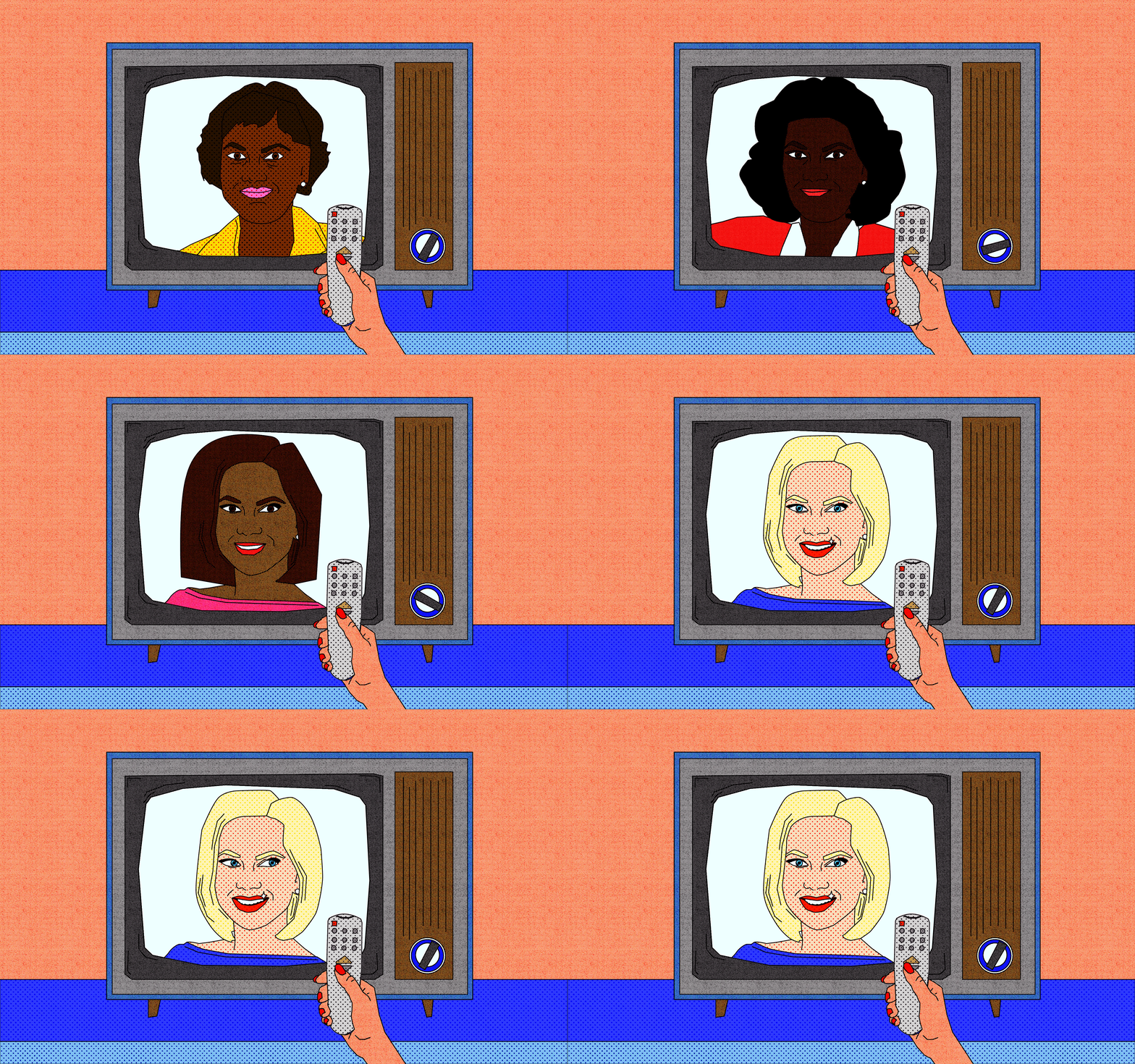
There’s a higher wall still for women of color. The historian Sarah Lewis recalled being told by a technician at an appearance that her outfit was a problem because it was “lighter” than her face. Of course, it was, she replied, baffled: “I’m Black.” Film lighting and aesthetics are mostly still calibrated around white skin. Only in the last couple of years has it become more acceptable for Black women to wear natural hair on TV. Women may have achieved parity in political-campaign reporting, but when CBS News announced last year the core on-the-ground team that would cover the 2020 elections, it included no Black correspondents.
As taxing as the emphasis on appearance is, it’s equally bad, as a woman correspondent, to be too hot. On one political show, a reporter recalled to me, producers complained that a colleague’s fashion was “too ‘fixy’” — too nice. “Her look did not offer street cred.”
So the line to tread with your looks remains ethnically specific and narrow. Curly-haired journalists told me of being commanded, sometimes at their own expense, to professionally straighten their hair for hits — something that is often only possible by treating it with toxic chemicals. And so what ends up being said about politics on TV becomes narrow, too. Historically, lots of journalists have been known for their unique fashion sense; Washington, D.C., has had reporter style icons like Joan Didion, Maureen Dowd, Dorothy Butler Gilliam, and Mary McCarthy. Writing may lend itself to real-world stylishness because of the merciful separation between your voice on the page and yourself. You can have a personal style because that style is not exactly your professional mien, your writing voice.
Once you have to be seen saying everything you know and think, though, there has to be more continuity. Didion would be a tricky guest on today’s TV shows. Her signature oversized coats wouldn’t translate, and her scarves would be distracting. (I was once asked to ditch my glasses for an appearance because they were “distracting,” as if everything we wear is only for show; unfortunately, I can’t see without them.)
Didion also said that “style is character.” In a D.C. ruled by television — and still unreflective about the special impact that has on women reporters — both style and character may be flattened. Several women journalists I talked to who don’t appear often on TV said it was because they were ”not the kind of person who goes on television.” Nobody had ever told them this, but these women had internalized the desired aesthetic. They didn’t try as hard to get on TV because they had long ago decided they didn’t look like the kind of women who were supposed to appear on it.
This isn’t a meaningless loss in terms of viewpoints. In addition to being a rare woman in the then-overwhelmingly male arena of political journalism, Loeb, the Manchester Union-Leader publisher, also had a visible disability. She’d been partially paralyzed in a 1977 car accident. A woman with a dramatically different kind of body is a very rare sight on contemporary political TV shows. But Heckman told me Loeb and her friends believed that being liberated to present herself differently — she had no choice — had emboldened her to say something different, to say what she really thought.
The reporter with the frizzy hair sometimes left her TV makeup on all day, since it was a monetary gift equivalent to a free breakfast. She also bought makeup like what she wore on TV. For a time, “I became obsessed with it,” she said. But when she went out to interview ordinary people, she began to realize her look disrupted her engagement with them. They noticed she didn’t look like they did. She looked like some kind of domestic version of the international-development expert who flies to central Africa to briefly survey the opinions of the locals and then hustles back into his air-conditioned SUV and lint-rolls his high-end suit jacket. “I need to emphasize that the D.C. TV look isn’t even cool,” she said. “It’s nothing like what you see 20- or 30-somethings anywhere else wearing on Instagram.” She felt it made her interviewees suspect her of “hiding something, or being rich, or scripted, or playing a part.”
She wondered if that phenomenon didn’t account for a bit of the distrust the public had for political journalists. She asked herself: Is it really a science, TV appearance? Why can’t political reporters and analysts look varied, look normal?
“I feel conflicted about this shift,” said the veteran political analyst who wore boxy suits and a ponytail in the ’90s to downplay her femininity. “It’s so nice that a woman can be beautiful now and be taken seriously. The downside is that everyone acts like that’s how you have any value in the journalism world.”
It can be nice not to have to hide behind an individuality-erasing D.C. uniform. It is, in one sense, a new kind of freedom — being able both to look cute and talk about nuclear weapons. But “I would like to be able to grow old and have my natural hair color and have lines on my face and not be a weirdo,” the analyst said wistfully. “I would like to be employable that way.”
The truth is there’s still a rigid looks standard for women political journalists that doesn’t call itself a standard. It becomes, in some ways, even stronger because it isn’t discussed.
Journalism then becomes another realm in which to realize you still can’t complain without being told you’re jealous or no fun. Another realm in which you have to get it exactly right. And women reporters become a group of people walking around in a world unable to put into words the obstacles they know are real. How old a problem is that?