
TERF Wars on Twitter: From Rowling to Atwood, former “feminist authors” are embracing transphobia online
For those of us Millennials who grew up on Harry Potter, J.K. Rowling’s transphobic outbursts online were one hell of a wake-up call. Now other beloved feminist authors, like Margaret Atwood and Joyce Carol Oates, might be wandering down the same path. What’s that they say about meeting your heroes?
Having 24/7 access to anybody famous is going to result in learning personal tidbits, habits, and opinions that might otherwise have been kept quiet. In the past, we learned scandalous things about authors when their diaries or letters were published post-mortem; think, for example, James Joyce’s incredibly kinky letters to his wife, or the knowledge that he may have has an affair or two. Now, though, fans of an author might encounter them in the “public” space of the Internet while that person is still alive and writing, and finding out that a real, living person is pedophilic, racist, homophobic, or transphobic is a very different matter than learning about some long-dead white dude’s coprophilia.
In the twenty-first century, Twitter is the biggest platform for this kind of scandal. Anyone can tweet anything in a matter of seconds: a thoughtless comment here, a retweet of an unknown there, and suddenly everyone thinks you’re transphobic! That sort of thing could be an accident, right? Yes, it can be. But when it is pointed out that a retweet is from a known racist or TERF (trans-exclusionary radical feminist), or that a last-second tweet is thoughtlessly ableist or homophobic, it’s the response that counts. Does the person delete the tweet and apologize for their ignorance, or do they double down and defend themselves like they’ve been personally attacked? How many “mistakes” of the same kind does a person have to make before we can safely say that they aren’t mistakes, but a pattern of behaviour based on their actual beliefs?
People who grew up on Harry Potter were not ready to let go of one of their childhood heroes and lose her to the annals of “stuffy conservatives who hate me and my friends.” The Harry Potter books taught love, acceptance, and radical non-compliance. Those books showed a generation of young readers that sometimes, adults are the bad guys — sometimes they are racist (the Death Eaters being the biggest example, but more subtle forms, like the Dursleys’ hatred of magic people, demonstrated that it wasn’t just Magic-Hitler-and-co.); sometimes governments are incompetent and politicians self-serving; sometimes teachers are the biggest bullies (Snape and Umbridge are almost bigger villains than Voldemort, because many kids had felt picked on by an authority before). The kids in these books learned to think for themselves as we ourselves did. Dudley Dursley becomes more accepting of magic than his parents. Draco Malfoy learns that being a Death Eater is not the side of history he wants to be on. Luna Lovegood’s classmates learn that bullying her for being different is wrong. Being poor isn’t a character flaw, and being rich isn’t a virtue; activism and civil disobedience are important and can lead to change; march on the government, question authority, stand up for your friends, celebrate your differences from one another: this is what Rowling’s book’s taught us. Is it any wonder that queer kids latched onto such a universe, and were loathe to let it go? J.K. Rowling got so many chances and opportunities to explain herself — so many more than anyone else would have gotten.
After a couple of years of close-calls and criticism that ultimately blew over — remember when she announced that Dumbledore was gay, after not writing it into the books? Remember Cho Chang? Remember when she liked a tweet referring to trans women as “men in dresses” and blamed it on a “middle-age moment” and a slip of the thumb? — things came to a head in 2019. In June 2019 (which is also Pride Month), it was discovered that Rowling was following a self-proclaimed “anti-trans activist,” Magdalen Berns, on Twitter. Berns was a YouTuber whose video titles included, “There is no such thing as a lesbian with a penis,” “Gender is NOT a social construct,” and “Non binary bullsh*t.” In her anti-trans manifesto, Rowling writes that “Magdalen was an immensely brave young feminist and lesbian who was dying of an aggressive brain tumour. I followed her because I wanted to contact her directly, which I succeeded in doing. However, as Magdalen was a great believer in the importance of biological sex, and didn’t believe lesbians should be called bigots for not dating trans women with penises.”
Following this person was a red flag, but for many, it wasn’t enough evidence that Rowling herself was a TERF. (The quotation above came out much later.) What finally broke the camel’s back was a tweet in December 2019 in support of Maya Forstater, a transphobic British woman who sued for wrongful termination over a series of transphobic tweets. Rowling tweeted,
Initial reactions to the tweet were a mix of positive and confused. Those who didn’t know the context of Forstater’s case thought that this tweet was in support of women’s rights, and even positive toward the trans community, as its first two lines could imply. However, it soon became apparent by those who did any amount of digging into the case what a dog-whistle the hashtag #IStandWithMaya was, and what it truly represented: vile, overt transphobia that was thrown out of court.
Forstater was a visiting (ie, temporary) fellow at an anti-poverty thinktank at the Centre for Global Development and, following a series of nasty tweets and comments toward a non-binary person, her contract was not renewed. That’s right, she wasn’t even fired: her temporary contract was served out. According to court documents, Forstater (defending herself) said in court:
“On Twitter I referred to [this non-binary person] by the pronoun ‘he.’ This was not purposeful or meant to cause harm. I had simply forgotten that this man demands to be referred to by the plural pronouns ‘they’ and ‘them.’ … [They] also [call] it ‘transphobic’ that I recognize a man when I see one. I disagree. … In reality, [this person] is a man. It is [their] right to believe that [they are] not a man, but [they] cannot compel others to believe this. Women and children in particular should not be forced to lie or obfuscate about someone’s sex. I reserve the right to use the pronouns ‘he’ and ‘him’ to refer to male people.”
Other tweets called as evidence include a retweet of a transphobic cartoon which depicts a person flashing two women at a swimming pool with the caption, “it’s alright — it’s a woman’s penis,” a tweet that reads, “it is unfair and unsafe for trans women to compete in women’s sport,” and another which reads, “Men cannot change into women.” The judge concluded that both her tweets and verbal comments were “incompatible with human dignity and fundamental rights of others” and ruled against her.
That is the context of Rowling’s tweet — that is the person she claimed to “stand with”: a person who mocks, degrades, disrespects, and campaigns against trans, intersex, and non-binary people. It is no wonder that Rowling came under fire after showing such bold support for an individual whose bigotry is as clear as day to anyone who knows a single thing about trans people.
In response to the online backlash, Rowling wrote her notoriously transphobic manifesto. The tweet in which she shares the manifesto simply reads, “TERF Wars.”
Her defense of her actions is full of misleading information (including an easily disprovable claim about “huge explosion [of trans people] detransitioning,” which is debunked by this 50-year study from 2010 following 767 trans participants and this 2015 survey of 28,000 US-based trans people). She makes strawman arguments about autistic girls being encouraged to transition, though repeated studies show neurodiverse people are more likely to identify as trans and/or non-binary of their own accord. Speaking from personal experience (and supported by scientific studies), acting as though autistic children are being forced to transition is ridiculous and ignores the fact that autistic people, and afab autistic people in particular, are socialized to act in certain ways based on gender. Many autistic people do not understand the social construct of gender, or why they are expected to behave differently based on their genital morphology. This is a facet of autism, and one which needs more research, not scare-mongering claims “for the sake of the children.”
Rowling also claims that “entire friend groups” of children are suddenly becoming “transgender-identified at the same time,” and considers this phenomenon a result of “social contagion and peer influence.” To counterpoint, as a bisexual person: of my childhood friends with whom I am still in contact, two of eight are straight and cisgender. Of my high school friends, only one of six. Of my college friends, two or three out of more than a dozen. Some of these friends came out during our school years, others as adults, but one thing is clear: queer people flock together. Regardless of “outness,” queer people surround themselves with queer people. Almost every single one of my college friends is bisexual. Did I start a trend when I came out, or is it maybe possible that my coming out made them more comfortable to come out? At a conference I was recently at, I hung out in a group consisting of four women and two men, all academics between the ages of 20 and 28 who had had little or no contact previously. Five of us were bisexual, and one of the men identified as gay. We know who our people are.
Praying on the fears of many parents about pedophiles finding their children in private spaces, Rowling writes in her manifesto that,
“I want trans women to be safe. At the same time, I do not want to make natal girls and women less safe. When you throw open the doors of bathrooms and changing rooms to any man who believes or feels he’s a woman — and, as I’ve said, gender confirmation certificates may now be granted without any need for surgery or hormones — then you open the door to any and all men who wish to come inside. That is the simple truth.”
There has never been a case of a trans woman assaulting a cis woman in a public toilet or changing room. Not a single case. In fact, the opposite is true: trans people are far more likely to be the target of bathroom violence. One study of over 3,500 American teens found that people are less likely to be bullied, harassed, or sexually assaulted when they are allowed to access toilets that align with their gender identity. In schools with sex-restricted toilets, trans boys were 26% more likely to experience assault than those with liberal policies, and trans girls were more than twice as likely to be sexually assaulted when forced to use the boy’s toilets or change rooms. And yet the fear that cis children are in danger of trans people in toilets is the justification for anti-trans policies that actively harm people.
More recently, Rowling has doubled-down on her transphobia, as if her manifesto (in which she claims outright she is not a TERF or against trans people — as if every argument she makes isn’t actively transphobic) wasn’t enough. In a tweet from June 2020 (during Pride Month again), she shared an article called “Creating a more equal post-COVID-19 world for people who menstruate” with the following caption:
So begins a string of authors online mocking inclusive language and/or claiming that it infringes upon their right to free speech. (In the USA, the First Amendment protects your right to speak freely without governmental censorship. You cannot be arrested for saying/tweeting your opinion in the USA. The 1A does not, however, protect you from consequences, such as being fired from your job or being trolled by teens online. Countries like Canada and the UK do not unequivocally protect free speech: hate speech and acts that incite violence are crimes.)
The phrases “people who menstruate,” “birthing people,” “pregnant people,” and “chest-feeding” (as opposed to breast-feeding) are inclusive of trans men and intersex and non-binary people who experience menstruation or pregnancy. In discussions about reproductive rights, it is important to include anyone who can get pregnant in the conversation around abortion access. If a trans man gets pregnant, he can face serious obstacles even getting an appointment at a gynecologist, despite having a uterus. He may be treated with suspicion or even abuse during his appointment, and is likely to be misgendered throughout the process, regardless of his choice to continue or terminate the pregnancy. Anyone with breast tissue (ie, almost every post-pubescent human who has not had a mastectomy, including cis men) can get breast cancer. Anyone with a cervix needs pap smears to check for the early warning signs of cervical cancer. Anyone with a prostate needs prostate exams for the same reason. Keeping medical terms gender-neutral is important to making sure that health care is accessible to those who need it, regardless of their gender identity or transition status — it is not a “fad,” and it certainly does not “erase women.”
Just days ago (19 October 2021), Margaret Atwood tweeted an article from The Star titled, “Why can’t we say ‘woman’ anymore?’”, prompting concern that Atwood might also be a covert TERF:
The backlash on Twitter was instant this time, with responses calling out the ridiculousness of both the article and the retweet. Being a “person” and being a “woman” are not mutually exclusive. In fact, the ability to call women people is a right that was fought for and won by Suffragettes, back when women couldn’t vote or own property. In responses to criticism against her sharing of the article, Atwood urges people to read the article, repeatedly replying “Maybe you should read Rosie’s piece?” and “Read her piece. She’s not a Terf.” But the pay-walled article, written by Rosie DiManno, contains nearly as much dog-whistling and false information as J.K. Rowling’s anti-trans manifesto. For example, describing an article in The Lancet which uses the phrase “bodies with vaginas” exactly one time in the entire article, DiManno claims,
In one fell swoop, “The Lancet” — remember this is a medical publication — reduced womanhood, biological or metaphysical, to purely anatomical parts, a gross reversal of the century-long campaign to, not only achieve equal rights, but for women to be seen as more than their biological and rampantly objectified, sexualized packaging. This is fundamental to feminism and humanism. Further, we are seeing in, for example, legislation passed or coming down the pike in U.S. to severely restrict abortions, basically undoing Roe vs. Wade, how fragile these gains can be.
Think about this argument critically for even one minute, and it falls apart. DiManno writes that The Lancet is “[reducing] womanhood…to purely anatomical parts” by using the phrase “bodies with vaginas.” Where is the word “woman” in that phrase? It is not present, because rather than reducing womanhood to genital morphology, the article actually does the opposite, by separating gender identity from sex organs. She also claims that Brighton and Sussex University Hospitals have banned gendered words, including “breast milk,” which is an outright fabrication made up by the London Times that has been thoroughly debunked. DiManno is similarly angry about this tweet from the American Civil Liberties Union, which paraphrases Ruth Bader Ginsburg’s comments from 1980 to be more inclusive:
DiManno criticizes the ACLU for their decision to alter these famous words in order to include everyone affected by anti-choice legislation, calling it “outrageous for anyone to mishmash the justice’s voice.” But we change quotations and legal language all the time. In 2018, the lyrics of the Canadian National Anthem were changed from “in all thy sons command” to “in all of us command” at the behest of feminist community leader Frances Wright. Gender-inclusive language has been something fought for by feminists for the entirety of the movement. The shift from “mother” and “father” to “parent or guardian” on schoolchildren’s paperwork is one such right, which acknowledges same-sex couples who parent biological or adopted children, single parents, non-binary and intersex parents, foster parents, and other types of guardianship such as grandparents and older siblings who have custody. The move from “maternity leave” to “parental leave” to include fathers is another example which, though based in the binary, ultimately helps include non-binary, trans, and intersex parents. These shifts in legal language remove barriers and create a more inclusive environment — they do not, as DiManno suggests, gatekeep women out. Even going so far as to defend J.K. Rowling’s horrendous “Wumben? Wimpund? Woomud?” tweet, DiManno argues that “trans activism [is running] amok,” and “recasting language” to mean something other than what it means, and that soon the word “woman” will be too taboo to say (or, as DiManno so eloquently puts it, “the no-speak word”).
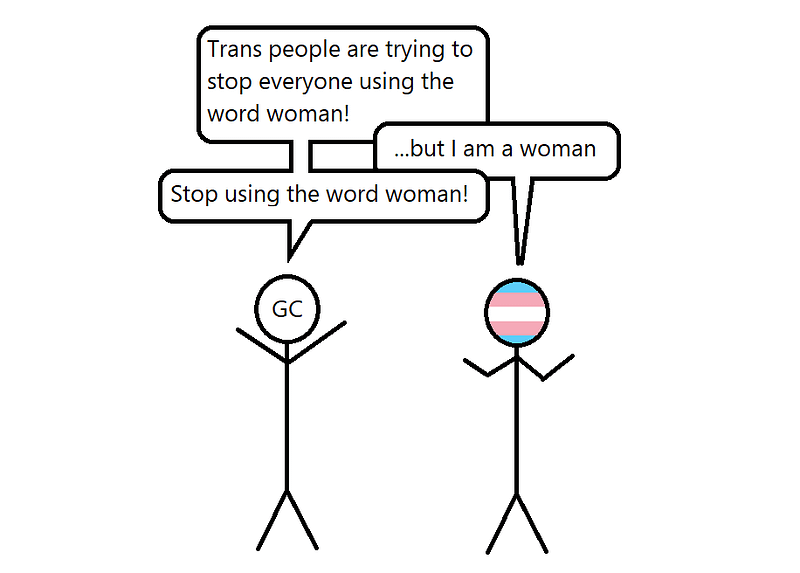
“There’s more than a whiff of misogyny to it,” writes DiManno. “Why ‘woman’ the no-speak word and not ‘man’? Why not ‘persons who urinate standing up’ or ‘people who eject semen’?” But these terribly written sentences, too, are a dog-whistle argument; in the bathrooms at Planned Parenthood, there are signs explaining how to collect a urine sample with different instructions for “people with vaginas” and “people with penises.” There are many other examples of cis men’s bodies being described this way as well. Medical care should not be contingent on one’s pronouns matching their genitalia, and believing otherwise leads to violence against trans people. There have been numerous examples of trans people being denied care, from EMTs refusing to treat trans women, leading to their deaths, to a trans man being denied treatment for breast cancer (he wasn’t told he had cancer because the surgeon claimed to be “confused” by his pronouns). A 2010 study, which surveyed over seven hundred LGBT patients in the USA, found that that 19% of transgender respondents reported having been refused medical care, 28% said they had faced medical discrimination, and 5% reported being denied emergency medical care by EMTs.
Despite her insistence that DiManno is “not a Terf” and that everyone should just “read the piece,” I hope that Atwood is actually the one who hasn’t read it, for if she has, I am ashamed to have been such a big fan of her work. As an author whose books have shaped feminist literature courses for decades, it is a real shame that Atwood feels the need to gatekeep womanhood in this way. Nearly every point DiManno makes is demonstrably false or misleading, and I am stunned that The Toronto Star published it. It is poorly written, sensationalist, and uses reductive stereotypes and language to describe the political Left: we can’t let “language radicals get their way,” or we’ll all be “clobbered by the social media mob,” for example. Eliminating the word “woman” (which no one has done or argued for) is “a bitchy thing to do to half the world’s population.” The article tries to make some pro-trans remarks in between the false accusations and frankly mean-spirited commentary, but it comes across as a kind of gaslighting. Like Rowling, who repeatedly claims to “support trans people” while actively pushing for legislation which harms them, DiManno adds lines like “props for an undertaking that has given voice and power to a demographic historically oppressed, horribly shaped [??] and disproportionally subjected to violence!” to her article while in the same breath claiming that Congressperson Alexandria Ocasio-Cortez has “jumped the shark” by using the phrase “menstruating people.”
Oh, but it gets worse. On 9 April, 2013, Rosie DiManno wrote a column which openly mocked a male victim of sexual assault (link is to coverage of the article, not the article itself). Her vile commentary includes the lines “one man’s sexual assault is another man’s sexual fantasy come true” and “Sexual assault, you say? Lucky guy others say, nudge-nudge, a fivesome and didn’t even have to pay for it.” The 19-year-old boy was gang-raped in a parking lot by four older women. What a funny joke. In January of that same year, DiManno wrote similarly crude and heartless coverage of the sexual assault of a woman undergoing surgery. The opening lines of this article (which I refuse to link), reads, “She lost a womb but gained a penis. The former was being removed surgically — full hysterectomy — while the latter was forcibly shoved into her slack mouth.” Dr. George Doodnaught, anesthesiologist, may have raped as many as 20 women under sedation. What a laugh!
Is this the person you want to fight for, Margaret Atwood? This reporter is the hill you want to die on? I sincerely, desperately, hope not.
While these are two egregious examples of beloved authors exposing their transphobia via Twitter (the jury might still be out on Atwood — I do hope she sees her error and comes around), there have recently been “smaller” cases of anti-trans rhetoric making waves among “feminist authors,” including Joyce Carol Oates, who, in an ironic twist, is best known for her novel They. On 6 October 2021, Oates tweeted a link to an article titled “Up in Arms Over a Pronoun” and later retweeted her own tweet to add the comment, “ ‘they’ will not become a part of general usage, not for political reasons but because there would be no pronoun to distinguish between a singular subject (‘they’) & a plural subject (‘they’). language seeks to communicate w/ clarity, not to obfuscate; that is its purpose.”
Oates, a very prolific novelist, seemed to have forgotten how words work. I can only imagine her in the seventeenth century, weighing in on pronouns: “Obviously, the plural ‘you’ will never supplant the singular ‘thou’ in common usage! People would get confused if there were two meanings of the word ‘you’!” And, as Trans Revolutionary Anarchist points out in a reply tweet (with examples), Oates herself uses the singular they on Twitter regularly:
After some pushback from Oates, it seems she has decided to apologize for her comments regarding the singular ‘they’. Her apology played out over a number of tweets where she seeming came to the realization that her words have the power to harm marginalized communities, which she says was never her intention:
As one response points out, however, an apology cannot undo harm that was done by the initial tweet, writing, “Apologizing is a step, but harm has been done. [W]hen you tweeted that, you provided respectability to all the vicious transphobes out there trying to litigate and harass us into non-existence. You could go farther in making restitution by reading & promoting trans authors.” Oates seems to have learned from the experience, but many of the replies under the original tweet (and the threads over which she works out her error) do not pass the vibe check. It is clear that several transphobes felt empowered and emboldened by what Oates called “a linguistic speculation” that she did not mean to have “real-life significance” — but her words did have real-life consequences.
Oates’ flub is but one of many. All these articles and tweets about pronouns are part of a larger campaign against the rights and dignity of trans people. It comes mostly from older people (and, oddly enough, from older “feminists”) who want to “protect the children” and champion “free speech.” There are currently movements in southern US States demanding that schools “ban pronouns” or “stop teaching pronouns” — as if pronouns aren’t some of the most common words in every language, and used every day. What they usually mean is that they want to ban preferred pronouns (ie, chosen pronouns and neo-pronouns, like gender-neutral ze/zir) as a crusade against inclusivity.
Like the recent mania over “Critical Race Theory” (a college-level course) suddenly being introduced to American primary schools (it never has been), all these arguments are meant to get people riled up and create change. The CRT debate led to numerous bills being put forward to ban the teaching of race altogether. You read that right: this would mean no discussion of slavery (unless it is “balanced,” including pro-slavery takes), anti-Semitism and the Holocaust (again, must include the “other side”), segregation, or ongoing race issues in America. If this sounds ridiculous, that’s because it is. But these bills are being pushed using a false narrative that kids are being taught CRT in Kindergarten, and White Supremacists will push any narrative that gets their side of things into the curriculum.
The same goes for the so-called “Gender Critical” (GC), otherwise known on the internet as TERFS. They will push any narrative that gets anti-trans legislation on the books, and that means spreading lies that a Kindergarten-aged child came home from school terrified that he wasn’t a boy anymore because his teacher asked the classes for their pronouns (didn’t happen), or that a little girl saw a trans woman’s penis in a public toilet (not possible with separate stalls), or that trans girls outperform cis girls in sports (research has proven this to be untrue, even at the Olympic level). In the case of the last example, the legislation introduced can harm cis girls, as these laws often allow anyone for any reason to question whether a student athlete is a girl. In order to fight an accusation, a student as young as eight might have to verify her gender by undergoing invasive testing, such as a gynecological exam. Does that sound like “protecting the children,” or policing children’s bodies and creating more situations for potential abuse?
When authors with significant following on social media platforms like Twitter (J.K. Rowling currently has 13.9M followers after losing a considerable amount to the controversy; Margaret Atwood has over 2M followers and Joyce Carol Oates 125.9K) partake in these so-called “smaller” or micro-transgressions — such as “innocently” questioning pronoun usage or asking whether the word “woman” is under attack — they perpetuate the more dangerous aspects of transphobia too. Even if unintentional or well-meaning, sharing this kind of content with millions of followers leads to dangerous “gender critical” beliefs becoming more mainstream. Pronouns may be the hot topic right now, but what these debates lead to is transgender children and adults not receiving adequate healthcare, facing discrimination, being banned from competitive sports, and not having a safe place to use the toilet. Inclusive language isn’t just about the words we say, it’s about what impact those words have. If our words can make a person feel safer, receive proper medical treatment, or not be assaulted, it is a small price to pay to have to think for one second before hitting “tweet.”
Support the author:
Follow me on social media: Twitter: @ MyExplodingPen Facebook: caseylawrenceauthor YouTube: Casey Lawrence Instagram: @ kcntv TikTok: @ kctnv
If you enjoy my content, consider showing your support by buying me a coffee or joining Medium via my affiliate link to get unlimited access to all of Medium.