
What are we Doing?
We are navigating love. Behold an awareness of what we are in terms of what we are to become. In which case: love as the map, love as the compass, love as the goal, love as the journey, love as the self, love as the obstacles to love.
There is a map within the map: therapy. I understand each patient as a flow of love, expressive and receptive, akin to the circulatory system flowing blood from and to the heart, oxygenating it through breath. In both Greek (pneuma) and Hebrew (ruakh) etymologies, breath means spirit. We are flowing love enriched by spirit throughout the self. Not bad.
The patient is in therapy for a reason, one seen in the past (unresolved self) and the future (resolved self) linked by the present: the pain of being unresolved while witnessing a resolved self within. The unresolved self maintains itself by holding onto this pain, the same pain of which the resolved self births itself by letting go.
So I witness where love does not flow in the patient’s psyche — and I ask, Why? Love knows only to flow, to happen, to be given and received. We must be taught to get in its way.
One learns to impede the flow of love by experiencing its absence. If, no matter our suffering, we understood that everything is love, or did not understand suffering to be the absence of love, Hell would be irrelevant. Suffering would still feel like Hell, but it would no longer mean Hell. Hell lies not in the burning, but in the ruination of our ability to love.
Hence Wagner’s ring epic begins with the maligned dwarf Alberich taking on the ring of power — all he has to do is to foresake love. That’s the trick! Alberich rushes into his shadow (as his shadow rushes into him) because letting go of love is empowering. When letting go of love feels good, the part of us that is feeling that as goodness is the deeper pathology taking over the psyche, akin to a coup of the psyche by one’s inner fascist. Hence fascist coups on a collective scale necessarily involve individuals who are undergoing the coup of their own shadows.
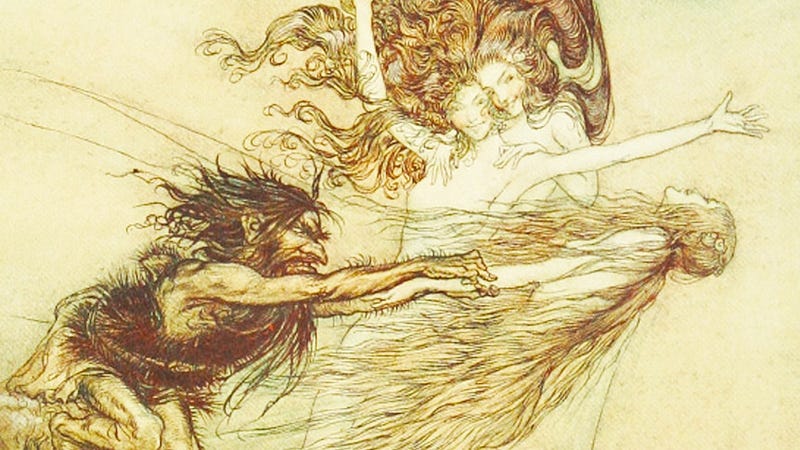
Taking on power by foresaking love feels good at first. No longer can we be abandoned: not by that which we abandoned. The Devil lures you with pleasure; the pain comes later. Only later, in therapy, in solitude, in tears, do we feel our internal torment eating us alive. That is when one sees the Devil took one long ago, not when we finally see we have been defending ourselves from love, but when we first felt empowered by the all the control power promised us.
Just as one can only be close to God in the state of love, as CS Lewis believed, one can only be close to the Devil in the absence of love. And experiencing the absence of love breeds in us a defense against love. We call it insecure attachment; we call it personality disorders; we call it toxic relationships; we call it codependence; we call it an inability to commit. Call it by what it does: a defense against love.
Psychological defenses manifest as psychological diseases. Jung wrote, ‘All mental illness is a defense against real suffering.’ The suffering is our separation from love. The disease fights to maintain the separation just as our health fights to end it. The defense runs on the belief that love wants separation from us (the patient as victim — life is broken) or that we want separation from love (the patient as pathology — I am broken). The mental illness can manifest positively in enjoying the power we gain from separating from love (it’s fun being narcissistic), or the misery we endure from that same separation (it’s alienating being narcissistic). The former weaponizes the absence of love while the latter embodies the masochism of internalized exile.
Hence the Devil rewards in this life to punish in the next. The next life may be the afterlife, or one’s hero’s journey, including therapy, in which we are born again to love. This is why hero’s from Jesus Christ to Harry Potter die and are reborn: the return to love amounts to the rebirth of the self. The Devil’s reward entails making the foresaking of love feel good. Which must mean that at some point, pursuing love must have felt bad.
Alberich, just before taking the Rhine gold to forge the ring of power (a function Tolkien gives to his Devil incarnate, Sauron), is mocked by the lovely Rhine maidens who are out of his league. They even tell him the gold can be his to empower himself beyond measure, if only he renounces love, as if to say: you can’t have us, but you can have power. To this ugly, wounded dwarf, the maidens who embody love have renounced him. To the victim, renouncing love is a reciprocity of shame where love should have flowed. Once we believe that love does not want us, all bets are off.
Patients are all too like this: renouncing love through the wounded perception that it is love that renounced them. A Newtonian law of psychology emerges: A subject in love stays in love— until an outside force acts upon it. This outside force is trauma.
Trauma is an environment so complete, so saturating, that it cuts one off from any other experience. While being raped, one cannot fathom one’s last normal moments — nor the next ones. When someone dies in your arms, you no longer live in the world in which they, too, lived. The worst part of trauma is not the suffering, but the underlying belief that love is gone.
Hell not only burns us, it transforms us into believing in the reality of Hell more than the reality of love. Perhaps we succumb to believing that love would not allow us this suffering. As if God would pick and choose because we would.
The trauma ends as a physical fact but endures as a psychological reality. The traumatized individual carries that seed in which they lived without God, without love. We can all be broken, just as Christ looks up from the Cross and asks, ‘Why did you abandon me?’ This statement is just as relevant to non-Christians as the mythological ethos remains: even the hero who embodies love can feel its absence.
We feel safe in love insofar as we believe it to be the creator as well as the creation. We feel safe in love insofar as we identify with it. And when, in our most hellish moments, we cease identifying with love, the seed of trauma gets planted within us, germinates when we are retraumatized, gets watered when we harm self or other, and bears fruit when we sabotage love.
Psychotherapy is the journey back to the Garden from which we Fell: where we were one with God, one with love. Perhaps the Fall is not human disobedience but God’s reaction to it (love renounced me) or the human reaction to that (I renounce love).
The journey in which we return to love does not undo the path we took out, but incorporates the trauma, the path through Hell, and the journey back. Hence a piece of Voldemort’s soul remains in Harry Potter. Hence Christ goes to Hell before his Ascencion. Hence the Oracle tells Neo that he is Smith. Hence Vader reveals he is Luke’s father. The shadow is our opposition only because it is ourselves.
This is the meaning of Jungian alchemy: to bear witness to the opposites as aspects of ourselves, and so to eventually integrate them. The hero who believes in love and the villain who fights it. The light that guides us to love and the shadow who resists it. To try to beat one with the other is to have the left hand fight the right. We need our shadow, need our resistance to love. We fragment our conciousness when we believe love would exclude anything that would resist it — we are then fragmenting our love. Sooner would we look into the sky and see the Sun with a bite taken out of it. Hence we identify with the entirety of the light, which includes its absence. Hence the Devil sees in God an other, but God must see in the Devil…Himself. What then could the Devil be but God’s ego?
The term ‘God’s ego’ strikes one as preposterous until one considers one’s own soul as a microcosm of God; and so our own ego is just as real, as valid, as preposterous: our own little devil. Pre-posterous comes from the Latin ‘before — coming after.’ The paradoxicality of the word conveys its meaning. We were whole before — before the beginning — and we shall become whole again — after the ending. Hence when humans are in the Garden, there is no time, whether before the world begins or after it ends. Hence when the universe is a singularity just ‘before’ the Big Bang or just ‘after’ the Big Crunch, there is no time, and all is one.
Somehow, we are that oneness finding itself. That is what we are doing.
To follow me: https://medium.com/@myartman
To subscribe: https://medium.com/@myartman/membership


