
Great Responsiveness Meditation
The Meditation Path Of Avalokitasvara In Detail
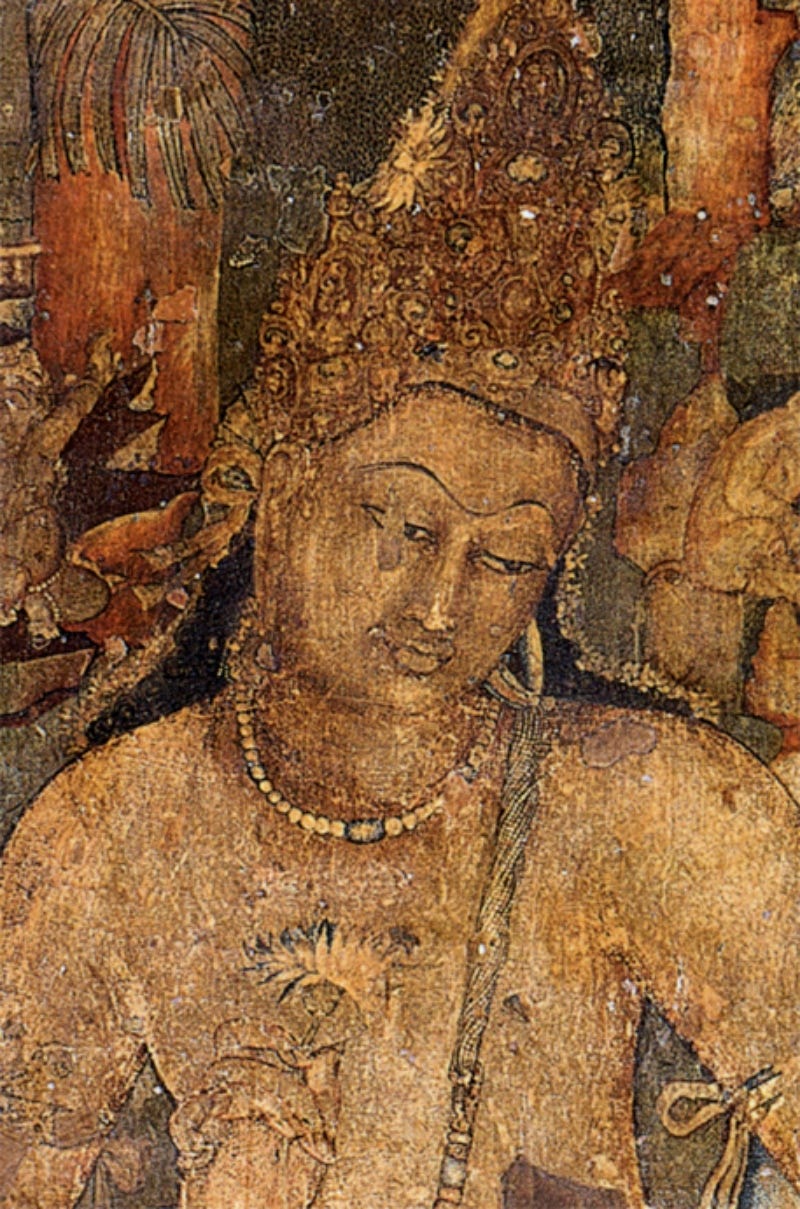

The Fourteen Kinds of Fearlessness that Avalokitasvara mentions in the Surangama Sutra, where he describes his meditation practice, are a list of fourteen benefits that individuals enjoy because of the powers that are gained directly from his practice.
These powers are refinements in one’s cognitive functioning that directly result from the progressive stages of his meditation practice, much as modern ‘mindfulness’ meditation results in stress reduction, and is touted for that benefit.
These Fourteen Kinds of Fearlessness are also featured in the Lotus Sutra, chapter 25, “The Universal Gateway of the Bodhisattva Perceiver of the World’s Sounds,” i.e., Avalokitasvara, although they are not designated there as Fearlessnesses. As well, the cognitive attainments that bring about each power are not given in that sutra.
Depending upon the translation of the Surangama Sutra that one studies, these powers are described either from the perspective of Avalokitasvara, or from the perspective of those who, inspired by his example, implement his exemplary practice and attain these same powers of fearlessness themselves.
The passages quoted below are taken from the new translation of the Surangama Sutra published by the Buddhist Text Translation Society, ISBN 978–0–88139–962–2, and are presented from the perspective of Avalokitasvara.
The Fourteen Kinds of Fearlessness which are detailed in the Surangama Sutra is first and most importantly, a list of the steps, or ‘moves’, that the meditation practice of Avalokitasvara encompasses, and the results obtained at each step. This is a repetition and further elucidation of the description that Avalokitasvara gave earlier in this section of the Surangama Sutra.
Avalokitasvara asserts that as a result of his own enlightenment, learning and practicing this meditation technique will lead to the accumulation of merit leading to the attainment of the same powers of fearlessness, which will aid all those in need.
These are stylized powers, rather than exact conceptual definitions. They are, of course, ultimately beyond conceptual description, so it is the context of the transitional movement of the stages of his meditation technique, in conjunction with the stylized power attained, that is the most important aspect to consider. It is not just the attainment of a power of fearlessness which is related to, but ultimately independent of, the specific meditative transitions once they are attained.
The list contains fourteen movements, some repetitive because they cascade through multiple insights and attainments, that Avalokitasvara’s practice entails; but it skips the very first step, that of ‘turning the hearing around’. This step means to turn one’s attention onto uncaused, spontaneous sound that arises as a resonance, or reverberation, of the manifesting of one’s physical appearing — i.e., one’s manifested body and ‘mind’. These sounds are always present during one’s lifetime, and afterwards during what Tibetan Buddhism calls the Bardo of Dharmata. They are always present because Emptiness, the naturing of all that appears, is continuous. This is in contrast to the various cultural and religious traditions that specify a creation event as the direct cause of what is. This continuity is evidenced on a mundane level by the coherent continuity of all manifested forms as their development unfolds over time.
Thus, these sounds are present within us as an intrinsic aspect of the activity that is the intrinsic naturing of our manifest form, i.e., our body, including that of our thoughts and emotions, which we call mind.
These sounds are continuously present throughout our lives because they are an intrinsic aspect of Emptiness. But our common misunderstanding of sound makes it difficult, or impossible, to understand how this can be, for surely all sound is caused by external or internal physical activity, and therefore is impermanent, as all manifested things are.
However, these sounds are uncaused and are unrelated to either external or internal physical conditions. They are not manifest sounds, in the way that day-to-day sounds that fill our lives are. And Emptiness, which is the intrinsic naturing of all beings and things is uncaused, never born, and never ending.
Thus, these inner spontaneous sounds are the autogenous resonances of the naturing of all appearing beings and things. In Buddhism, they are called the ‘self-sound of the Dharmata’, which is saying the same thing.
Once you have accomplished this turn inward, no longer listening to what is normally taken to be other and outside of oneself, resting absorbed in the manifestations of inner spontaneous sound within one’s mind, it can be said that you have turned your hearing around.
The importance of this step is that once you empty the hearing of sounds of their presumed existence in the dualistic ‘external’ world, seeing them as solely mental phenomena — arising in response to physical conditions, in the case of normal sound — you are then able to proceed with the next steps, or movements, and these bring certain important insights and powers. The list of these are as follows (my commentary is placed within brackets):
First, because I did not listen to sounds and instead contemplated the listener within, I can now hear the cries of suffering beings throughout the ten directions, and I can bring about their liberation.
[Once one has succeeded in turning their hearing around and has gained access to the inner spontaneous sounds, focus is placed on the meditator of these sounds. Thus, while still being aware of the sounds, one must, at this point, contemplate the meditator; which is to say, move the meditation onto the hearing, and specifically the hearing of these inner spontaneous sounds.
This is done in order to directly see the nature of hearing. Given the presence of these uncaused, unborn, and unending inner spontaneous sounds, the nature of hearing is seen to be different than what it was once understood to be.
By this insight, Avalokitasvara was able to disengage himself from both sense organs and their perceptions, enabling the direct realization of this all-embracing (Mahākaruṇā) Buddha naturing of all that manifests as, and in, the world. This naturing is the intrinsic nature of that which we call ‘mind’, and this is the direct insight needed for further progress along the path.
But the most important point of this first statement is this: using the practice that is being described by Avalokitasvara, which relies on the inner spontaneous sounds for support, very quickly results in what I describe as an alchemical change in the practitioner. This change is normally only accomplished much, much later along the path to complete enlightenment.
Here at this very early stage in his practice, Avalokitasvara attests to being able to hear the cries of suffering beings and respond to them so that they can be liberated from their suffering. This is the result of having used inner spontaneous sounds, which are nothing other than the intrinsic Emptiness. They are not a manifested phenomenon of Emptiness; but rather, the resonances or reverberations of the activity of Emptiness manifesting (called dharmata in Tibetan Buddhism) the world and all that it encompasses.
You see, by initially meditating on these sounds and using them to break free of sense perceptions and senses (see below) in order to have a direct experience of this intrinsic naturing, your hearing faculty is very quickly liberated from, and no longer constrained to, sensed sound. Hearing the cries of suffering beings is not the same as our mundane hearing sounds of crying. I cannot stress this point enough, but only those that have accomplished this hearing will truly understand this.]
Second, I was able to turn my awareness around and restore it, and therefore, should beings be caught in a conflagration, I can make sure that they are not burned.
[This particular move is often misunderstood, variously described as ‘restoring awareness to its original nature, which is the enlightened mind’ or ‘returning discriminative intellect to its absolute source’. But “turning my awareness around” entails a perspective change only.
‘Awareness’ is a conceptualization of another aspect of the intrinsic naturing of all things. And in Buddhism, this naturing is enlightened activity that is never anything other than that. That is to say, Awareness-Emptiness is our ‘original nature’ and is the absolute source of all beings and things, thus there is nothing to restore and nothing to return to, because there is nothing other than this activity.
However, because of our having accumulated misunderstandings, referred to in Buddhism as ignorance, we experience everything from a dualistic perspective, seeing the world as being separate from us, and we ourselves as nothing other than our body and mind, separate from everyone and everything else.
Even though we may come to understand that body and mind are not two things, and even come to understand that we are not separate from the world — that all things are connected — still our experience is fundamentally dualistic. This is referred to as finding unity in multiplicity. We start from an understanding of plurality — that reality consists of many things and many beings — and find their interconnectedness. The world then is a complex whole.
But we are nothing other than this intrinsic naturing — we are not some ‘nature’ or ‘ground’ from which all things come, such as an ‘original nature’ or an ‘absolute source’.
Instead we must change our perspective by finding multiplicity in unity, and we do this by realizing the truth about ‘where’ awareness is: not present to what is intrinsically manifested, but present as the enlightened activity that is this intrinsic manifesting. Why? Because there is nothing other than Emptiness, and Awareness is not different than this (Awareness is an aspect of Emptiness). This is the initial step in the process of ‘turning awareness around’, which is called ‘breaking the mirror’. So the world takes on the appearance of a simple whole that is complexified by our mind distinguishing aspects of that whole.
Specifically, our perspective is no longer upon anything, but rather, within, as the manifesting intrinsic naturing — i.e., the enlightened activity.
It’s as if we have been looking through the wrong end of a telescope so that everything looked far off, and by turning the telescope around, we see everything very close up — as it should be.
I refer to this re-turned perspective as sciomorphogenesis — meaning: knowing through the generation of form.
Thus, having moved from meditating upon the inner spontaneous sound, onto the meditator, we now see that the meditation is nothing other than this enlightened intrinsic naturing. We initially create the condition for this by using the inner spontaneous sound to guide us to the naturing and then we place the origin of our perspective there, rather than some part or other of our body.]
“Third, since I was able to turn my awareness around and restore it, I can make sure that beings who are adrift in a flood will not be drowned.”
[Having initially accomplished the re-turned perspective of awareness at the second step, and now having perfected that ability, this new power is gained.]
“Fourth, because I have put an end to deluded acts of mind, and so have no thoughts of harming or killing, I can make sure that any being who enters the realms of ghosts will not be harmed by them.”
[Putting an end to “deluded acts of mind” refers to the inactivation of the ignorance inherent in our dualistic understanding of our hearing faculty. Once we have removed that, having re-turned our perspective of awareness (our attention) to its true origin within the naturing activity that we call ‘mind’ — seeing clearly that ‘hearing’ is nothing other than this intrinsic naturing (“Emptiness”) — two things occur: the first is that we are no longer tormented by what appears within mind, and thus, no longer have harmful thoughts. The second, is described in the next Fearlessness, below.]
“Fifth, when I had succeeded in merging my faculty of hearing with the enlightened nature of hearing, my six faculties dissolved into each other to become one with my faculty of hearing. Therefore, if beings are about to be attacked, I can cause the attackers’ blades to shatter so that these beings will suffer no hurt, any more than water will be hurt by a knife that is plunged into it, or any more than light will be affected by a puff of wind.”
[Again, the “faculty of hearing” is never other than the enlightened intrinsic and spontaneous naturing of sound within one’s mind. Most sounds arise spontaneously yet are responsive to the conditions actuated by audible sense perceptions and the possibilities that those perceptions enable. Those that I refer to as inner spontaneous sounds are not conditioned in this way, but are, as I have said, resonances or reverberations of the naturing of our physical presence. So it is not truly a “merging,” but rather a removal of the misunderstanding about what hearing actually is, and a letting go of the audible illusion that sound is to be found, or is created, outside of this intrinsic naturing that we call ‘mind’.
Once this is accomplished, the nature of all of our sense faculties, which includes our thinking ‘mind’, are intuitively seen to not be different in any way from the intrinsic naturing of our ‘faculty of hearing’, and thus, we realize that there is only one source of all our perceptions and thoughts, and that they are not caused by anything external to us, in a dualistic sense, but arise as the activity of our intrinsic naturing in response to the conditions actualized by sense perceptions and thoughts.]
“Sixth, my hearing was infused with an essential brilliance that illuminated the entire Dharma-Realm and dispelled the darkness of all hidden places. Therefore, I can ensure that beings will be invisible to any yakṣas, rākṣasas, kumbhāṇḍas, piśācas, pūtanas, or other such ghosts that might approach them.”
[Having accomplished the perfection of One Sense (or One Mind), Avalokitasvara finds that his vision of the Dharma-Realm has become illuminated because he is no longer blinded by, or the Dharma-Realm is no longer obfuscated by, his ignorance. Discovering the true nature of mind, which is the intrinsic responsive naturing of all, illumination — in the sense of wisdom — necessarily arises. This illumination, clarity, and wisdom, are synonyms for the third aspect of Emptiness.]
“Seventh, sound itself completely dissolved as I reversed the direction of my hearing and became free of distorted perceptions of sense-objects. Therefore, if a being is confined by a cangue, I can make that cangue disappear.”
[The dissolution spoken of is the dissolving of the understanding that sound arises externally, caused by physical interactions. Sound only arises within ‘mind’ and thus this misunderstanding of the dualistic nature of sound and of hearing sound vanishes forever from our mind. We no longer take sense perceptions as being objective — in the modern sense of that word — rather, they are always understood to be co-dependently actualized conditions in response to which, sound arises spontaneously. Thus, this does not mean we no longer have the experience of sound. It means that we experience sound as it truly is — as the intrinsic naturing that is called Emptiness.
The error to be overcome here can be explained in a different way that may make it easier to understand: We normally see our thoughts as our own activity — “I think, therefore I am” as Descartes put it — but we do not see perceptions in the same way. Why is that?
Can a perception be anything other than our activity of perceiving? It is clear, both that our senses are limited in what extant conditions they can sense: eyes see light, ears hear sound, nose smells scents, etc., and that we make errors in our discernment even in those conditions we can sense. How then are perceptions anything other than ours, limited and error-prone as we are?
Perceptions are, of course, conditioned by extant conditions and our sensory capabilities, and so are our thoughts. Why then, is the latter about the world, and the former of the world? It is our common way of understanding this that creates our dualistic blindness.]
“Eighth, when sound was extinguished once and for all and my hearing was perfected, my kindness gained an all-pervading power. Therefore, should beings be traveling on dangerous roads, I can make sure that they will not be robbed by highwaymen.”
[This is the perfection of Great Responsiveness (Mahākaruṇā).]
“Ninth, once my faculty of hearing had become merged with the enlightened nature of hearing and so had gained independence from perceived objects, then no object, no matter how enticing, could affect me. Therefore, I can cause beings who have a great deal of desire to break free of their desire.”
[Because of having overcome the dualistic perspective at the heart of our common perceptions of the world around us, ourselves, and most of all, our thoughts, Avalokitasvara now sees that all of these are manifested by the intrinsic naturing that is “Emptiness,” as the spontaneous response to the co-dependently actualized conditions extant in each moment, and therefore have no true reality themselves. And because they are not truly real, he forms no attachment to them, nor desire for them.
Specifically, “beings who have a great deal of desire” refers to carnal desire. This kind of desire, more than any other, chains us to the world of illusory reality, and frequently causes much suffering for ourselves and those we have sexual intercourse with — when it is engaged in as the fulfillment of carnal desire, which is always directed to the desire for self satisfaction.
Sexual intercourse, as an expression of love, does not have the same effect of chaining us to the illusory world, but only to the extent that the act is an expression of love. To the extent that carnal desire is also involved as the reason for engaging in sexual relations, the negative result follows on necessarily. There is a fine line that makes all the difference here.
Thus, this is not a prohibition against sexual relations, anymore than there might be a prohibition against breathing. Sexual relations per se are not evil, wrong, or prohibited. It is the “great deal of desire” that is the problem. So by following the path of Avalokitasvara, we can become liberated from desire for sexual self-satisfaction, especially excessive desire for sex.
It should be pointed out that this does not undermine the Buddhist Precept relating to the need for monks and nuns to refrain from engaging in sexual relations. The purpose behind that is other than what is important here. It also is not meant to undermine cultural norms. The purpose of this commentary is to point out what is the problem and how the practice of Avalokitasvara enables one to overcome that problem.
I should also point out here, where it is most relevant, that in the depiction of the twelfth and thirteenth Fearlessnesses below, Avalokitasvara speaks of being able to help childless people to have a baby. He is not speaking of immaculate conceptions.]
“Tenth, once sounds were so purified that they ceased being objects of perception, then the ear-faculty and its objects became completely interfused so that there was nothing that perceived and nothing that was perceived. Therefore, I can cause beings burdened by anger and hatred to be free of their enmity.”
[Once it is seen that hearing has no object, it then becomes clear that hearing itself is also empty of actuality. That is, while the manifested body has the physical appurtenances for sensing vibrations in the surrounding medium, whether the air that surrounds us, or water in which we may submerge ourselves, the ground on which we place our ear, etc., hearing is nothing other than the intrinsic naturing that is “Emptiness.”
Therefore, the hearing faculty is not different from what is heard — they are both the intrinsic responsive naturing of all. In this way, “hearing” and “sound” are interfused within this responsive naturing. There is nothing that perceives, and nothing that is perceived. Both are known as they are natured — I call this Sciomorphogenesis.]
“Eleventh, once perceived objects had disappeared from my mind as I turned the light of my understanding inward, my body and mind and the entire Dharma-Realm were as bright and translucent as crystal. Therefore I can bring freedom from stupidity to beings whose natures have been so darkened by their dullness that they have had no intention of ever becoming enlightened.”
[At this step, Avalokitasvara’s understanding has been cleared of ignorance — those ideas and concepts, and the structure they impose upon our life through habituation. His perspective has dissolved within the active naturing, freeing him forevermore from dualistic perception and interpretations.
Therefore the clarity, which is the final aspect of this intrinsic responsive naturing, permeates everything that arises for him. This is what is meant by “my body and mind and the entire Dharma-Realm were as bright and translucent as crystal” — Avalokitasvara sees everything clearly because everything arises with complete freedom from obfuscation, obstruction, interpretation, misunderstanding, and conceptual fragility.]
“Twelfth, once perceived objects became interfused and returned to the enlightened nature of hearing, I could travel to distant lands without leaving the place for awakening, and all at the same time, without any disruption, I could travel among the worlds. There I can make offerings to an infinite number of Buddhas throughout all ten directions and serve each of these Buddhas as a Dharma-Prince. For that reason, should childless beings anywhere in the ten directions wish for sons, I can cause them to have sons who will be virtuous, blessed, and wise.”
[Time and Space are vanquished — literally — because they both are merely conventions of conceptual understandings based upon the dualistic structuring of ignorance. The ultimate nondual simplicity of reality becomes manifest.]
“Thirteenth, once my six faculties perfected an interconnected functioning and became united in their capacity to clearly perceive everything in all the worlds throughout the ten directions, my mind became like a great flawless mirror that reflected the emptiness of the Matrix of the Thus-Come One. I reverently served an infinite number of Thus-Come Ones and thoroughly mastered esoteric aspects of the Dharma. Therefore, should childless beings anywhere in the ten directions wish for daughters, I can cause them to have daughters who are upright, blessed, virtuous, compliant, wholesome in appearance, and liked and respected by all.”
[At this point in his practice, Avalokitasvara no longer imposes any structure, interpretation, dichotomizations, or limits, upon that which manifests — for him. There is still a subtle perspective, and this is indicated by his statement that his mind is like a great flawless mirror. It is the possessive taint of having a mind that is the subtle perspective. And it is the having of that subtle perspective that is “like a great flawless mirror.”]
“Fourteenth, sixty-two times as many Dharma-Princes as there are sand-grains in the River Ganges appear in each of the worlds of this system of a billion worlds, with its hundreds of billions of suns and moons, to practice the Dharma and to act as exemplars in order to teach beings how to transform themselves. With skill and wisdom, these Dharma-Princes respond in various ways to what various beings require. I have broken through to the fundamental source of my ear-faculty, thus revealing the ear as a gateway to the wondrous. My body and mind, in a subtle and “wondrous way, have encompassed and pervaded the Dharma-Realm. Therefore, I can cause someone who recites my name to gain as many blessings and as much merit as someone else would gain from reciting the names of all those multitudes of Dharma-Princes — sixty-two times as many of them as there are sand-grains in the River Ganges. The blessings and merit that those two reciters will gain will be the same. World-Honored One, because, by means of my spiritual practice, I have completely broken through to enlightenment, the power of my name alone is equal to the power of all those many other names.”
[The mirror is broken. The subtle last perspective is gone. “My body and mind, in a subtle and ‘wondrous way, have encompassed and pervaded the Dharma-Realm.’” There is no longer any separation between Avalokitasvara and Reality. This is simple Unity — and finding multiplicity in unity.]


