
My Taxes Paid Off Slave Owners
I want that blood money back
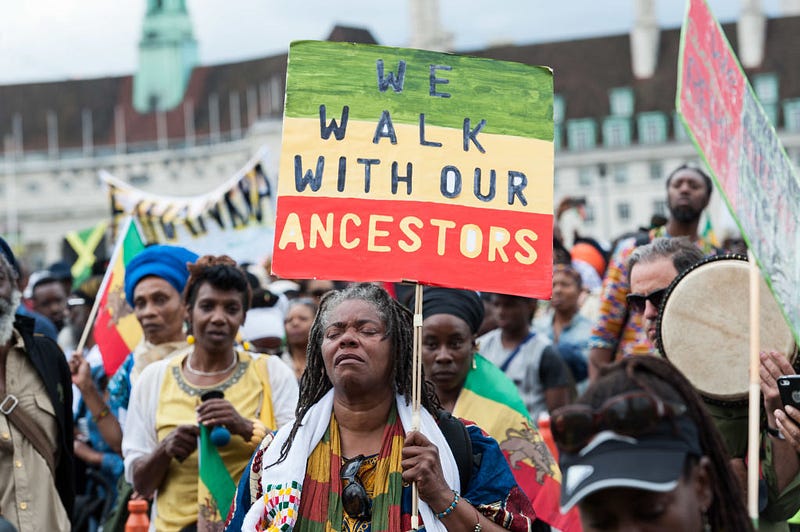
Emancipation Day, or August 1, is to Black Britons what Juneteenth is to African Americans, but the difference is that just five years ago, we finally became “free” after paying off the national debt incurred for the release of our bondage. It wasn’t until 2015 that British citizens, including those descended from enslaved Africans, finished paying off the $25.7 million (an estimated $21.6 billion in 2020 dollars) our government borrowed from the treasury to pay 46,000 British slave owners. They profited from the loss of their human property in 1833, and my direct family and I were taxed to pay for their freedom. We, the descendants of those slaves, received nothing in exchange for centuries of brutalization and discrimination.
I want a refund!
My family already paid with their souls on plantations. I have paid taxes to settle the iniquitous debt to my family’s enslavers. And though I was born British, I do not have the privilege of equality of opportunity.
Many of those British families that made slave fortunes have privileges that still allow them to enjoy the vestiges of financial and political influence. Former British Prime Minister David Cameron’s forbearer received around $5,200 — equivalent to more than $3.8 million today — to compensate him for the loss of 202 slaves in Jamaica.
Britain made more than 10,000 voyages to Africa to enslave its people between 1562 and 1833, when the Slavery Abolition Act was enacted. On paper, this ended chattel slavery in the British colonies on August 1, 1834. However, in practice, the British Empire did not free the 750,000 enslaved Africans in the Caribbean until August 1, 1838. The government decided to pay each slave owner for their slave losses. This averaged around $33 then, now $915, per enslaved human, and the fact that we paid for this with our own taxes is beyond the pale.
The government obfuscated the truth about taxpayers paying this morally reprehensible blood debt. My ancestors paid with their wombs, broken bones, the loss of their languages, religions, and ultimately their lives.
Most British citizens — including myself — did not know we were paying the slave owners’ compensation debt as the information was revealed by the Treasury only after a Freedom of Information request from the Bristol Post newspaper and a tweet from the Treasury celebrating the final payment in 2015.
Regardless, Black British people of primarily Caribbean descent in the United Kingdom use Emancipation Day to help the larger population understand our forced contribution to the country and the specific challenges we face as a result of a 350-year slave history and the racism that is a product of it.
I have paid taxes to settle the iniquitous debt to my family’s enslavers.
Similar to the United States, the inequalities and disparities racism yields in the U.K. are illustrated in every sector of Black British life. During the height of the Covid-19 pandemic, the Office of National Statistics found that Black people were four times more likely to die from the disease. Much of the disparity was blamed on social and economic disadvantage, but a remaining part of the disparity in the mortality rate has not yet been explained. Black people in London were also twice as likely to be fined as White people for breaching Covid-19 lockdown rules and three times more likely to be arrested, according to analysis by Krisztián Pósch, a lecturer in crime science at University College London.
The inequities continue. Black people in the U.K. make up 3% of the British population but make up 12% of prisoners here, making us four times more likely to be imprisoned than others, according to the Lammy Review. British Black women are five times more likely to die of pregnancy-related issues than White women, according to the U.K. Confidential Enquiry into Maternal Deaths. And when it comes to systemic oppression in schooling, Black British Caribbean children are three times more likely than White children to be permanently excluded from high school, according to the Timpson Review.
All this was unfolding while we were paying for slavery and still earning less money than the average White Briton.
The recent Black Lives Matter protests, sparked by the police killing of George Floyd in the USA, has for us energized existing social justice campaigns against racist systems and policies that adversely affect the life chances of Black British people. That’s why this Emancipation Day might look different than previous ones.
The Black Lives Matters U.K. (no affiliation with the U.S. organization) has raised more than $1,274,000 in a GoFundMe campaign in the last month alone to fight injustices. Protesters in Bristol, the city once known as the “slave capital” of Britain, toppled the statue of wealthy 17th-century slaver Edward Colston and dumped it in the harbor. A sculpture of Jen Reid, a Black Lives Matter protester, was erected in its place but removed by Bristol City Council just over 24 hours later.
Britain’s Black community is also organizing in an effort to give us an emotional and financial boost. The second Black Pound Day asks all people to support Black businesses on Emancipation Day 2020.
Historically, Emancipation Day is marked with thousands of people marching from Brixton (a historically Black community in London) to the Houses of Parliament. Those marchers are joined by smaller family and community gatherings across the country. It is likely the conversation this year will again bring up reparations from the British government to atone for the horrors of its empire that created chattel slavery and the colonization of 18 out of 54 African countries. Our history teaches us that Britain wanted outposts from “Cairo to Cape” — a region stretching from Egypt to South Africa — to continue to cash in on the human misery of chattel slavery and to rob the continent not only of its people but its natural resources.
The fact that exactly 182 years later, all Black Britons inadvertently paid plenty to the people who perpetrated this evil makes reparations a modern-day issue that my government cannot continue to ignore.
Sister Esther Stanford-Xosei, a reparations expert who organizes the Brixton march in London, is advocating for a holistic and all-inclusive reparations package. This delves into a lingering issue between Brits of African and African Caribbean descent. Stanford-Xosei thinks the reparations discussion should include all Black people in the U.K. “Focusing [soley] on African Caribbean British people is divisive because chattel slavery morphed into colonization,” she says.
The legacies of slavery in Britain continue to affect the everyday lives of Black British people through racist policies that create harmful social and economic conditions and dishonest cultural narratives that deny us our esteemed place in British history.
If the Black Lives Matter protests and the anti-racist reforms being asked for lead to lasting change, hopefully Emancipation Day will take on more national prominence and the call for reparations in the U.K. will be answered favorably.


