avatarToni Lane, TLC

Free AI web copilot to create summaries, insights and extended knowledge, download it at here

8162

Abstract

he underlying business models of identity have changed, and we need only to observe the monetization strategies for two of the largest companies in the world: Facebook and Google, to understand why this is true⁸. </p><p id="9b05">Consider that we transact with Facebook, Google and the web with exponentially more substantial frequency than we transact with a national governing body.</p><figure id="5d75"><img src="https://cdn-images-1.readmedium.com/v2/resize:fit:800/0*faGJIvaAQ8u1QKfR"><figcaption><i>Footnotes: 1.) The figure for Google users refers to the number of unique monthly search users, which doesn’t reflect all the people that see its ads and use its services. 2.) The figure for Groupon users refers to reported “cumulative customers” in 2010. 3.) The figure for active Zynga users refers to “monthly unique users” from October through December 2010. 4.) The figure for active Twitter users refers to a recent report from Business Insider that found that only 21 million Twitter users follow 32 or more accounts. Twitter considers an “active” user to be someone who is following 30 accounts, with a third of those accounts following back. 5.) Revenue figures for Facebook and Twitter are based on estimates from eMarketer, a research firm. 6.) Revenue figures for Zynga and Groupon come from their IPO filings with the Securities and Exchange Commission.⁸</i></figcaption></figure><p id="eb34">Systems based on low-trust, closed networks and exclusion no longer represent our greatest human potential, or most substantial capital opportunity. </p><p id="dd79">We live in an interconnected and interdependent world of open networks. With Blockchain enabled incentives for distributed information processing, storage and commnuications, contribution to these networks can result in immediate access to new forms of wealth for people around the world.</p><figure id="9428"><img src="https://cdn-images-1.readmedium.com/v2/resize:fit:800/0*9vt8QbuttkQ7a-nZ.jpg"><figcaption>Are digital currency networks simple enough to glean something from these mathematics? Some would say yes. Will my theory that AI’s processing information will become the new mining exemplify more equitable distribution? Could everyone have a personal AI running as a node on the network? Time will tell. A New Bound in Information Theory: Popescu, Slusanschi, Iancu, Pop⁹</figcaption></figure><p id="fcd8">Many people have expressed fear concerning the rise of Artificial Intelligence. However, the greatest human fear is not radical change or the impact of emergent technology, but the use and exploitation of absolute power. In an ideal situation, AI and emergent technologies will enable us to live with greater freedom, helping us to mature as humans toward the point of transcendence!</p><p id="c0f3">With the rise in automation, and subsequently, AI, we have the means to create a world where our children will not have to think about what it means to have a job. </p><p id="6009">Future generations will have the ability to make money, or rather, create value, contributing to anything that interests them. </p><p id="04d7">This substantive alternative to “work” has the ability to create more freedoms when compared to the current model, which requires humanity to process sentience through role definition within systems designed to progress structure before life.</p><p id="3e73">Our world will become infinitely smaller and more interconnected, while our human ability to live out our purpose and fulfill our potential will become more vast and expansive than we are presently able to recall.</p><figure id="2a4e"><img src="https://cdn-images-1.readmedium.com/v2/resize:fit:800/0*J9H-38BUMJnmqwN0.jpg"><figcaption>Full-Time Worker: Circa 2016¹¹</figcaption></figure><p id="5170">The “future of work” coin will emerge from the shifting incentives in labor due to the redistribution of economics within information using Blockchain, and thus, shifting economic incentives for every major technology company. Information is arguably the most humane of the largest industries on our planet, and automation is coming. </p><p id="15bb">Every person reading this piece uses the internet and (likely) social media. If you use the internet and social media, you are a #<b><i>datalaborer.</i></b> This means you are currently giving your data away to organizations who monetize your time and attention to create billions of dollars for centralized organizations, without <b>yet</b> providing meaningful resource distribution back to the people providing the work.</p><p id="6d01">Blockchain enables new forms of stewardship for the data we are generating on social networks, and broadly throughout on the massive pipeline infrastructure that is the world wide web.</p><p id="f1cc">Social media is in and of itself, not “work”. It is not yet clear that the value of our data would constitute enough of a meaningful living wage to qualify as Universal Earned Income. </p><p id="22d9">Beyond generating data, it is our participation in generating <i>meaning</i> through contributions to networks that will create and distribute more significant stewardship of value and wealth back to all. </p><p id="5e6d">This call for participation is not an attempt to negate the value of time and attention. There is certainly economic value derived from the amount of <i>time</i> spent using applications, or the data generated from our evocative emotional responses toward content and (unfortunately, at this stage) advertisements. This information gives organizations a representation of our deeper, self-identified context. However, it is unlikely <b><i>with the current incentives</i></b> that the value generated from attention alone would be enough to create real living wages for people around the world. And would this be the right model in the first place?</p><p id="7ffa">If we are merely obtaining wealth from having our time and attention owned as we passively interact with the world, are we valuing ourselves and the amount of time we have on this earth? My answer to that question would be, of course not.</p><p id="7879">Life is not meant to be lived through a screen alone, it is meant to be lived in worlds. Whether physical, spiritual or virtual, the more passively we are engaged in life, the less value we can accrue from our experience here on earth, and thus, the less wealth we have… no matter how you quantify!</p><p id="d2d6">In addition to the potential Blockchain technology has to enable the next generation of shared ownership and experiential existence, this technology provides us with the capacity to build regenerative wealth ecosystems.</p><p id="3925">The current incentives for information economies see and value many forms of knowledge and intelligence as intangible forms of wealth. Blockchain is a radical change in this paradigm.</p><p id="26c3">For a current example of “intangible” wealth and the value of unquantified intelligence, consider our planet. Consider her health. Our planet represents a massive, complex and hugely valuable network dataset that encourages, through regeneration and discovery, longevity for all forms of life. </p><p id="264f">We have not been able to quantify the information and meaning generated by our planet as an asset, and thus it has been seen as a “soft” representation of “hard” value. What a mess that’s gotten us into. The planet should have personhood, and economic rights¹².</p><p id="24da">When we are provided with real context on the consequences of our actions, it will be obvious and immediate for those of us who care about life to redefine the structural incentives of wealth toward the benefit of all.</p><p id="bb69">New methods for the distributed monetization of information in relation to our emergent quantum consciousness will steer the development of our values in life toward deeper, more comprehensive connection. Governing incentives will likely drift from Hardin’s “Tragedy of the Commons”¹³, toward Elinor Ostrom's Nobel Prize-winning work¹⁴ on Self-Organized Governance of the Commons¹⁵. </p><p id="bb08"></p><figure id="37e6"><img src="https://cdn-images-1.readmedium.com/v2/res

Options

ize:fit:800/0*Nnz_SW4V_IPEc5vd.jpg"><figcaption>The Political Values of the Commons¹⁶</figcaption></figure><figure id="9cd2"><img src="https://cdn-images-1.readmedium.com/v2/resize:fit:800/0*DkAZGyHPSC_JNSff.png"><figcaption>Mapping the New Commons, Hess¹⁷</figcaption></figure><p id="6615"></p><p id="f9b6">Fundamentally, the emergent incentives of information economies are shifting us toward economic abundance. </p><p id="fcde">Global sovereignty is an emergent principle of this economic system.</p><p id="b474">I propose we prepare for this shift by universalizing the provision of public goods through basic repurposing of transaction fees <i>(future articles will address new structures for proofs based on AI using information mining for problem solving at an individual level to generate distributed value for our collective intelligence on an open network)</i>. </p><p id="738e">Repurposed transaction fees can and should be used for the development of better public infrastructure, alongside investment in the well-being of individual life. </p><p id="e2a1">In implementing this proposal, we have the ability to change the methods and behaviors that signal reward mechanisms in society. We can create a future where we value <b><i>human life</i></b> over our own sense of fear about existence and the future.</p><p id="f6e0">If we care about peace, abundance and the ultimate experience, we must take a stand to enable the right incentives. </p><p id="00ef">Staking full sovereign ownership of your economic rights is the first step you can take as an individual. Educate yourself. Reach out. Rise up. And build! If we want a better world, it is up to us!</p><p id="53fb"></p><p id="2c37"><i>for more content visit: <a href="http://www.tonilane.com">www.tonilane.com</a> and follow <i>@tonilanec</i></i></p><p id="47f1"></p><p id="2564"><b>*Brief Bio on the Author:</b> <i>Toni Lane is an artrepreneur in Emerging Technologies | Digital Currencies, and well-respected leader in the movement for global sovereign unity. She works closely with Indigenous Nations, and is an early pioneer in Blockchain. </i></p><p id="7c71"><i>Miss Lane is currently an Integral Steward of the Blockchain Commons, and spends her time creating Cultu.re, a company working to evolve “government” into networks of transactions and communities beyond borders; a stateless global society. She is an empath, investor, artist, advisory board member, transformational evangelist and founder who has been affectionately entitled “The Joan of Arc of Blockchain” by her peers and various publications.</i></p><p id="be7d"><a href="http://www.tonilane.com"><i>www.tonilane.co</i></a><i>m | <a href="undefined">Toni Lane, TLC</a>- @tonilanec |<a href="https://t.me/cultureisfuture">https://t.me/cultureisfuture</a></i></p> <figure id="f2fe"> <div> <div> <img class="ratio" src="http://placehold.it/16x9"> <iframe class="" src="https://www.instagram.com/p/BuaNEC-HBLE/embed/?cr=1&amp;rd=https%3A%2F%2Fwww.instagram.com" allowfullscreen="" frameborder="0" height="882" width="658"> </div> </div> </figure></iframe></div></div></figure><p id="bd7e"></p><p id="16f9"></p><p id="9dd2">[1]: Satoshi Nakamoto. <i>Bitcoin: A Peer-to-Peer Electronic Cash System. <a href="https://bitcoin.org/bitcoin.pdf"></a></i><a href="https://bitcoin.org/bitcoin.pdf">https://bitcoin.org/bitcoin.pdf</a></p><p id="11ae">[2]: Kasey Panetta. <i>5 Trends Emerge in the Gartner Hype Cycle for Emerging Technologies. (Gartner) <a href="https://www.gartner.com/smarterwithgartner/5-trends-emerge-in-gartner-hype-cycle-for-emerging-technologies-2018/"></a></i><a href="https://www.gartner.com/smarterwithgartner/5-trends-emerge-in-gartner-hype-cycle-for-emerging-technologies-2018/">https://www.gartner.com/smarterwithgartner/5-trends-emerge-in-gartner-hype-cycle-for-emerging-technologies-2018/</a></p><p id="7ddb">[3]: Heather Pemberton Levy. <i>The Reality of Blockchain. (Gartner) <a href="https://www.gartner.com/smarterwithgartner/the-reality-of-blockchain/"></a></i><a href="https://www.gartner.com/smarterwithgartner/the-reality-of-blockchain/">https://www.gartner.com/smarterwithgartner/the-reality-of-blockchain/</a></p><p id="0450">[4]: P2P Foundation. <i>Blockchain Proofs. <a href="https://wiki.p2pfoundation.net/Blockchain_Proofs"></a></i><a href="https://wiki.p2pfoundation.net/Blockchain_Proofs">https://wiki.p2pfoundation.net/Blockchain_Proofs</a></p><p id="37f2">[5]: Max Roser and Hannah Ritchie. <i>Technological Progress: Our World in Data. <a href="https://ourworldindata.org/technological-progress"></a></i><a href="https://ourworldindata.org/technological-progress">https://ourworldindata.org/technological-progress</a></p><p id="676b">[6]: Ray Kurzweil. <i>Exponential Growth of Computing. <a href="http://www.kurzweilai.net/exponential-growth-of-computing#!prettyPhoto"></a></i><a href="http://www.kurzweilai.net/exponential-growth-of-computing#!prettyPhoto">http://www.kurzweilai.net/exponential-growth-of-computing#!prettyPhoto</a></p><p id="ddd0">[7]: Marshall McLuhan is an excellent reference to explore in regards to this transition.</p><p id="d6f4">[8]: Mike Orcutt. <i>How Much Is a User Worth?. (MIT) <a href="https://www.technologyreview.com/s/424650/how-much-is-a-user-worth/"></a></i><a href="https://www.technologyreview.com/s/424650/how-much-is-a-user-worth/">https://www.technologyreview.com/s/424650/how-much-is-a-user-worth/</a></p><p id="2c07">[9]: Popescu, Slusanschi, Iancu, Pop. <i>A New Bound in Information Theory. <a href="https://www.researchgate.net/publication/270581922_A_new_bound_in_information_theory"></a></i><a href="https://www.researchgate.net/publication/270581922_A_new_bound_in_information_theory">https://www.researchgate.net/publication/270581922_A_new_bound_in_information_theory</a></p><p id="51e7">[10]: Derek Thompson. <i>A World Without Work. (The Atlantic) <a href="https://www.theatlantic.com/magazine/archive/2015/07/world-without-work/395294/"></a></i><a href="https://www.theatlantic.com/magazine/archive/2015/07/world-without-work/395294/">https://www.theatlantic.com/magazine/archive/2015/07/world-without-work/395294/</a></p><p id="7449">[11]: Wikipedia. <i>Economic, social and cultural rights. <a href="https://en.wikipedia.org/wiki/Economic,_social_and_cultural_rights"></a></i><a href="https://en.wikipedia.org/wiki/Economic,_social_and_cultural_rights">https://en.wikipedia.org/wiki/Economic,_social_and_cultural_rights</a></p><p id="4f04">[12]: Garrett Hardin. <i>The Tragedy of the Commons. <a href="https://www.garretthardinsociety.org/articles_pdf/tragedy_of_the_commons.pdf"></a></i><a href="https://www.garretthardinsociety.org/articles_pdf/tragedy_of_the_commons.pdf">https://www.garretthardinsociety.org/articles_pdf/tragedy_of_the_commons.pdf</a></p><p id="ca39">[13]: Nobel Prize. <i>The Sveriges Riksbank Prize in Economic Sciences in Memory of Alfred Nobel 2009. <a href="https://www.nobelprize.org/prizes/economic-sciences/2009/ostrom/facts/"></a></i><a href="https://www.nobelprize.org/prizes/economic-sciences/2009/ostrom/facts/">https://www.nobelprize.org/prizes/economic-sciences/2009/ostrom/facts/</a></p><p id="dd45">[14]: Elinor Ostrom. <i>Coping With The Tragedies of The Commons. <a href="https://pdfs.semanticscholar.org/7c6e/92906bcf0e590e6541eaa41ad0cd92e13671.pdf"></a></i><a href="https://pdfs.semanticscholar.org/7c6e/92906bcf0e590e6541eaa41ad0cd92e13671.pdf">https://pdfs.semanticscholar.org/7c6e/92906bcf0e590e6541eaa41ad0cd92e13671.pdf</a></p><p id="1ddc">[15]: P2PFWiki. <i>On The Commons. <a href="http://wiki.p2pfoundation.net/Category:Commons"></a></i><a href="http://wiki.p2pfoundation.net/Category:Commons">http://wiki.p2pfoundation.net/Category:Commons</a></p><p id="a4a5">[16]: Charlotte Hess. <i>Mapping the New Commons. <a href="https://papers.ssrn.com/sol3/papers.cfm?abstract_id=1356835"></a></i><a href="https://papers.ssrn.com/sol3/papers.cfm?abstract_id=1356835">https://papers.ssrn.com/sol3/papers.cfm?abstract_id=1356835</a></p><p id="0213"></p><p id="7250"></p></article></body>

This is how we will become a Stateless Global Society

Let’s begin this piece by asking an existential question. “Why do we need government?”

The popular argument amongst economists includes the belief that government is required to provision public goods. ie: “If we do not have government, who will build the roads?!”

The answer to the “who will build the roads?” question is pretty simple. The next wave of automation, robots and beyond, will build the roads.

“Okay, but, where will we get the money to pay robots (or their holding companies) to build the roads?”

This is also a pretty simple answer. Digital currencies and new forms of emergent economic power.

My proposal for “how” this happens comes shortly.

Digital currencies represent a re-translation of the human relationship to identity and global sovereignty.

Blockchain is one of the integral technologies that will inform our structural evolution and consciousness over the next century.

Bitcoin was the first digital currency that enabled people to transact freely across the world.

Created by Satoshi Nakamoto in 2009¹, Bitcoin has enabled a few implications:

(I) People from around the world can transact beyond the bounds of any jurisdiction for a lower cost, and with lower friction. This enables global, digital money to become the primary medium of exchange.

(II) Bitcoin enables the “internet of money”. Any person around the world can create other digital currencies like Ethereum, EOS, and national digital monies. The freedom to create an economic layer, independent of physical locality, leads to the abstraction of the nation-state as a holding company for an economy.

(III) (here is an in-depth answer to the roads question) Digital currencies publicly record all exchanges of value are on a digital cryptographic ledger, the Blockchain. Small fees are required for transacting. I propose these fees can be repurposed toward the provision of public goods like universal income, the building (and rebuilding) of roads, and other public goods and services necessary for the well being of human life. The distribution of these funds will likely be managed by networks of Artificial Intelligences, not by a government or a central planning agency.

You might ask, “Why would people do this? Why will systems change?”.

The answer is as simple as ever. Change is already here, and it is not yet fully implemented!
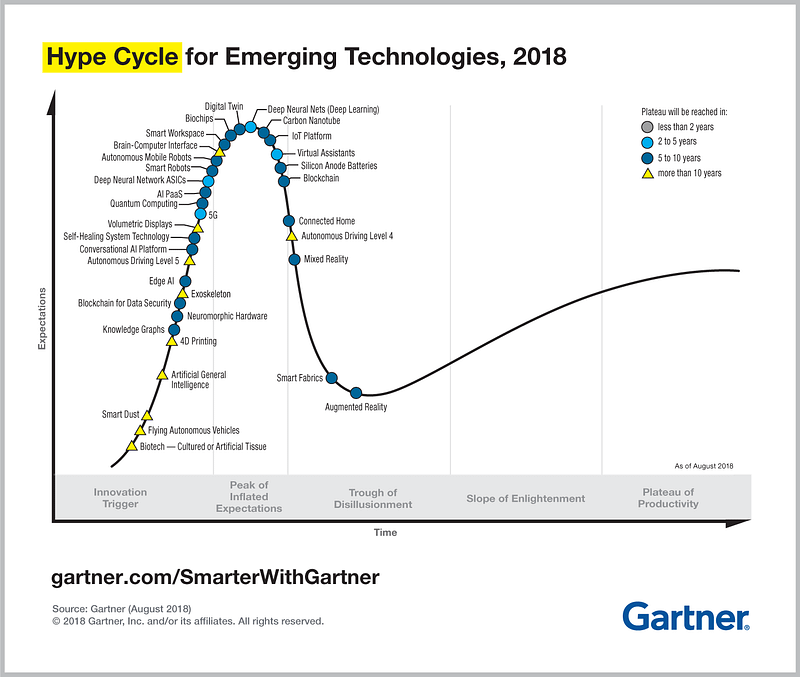
Gartner Hype Cycle for Emerging Technologies: 2018²
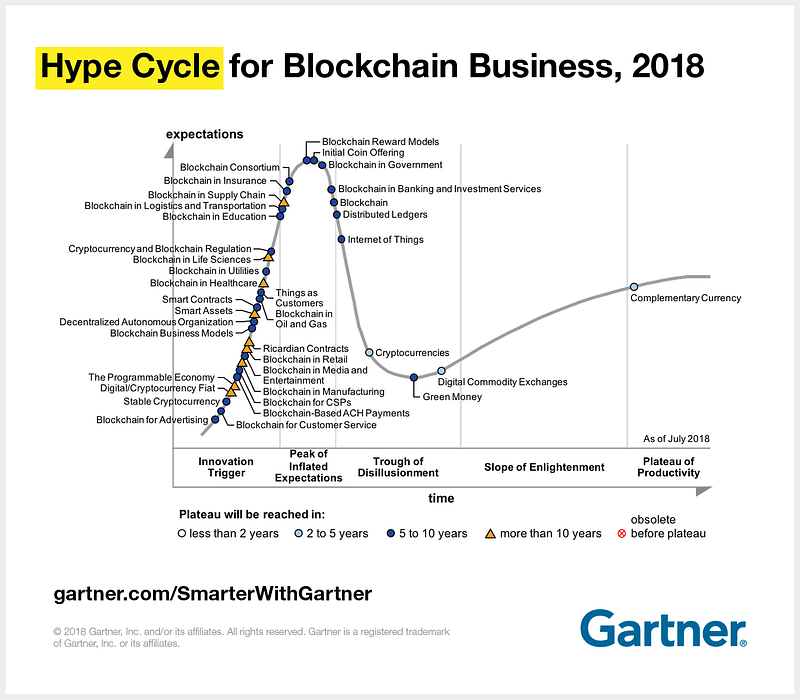
Gartner Hype Cycle for Blockchain Technology: 2018³

The structure and economic opportunity of global systems will change because emergent technology, like Blockchain and digital currencies, are a better, cheaper and faster way to use “money”, or rather, exchange value.

The transaction fees of digital currencies are negligible considering the time and capital cost required by traditional state-based taxation. With the brief proposal I have outlined to repurpose transactions fees toward the provision of public goods, the largest wealth holders and institutions on our planet would redistribute capital back into the world as a process of spending, and thus engage more efficient and powerful network effects toward the benefit and well being of all life.

This will, of course, require an incentive shift for proofs⁴.

Incentive shifts will likely be encouraged, not discouraged, when top-down systems expand their involvement in the global distribution of wealth. I know this sounds strange, and perhaps counter-intuitive, but it is not. When new technology reduces friction so substantially that similar goals will be accomplished in a fraction of the time and at a fraction of the cost, they will inevitably be implemented, and systems will inevitably change.

Those who note, “bitcoin will replace banks and governments” do so with reason, and not necessarily in the pursuit of anarchistic or libertarian motivations. To replace a failing system, we must actualize the use of a new technology, whose impact will improve the quality of life at such a deep and fundamental level, that even those who benefit from structurally entrenched institutions will be rewarded from the optimization brought on by technological advancement.
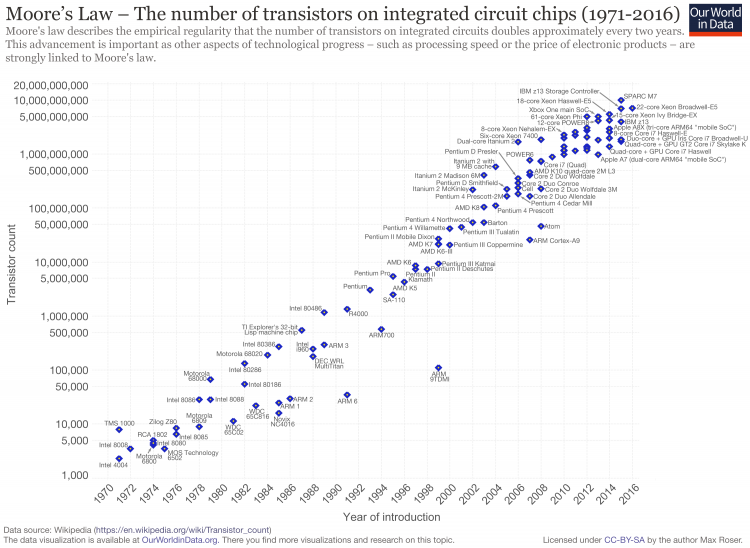
Moore’s Law: Transistors per Microprocessor⁵ (interactive graph below)
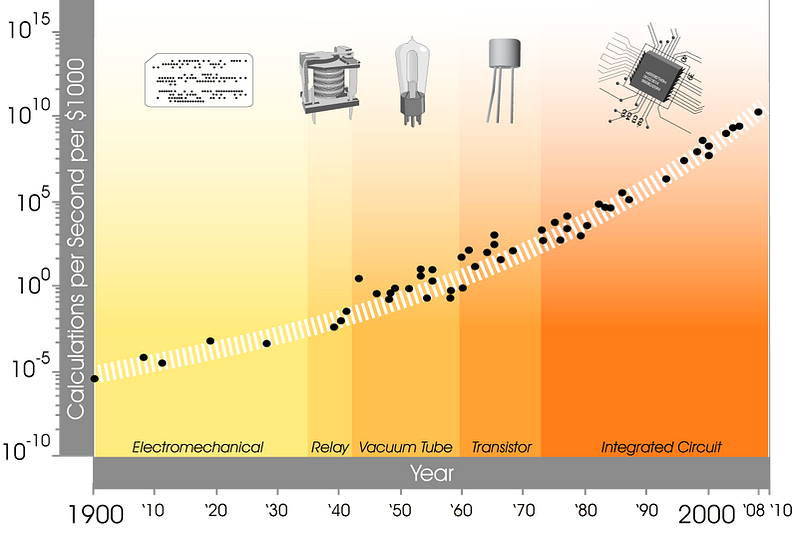
Exponential Growth of Computing, Kurzweil⁶

The technologies structuring the foundations for our emerging future include: Blockchain, Artificial Intelligence , Virtual or Merged Reality, Quantum Computing, and Biological or Technological Modifications to the human (and virtual) body.

As Blockchain restructures our relationships to value, other technologies will redefine life as we know it today. AI will likely be responsible for, among other implications, helping to restructure the distribution of resources and tasks. Climate change and Merged Reality worlds will reshape our relationship to general geography and physical space. Biological Modifications will reshape our relationship to radically expressive forms of self-identification. Virtual environments and Quantum Computing will restructure our relationship to Consciousness and space-time, enlightening our connections to worlds.

Until now, humans labored like cogs in a system built on Western “ego consciousness.” The future creative economy, underpinned by consciously Eastern mythos, will embody collective consciousness, harmony, and self-expression. These values will structure society; their derivatives will provide deterministic metrics for growth.⁷

This civilization structure is a far cry from the fear propagating, closed networks of today, where the notion of “I” over all else reigns, secrecy is leveraged to propagate the idea of truth, and scarcity to disparage the notion of wealth.

If we are to consider innovation a priority, particularly within the framework of global sovereignty, it would be to our benefit to question why and how present day systems in our world are disconnected from the deeper reality of life.

For example, our identity is likely more about the relationships we have to each other than it is representative of our relationship to a national governing body.

To explore the validity of this point, we can use the incentives in our current information economy. The underlying business models of identity have changed, and we need only to observe the monetization strategies for two of the largest companies in the world: Facebook and Google, to understand why this is true⁸.

Consider that we transact with Facebook, Google and the web with exponentially more substantial frequency than we transact with a national governing body.
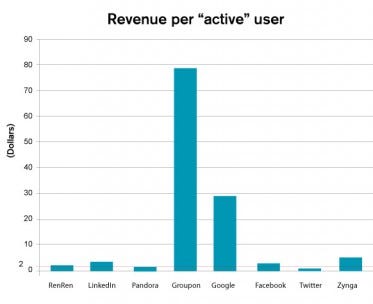
Footnotes: 1.) The figure for Google users refers to the number of unique monthly search users, which doesn’t reflect all the people that see its ads and use its services. 2.) The figure for Groupon users refers to reported “cumulative customers” in 2010. 3.) The figure for active Zynga users refers to “monthly unique users” from October through December 2010. 4.) The figure for active Twitter users refers to a recent report from Business Insider that found that only 21 million Twitter users follow 32 or more accounts. Twitter considers an “active” user to be someone who is following 30 accounts, with a third of those accounts following back. 5.) Revenue figures for Facebook and Twitter are based on estimates from eMarketer, a research firm. 6.) Revenue figures for Zynga and Groupon come from their IPO filings with the Securities and Exchange Commission.⁸

Systems based on low-trust, closed networks and exclusion no longer represent our greatest human potential, or most substantial capital opportunity.

We live in an interconnected and interdependent world of open networks. With Blockchain enabled incentives for distributed information processing, storage and commnuications, contribution to these networks can result in immediate access to new forms of wealth for people around the world.
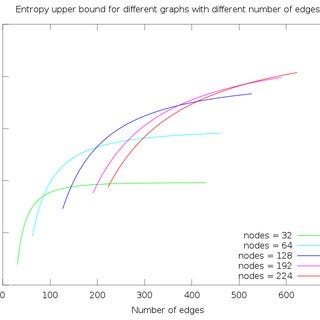
Are digital currency networks simple enough to glean something from these mathematics? Some would say yes. Will my theory that AI’s processing information will become the new mining exemplify more equitable distribution? Could everyone have a personal AI running as a node on the network? Time will tell. A New Bound in Information Theory: Popescu, Slusanschi, Iancu, Pop⁹

Many people have expressed fear concerning the rise of Artificial Intelligence. However, the greatest human fear is not radical change or the impact of emergent technology, but the use and exploitation of absolute power. In an ideal situation, AI and emergent technologies will enable us to live with greater freedom, helping us to mature as humans toward the point of transcendence!

With the rise in automation, and subsequently, AI, we have the means to create a world where our children will not have to think about what it means to have a job.

Future generations will have the ability to make money, or rather, create value, contributing to anything that interests them.

This substantive alternative to “work” has the ability to create more freedoms when compared to the current model, which requires humanity to process sentience through role definition within systems designed to progress structure before life.

Our world will become infinitely smaller and more interconnected, while our human ability to live out our purpose and fulfill our potential will become more vast and expansive than we are presently able to recall.

Full-Time Worker: Circa 2016¹¹

The “future of work” coin will emerge from the shifting incentives in labor due to the redistribution of economics within information using Blockchain, and thus, shifting economic incentives for every major technology company. Information is arguably the most humane of the largest industries on our planet, and automation is coming.

Every person reading this piece uses the internet and (likely) social media. If you use the internet and social media, you are a #datalaborer. This means you are currently giving your data away to organizations who monetize your time and attention to create billions of dollars for centralized organizations, without yet providing meaningful resource distribution back to the people providing the work.

Blockchain enables new forms of stewardship for the data we are generating on social networks, and broadly throughout on the massive pipeline infrastructure that is the world wide web.

Social media is in and of itself, not “work”. It is not yet clear that the value of our data would constitute enough of a meaningful living wage to qualify as Universal Earned Income.

Beyond generating data, it is our participation in generating meaning through contributions to networks that will create and distribute more significant stewardship of value and wealth back to all.

This call for participation is not an attempt to negate the value of time and attention. There is certainly economic value derived from the amount of time spent using applications, or the data generated from our evocative emotional responses toward content and (unfortunately, at this stage) advertisements. This information gives organizations a representation of our deeper, self-identified context. However, it is unlikely with the current incentives that the value generated from attention alone would be enough to create real living wages for people around the world. And would this be the right model in the first place?

If we are merely obtaining wealth from having our time and attention owned as we passively interact with the world, are we valuing ourselves and the amount of time we have on this earth? My answer to that question would be, of course not.

Life is not meant to be lived through a screen alone, it is meant to be lived in worlds. Whether physical, spiritual or virtual, the more passively we are engaged in life, the less value we can accrue from our experience here on earth, and thus, the less wealth we have… no matter how you quantify!

In addition to the potential Blockchain technology has to enable the next generation of shared ownership and experiential existence, this technology provides us with the capacity to build regenerative wealth ecosystems.

The current incentives for information economies see and value many forms of knowledge and intelligence as intangible forms of wealth. Blockchain is a radical change in this paradigm.

For a current example of “intangible” wealth and the value of unquantified intelligence, consider our planet. Consider her health. Our planet represents a massive, complex and hugely valuable network dataset that encourages, through regeneration and discovery, longevity for all forms of life.

We have not been able to quantify the information and meaning generated by our planet as an asset, and thus it has been seen as a “soft” representation of “hard” value. What a mess that’s gotten us into. The planet should have personhood, and economic rights¹².

When we are provided with real context on the consequences of our actions, it will be obvious and immediate for those of us who care about life to redefine the structural incentives of wealth toward the benefit of all.

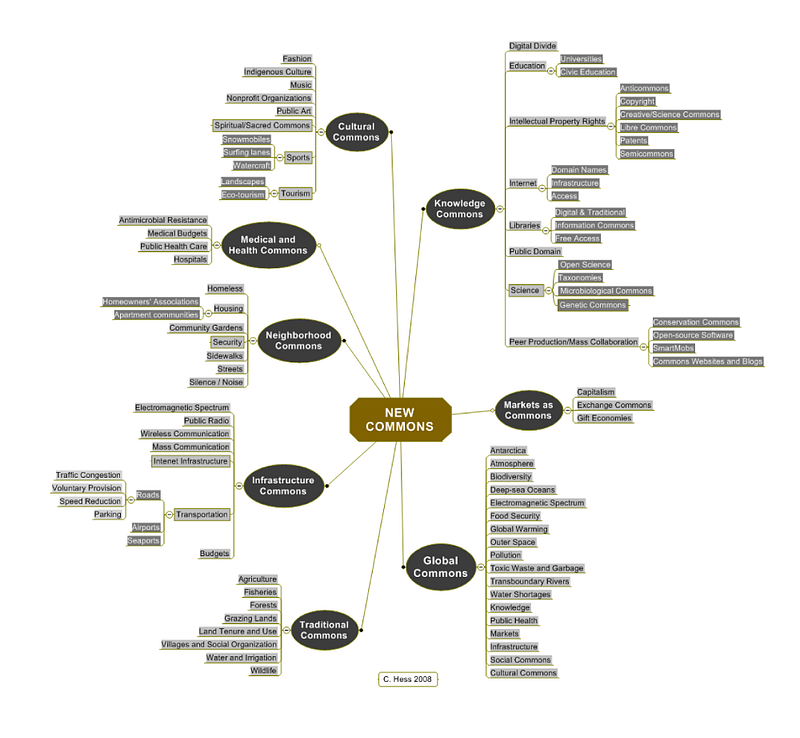
New methods for the distributed monetization of information in relation to our emergent quantum consciousness will steer the development of our values in life toward deeper, more comprehensive connection. Governing incentives will likely drift from Hardin’s “Tragedy of the Commons”¹³, toward Elinor Ostrom's Nobel Prize-winning work¹⁴ on Self-Organized Governance of the Commons¹⁵.
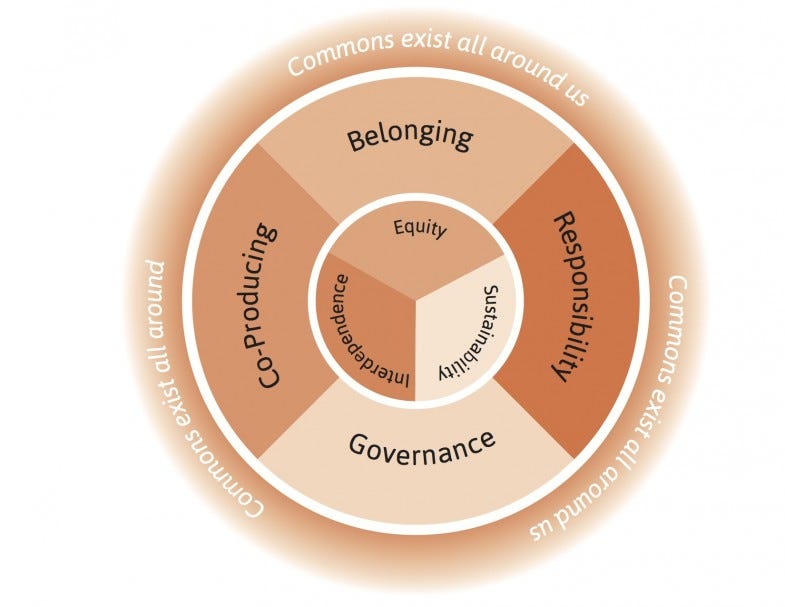
The Political Values of the Commons¹⁶
Mapping the New Commons, Hess¹⁷

Fundamentally, the emergent incentives of information economies are shifting us toward economic abundance.

Global sovereignty is an emergent principle of this economic system.

I propose we prepare for this shift by universalizing the provision of public goods through basic repurposing of transaction fees (future articles will address new structures for proofs based on AI using information mining for problem solving at an individual level to generate distributed value for our collective intelligence on an open network).

Repurposed transaction fees can and should be used for the development of better public infrastructure, alongside investment in the well-being of individual life.

In implementing this proposal, we have the ability to change the methods and behaviors that signal reward mechanisms in society. We can create a future where we value human life over our own sense of fear about existence and the future.

If we care about peace, abundance and the ultimate experience, we must take a stand to enable the right incentives.

Staking full sovereign ownership of your economic rights is the first step you can take as an individual. Educate yourself. Reach out. Rise up. And build! If we want a better world, it is up to us!

for more content visit: www.tonilane.com and follow @tonilanec

*Brief Bio on the Author: Toni Lane is an artrepreneur in Emerging Technologies | Digital Currencies, and well-respected leader in the movement for global sovereign unity. She works closely with Indigenous Nations, and is an early pioneer in Blockchain.

Miss Lane is currently an Integral Steward of the Blockchain Commons, and spends her time creating Cultu.re, a company working to evolve “government” into networks of transactions and communities beyond borders; a stateless global society. She is an empath, investor, artist, advisory board member, transformational evangelist and founder who has been affectionately entitled “The Joan of Arc of Blockchain” by her peers and various publications.

www.tonilane.com | Toni Lane, TLC- @tonilanec |https://t.me/cultureisfuture

[1]: Satoshi Nakamoto. Bitcoin: A Peer-to-Peer Electronic Cash System. https://bitcoin.org/bitcoin.pdf

[2]: Kasey Panetta. 5 Trends Emerge in the Gartner Hype Cycle for Emerging Technologies. (Gartner) https://www.gartner.com/smarterwithgartner/5-trends-emerge-in-gartner-hype-cycle-for-emerging-technologies-2018/

[3]: Heather Pemberton Levy. The Reality of Blockchain. (Gartner) https://www.gartner.com/smarterwithgartner/the-reality-of-blockchain/

[4]: P2P Foundation. Blockchain Proofs. https://wiki.p2pfoundation.net/Blockchain_Proofs

[5]: Max Roser and Hannah Ritchie. Technological Progress: Our World in Data. https://ourworldindata.org/technological-progress

[6]: Ray Kurzweil. Exponential Growth of Computing. http://www.kurzweilai.net/exponential-growth-of-computing#!prettyPhoto

[7]: Marshall McLuhan is an excellent reference to explore in regards to this transition.

[8]: Mike Orcutt. How Much Is a User Worth?. (MIT) https://www.technologyreview.com/s/424650/how-much-is-a-user-worth/

[9]: Popescu, Slusanschi, Iancu, Pop. A New Bound in Information Theory. https://www.researchgate.net/publication/270581922_A_new_bound_in_information_theory

[10]: Derek Thompson. A World Without Work. (The Atlantic) https://www.theatlantic.com/magazine/archive/2015/07/world-without-work/395294/

[11]: Wikipedia. Economic, social and cultural rights. https://en.wikipedia.org/wiki/Economic,_social_and_cultural_rights

[12]: Garrett Hardin. The Tragedy of the Commons. https://www.garretthardinsociety.org/articles_pdf/tragedy_of_the_commons.pdf

[13]: Nobel Prize. The Sveriges Riksbank Prize in Economic Sciences in Memory of Alfred Nobel 2009. https://www.nobelprize.org/prizes/economic-sciences/2009/ostrom/facts/

[14]: Elinor Ostrom. Coping With The Tragedies of The Commons. https://pdfs.semanticscholar.org/7c6e/92906bcf0e590e6541eaa41ad0cd92e13671.pdf

[15]: P2PFWiki. On The Commons. http://wiki.p2pfoundation.net/Category:Commons

[16]: Charlotte Hess. Mapping the New Commons. https://papers.ssrn.com/sol3/papers.cfm?abstract_id=1356835

Recommended from ReadMedium