
51 Years Ago, but I Remember It As Though It Were Yesterday
The power of a single photograph.
As is so often the case when I write anything, the process frequently means that I end up writing something different than the thought that I started out with. Today’s piece is a good example. I started out looking at a photo, but the photo faded to insignificance as a more powerful memory took control of the story.
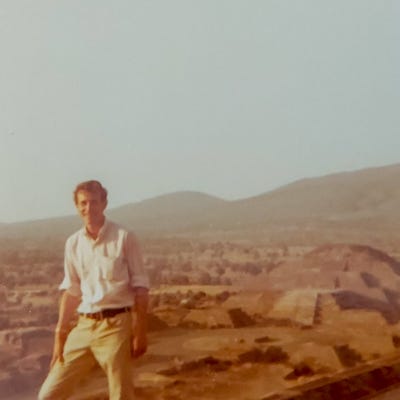
Yesterday I was looking at some old photos and I pulled out a couple that had the effect of a time machine zipping me back to 1971 when I had more hair and fewer wrinkles than I do now. I was taking a trip back to England via Mexico to see my parents. Then there weren’t as many tourists as there are these days, excluding the covid years, and for me, it was more exotic than anywhere I’d been up until then. Mexico was exciting, vibrant, and different.
While in Mexico City, I did all the usual touristy things, which included a visit to the ancient city of Teotihuacán, my number two highlight. Dominating the landscape are two massive pyramids, one being dedicated to the Moon and the other, the larger one, to the Sun. The Pyramid of the Sun rises 216 feet (66 metres) and the climb to the top was unforgettable and torturous.
It was so steep and each step so high, that I remember coming down each step, one at a time on my ass. Just as well that I wasn’t trying to impersonate Indiana Jones because I’d have failed dismally.
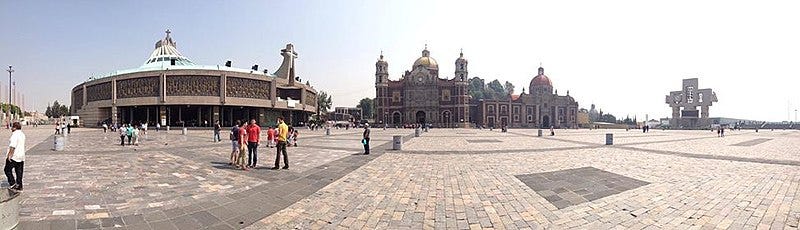
The Basilica of Santa María de Guadalupe left me with an indelible image that remains as powerful today as it was back then. As testimony to the pull of Catholicism in Mexico the Basilica of Santa María is the most visited Marian precinct in the world, and visits by the faithful is surpassed only by Saint Peter’s Basilica in Rome.
Today There’s a new, modern Basilica to cope with the annual numbers. The first photo showed their relative sizes.
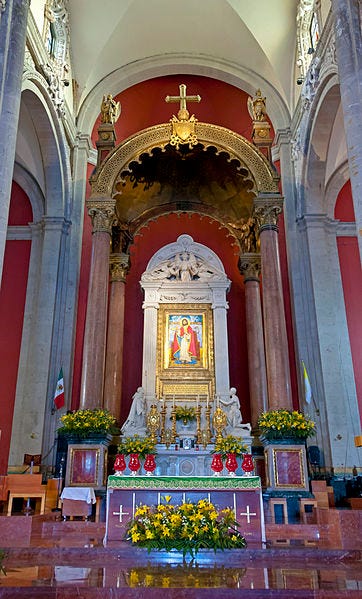
Like all the other faithful pilgrims and tourists who were there that day, I was gobsmacked by the sheer opulence manifested by the Basilica and the other churches that were there. My brain had trouble processing what I saw.
Sure, I’d seen church wealth before, so it oughtn’t to have caught me by surprise. No, this was shocking because of the poverty that I also saw.
Walking outside onto the plaza that fronted the Basilica you could see the faithful edging closer to their goal. These were the poor, the peasants and working-class Catholics who needed help to cure a loved one or a divine intervention known only to them.
These poor Mexicans crossed the massive square on their knees, shuffling their way to the Golden, bejewelled temple of Mary to offer the money they had to the church, money that they needed for more tangible help.
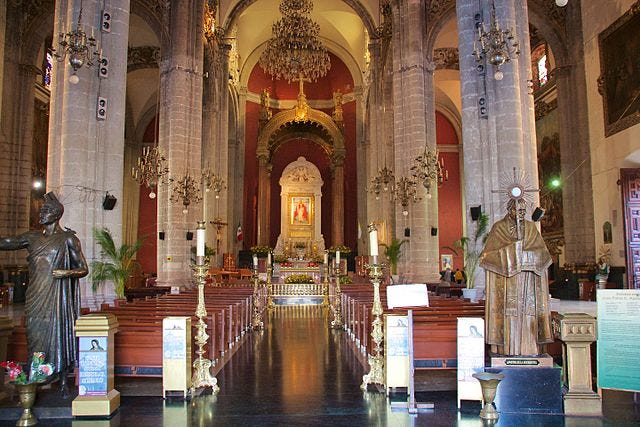
Had I not already left the world of organized religion, I think that day at The Basilica of Santa María de Guadalupe would have resolved any doubts that might have remained.
To see the humility of poor supplicants, on their knees against the backdrop of the church’s wealth makes you wonder if the church hierarchy ever justifies to themselves the enormous wealth that keeps on growing. As a footnote, the amount of money that the Mexican church contributes to the Vatican’s coffers makes it the ninth largest, which isn’t bad for such a poor country. (Refer to link at the end)
I’m sure the church would likely argue that the money goes into charitable works, but I wonder how much. I saw a recent article about the vast amounts needed for payroll. Mostly it pertained to the Catholic Church in the United States. It would be interesting if someone with all the information for the entirety of the Catholic Church could come up with a figure to tell us how much of the honeypot is left for charitable works.
The following figures are extracted from information acquired from the sources shown in the links at the end of this piece.
I’m not against the Catholic Church, it’s up to the individual what they do or don’t believe. That said, I was inspired to write this because of what I saw in Mexico all those years ago. The sight of those poor people I saw back then, shuffling on their knees to the Basilica has remained with me. I hope that practice has stopped.
The reality is that Mexico’s a poor country and yet so much of the people’s wealth goes to Rome, and to me that seems unjust. What do you think?
Who finances the Catholic Church in Mexico?
Direct contributions from the faithful. They are the main source of financing and represent 50% of the income.
What is the country that contributes most to the Vatican?
The list of countries making donations to the Vatican is extensive. The Catholic Publication, Eternal God Religious portal on Catholicism (Link One) Those made through the OBOLO (Donations from parishioners) are led by the United States, followed by Italy, Germany, France, Spain, Ireland, Canada, Korea, while Mexico holds the ninth position.
The Organisation for Economic Co-operation and Development (OECD) Net worth per household in USD
Ranking of major OECD countries Position & Net Worth per Household 3 USA $684,500 5 Australia $528,578 6 UK $524,422 8 Canada $478,240 11 Ireland $370,341 13 Sth Korea $363,340 33 Mexico $121,741


