
50 Very Short Rules for a Good Life From Buddhist Philosophy
Follow them and you’ll change your mind forever.
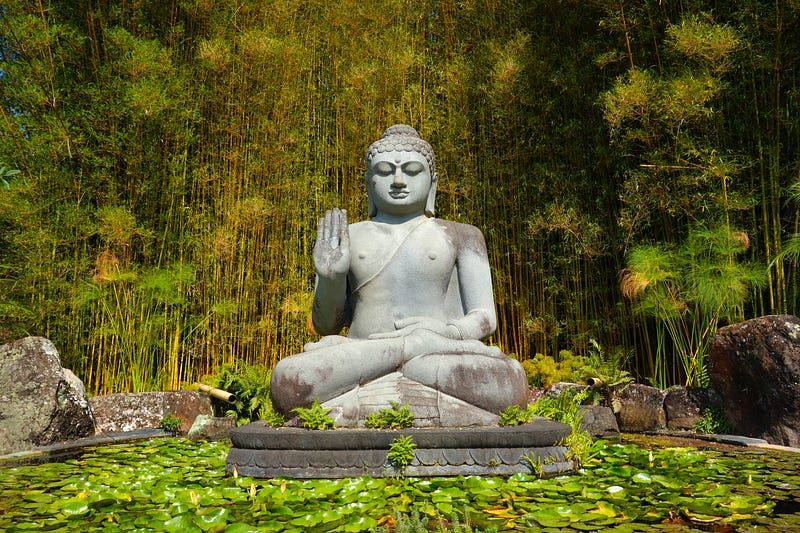
Buddhism is complicated. So are we.
Before I discovered this ancient philosophy I was impulsive and distressed. Negative events took me down into the abyss and my emotions controlled me.
I’m a worrier. While I enjoy the small spontaneities of everyday life, on bad days, uncertainty gets the best of me. If I don’t know what disaster hides down the road and how to prevent it can drive me into a hell ride of anxiety.
My inner world transformed gradually but radically in the past three years, as I dove deep into Buddhist philosophy. Serendipity introduced me to it as a tool to deal with pain.
Since then, I read about what the Buddha taught and follow contemporary teachers who interpret and help us apply his texts.
I meditate daily and even designed my solo custom 2-day meditation retreat at home.
Rest assured I’m still far from being a model Buddhist. Nor do I have to be. Rather, I learned life isn’t supposed to be easy or about me. I realized there’s a way to live with difficult emotions without drowning them in unhealthy distractions.
Buddhism can be nebulous for beginners. It doesn’t come with ten clear commandments, only a few no-nos, and do-dos here and there.
The following 50 rules are my distilled version of what I learned and do my best to apply.
I hope they help you accept yourself and cultivate compassion as they helped me.
- The present moment is the perfect teacher and it’s always with you.
- Everything that occurs is not only usable and workable but the way itself.
- Pain is inevitable, suffering is optional. You choose how you respond to pain.
- Feelings aren’t deeply meaningful. They just are.
- When we feel pain it doesn’t mean that something is wrong. Pain is part of life, it doesn’t happen because we personally made the wrong move.
- On the primary level, what guides us through our day are thoughts and feelings that helped our ancestors procreate. Keep this in mind before you allow them to run you around in circles.
- Consequentially, understand that evolution designed feelings to convince you to follow them. By definition, they feel true and discourage you from viewing them objectively.
- Your mind is only an organ. Its job is to think. Your job is to see the true nature of your thoughts. The less you judge the content of your mind the more clearly you see it and the less deluded you are.
- Accept impermanence.
- Chaos is good news. Cultivate the courage to lean into life’s sharp points, as tenderness arises through hardships.
- “Only to the extent that we expose ourselves over and over to annihilation can that which is indestructible be found in us.” — Pema Chödrön
- If you feel the urge to solve a large, overwhelming problem, stop. Instead, pause, and do something unfamiliar first.
- In the end, things don’t get solved. They come together and they fall apart.
- “Come and see”, not “come and believe”.
- There’s no “moral justice” or “reward and punishment”, as there’s no judge. Karma is a natural law of cause and effect.
- The absolute truth is there’s no absolute truth. Everything is relative, conditioned, and impermanent.
- Therefore, notice your opinions and don’t become aggressive about them.
- Don’t be unhappy about your unhappy feelings and worried about your worries. Observe them instead.
- This means you’re not a judge but a scientist.
- However, don’t intellectualize the world. Go see and experience it.
- Be willing to feel what you’re going through.
- When it comes to feelings, practice the RAIN method: recognize, allow, investigate, nurture.
- Your head will explode if you over-rationalize Buddhism. Experience it instead.
- Therefore: Meditate.
- Aim for the flow-state: You produce great work when you’re lost in your actions and are free from self-consciousness.
- Abstain from professions that bring harm to others.
- Practice universal love and compassion for all living beings.
- Abstain from animal products as well as you can.
- Practice right speech: Don’t lie, gossip, and abuse through language.
- We vastly overestimate how much happiness pleasure and reaching our goals will bring. Pleasure is fleeting at best.
- Keep in mind every time we see others do something, they’re doing it in our presence. They likely behave differently around or toward other people.
- We underestimate the role of the situation and overestimate the role of disposition. We apply the former to us and our friends (ie. the situation drove them to act this way) and the latter to our rivals and enemies (ie. they act this way because they’re evil). Keep this in mind before you judge others.
- You don’t have to love your enemies. However, it’s essential you see them clearly.
- Observe your urges and impulses with a natural curiosity to resist and overcome them.
- Become intimate with fear. It’s where courage comes in.
- The search for lasting pleasure and the avoidance of pain is a hopeless, endless cycle. It causes us to suffer greatly.
- It’s futile to seek lasting security.
- Take death seriously and allow it to hit home. “Life is like getting into a boat that’s just about to sail out to sea and sink.” — Shunryū Suzuki
- Study yourself.
- Know your own confusion so you can alleviate the confusion of others.
- You don’t have to love yourself. Practice self-compassion and self-responsibility instead.
- Avoid inbound aggression by looking at yourself honestly, and gently.
- Don’t overwork, overeat, oversmoke, or overseduce. Stop causing harm.
- Loneliness is not a problem — it’s nothing to be solved. Relax with it.
- In the end, we’re fundamentally alone, and there’s little to hold on to. This isn’t a problem but an opportunity to discover an authentic state of being.
- “Nothing ever goes away until it has told us what we need to know.” — Pema Chödrön
- The essence of life is that it’s challenging. To solve everything and finally get it together means death, as it rejects a lot of our basic experience.
- “Approach what you find repulsive, help those you cannot help, and go to places that scare you.” — Machig Labdrön
- We don’t experience the world fully unless we’re ready to give everything away.
- In the end, life is a good teacher and a good friend. Lighten up and relax with it.
Finally, here’s the most important rule to all these rules:
Don’t try to use these Buddhist teachings to be a better Buddhist. Use them to become a better you.
You can have endless debates about what the Buddha meant when he said this or that 2,000+ years ago. The confusion is real and there’s no universal agreement about concepts like reincarnation, karma, and no-self.
It doesn’t matter, as we know this: Buddhism is a philosophy of peace, compassion, tolerance, universal love, and understanding towards all beings. Violence in any form, under any pretext, stands sharply against its teachings.
In the end, the inflated ego is the root of all violence. A lack of self-awareness and self-compassion causes us to harm others and ourselves. By cultivating mindfulness we also help create a better, more compassionate world.
Finally, I’ll leave you with wisdom from Cloud Atlas, a book and movie dedicated to bringing together Eastern philosophy and Western thought:
“Our lives are not our own. From womb to tomb we are bound to others, past and present… and by each crime, and every act of kindness we birth our future.“
Mind Cafe’s Reset Your Mind: A Free 10-Day Email Course
We’re offering a free course to all of our new subscribers as a thank you for your continued support. When you sign up using this link, we’ll send you tips on how to boost mental clarity and focus every two days.


