
5 Weird Italian Folk Tales Passed Down Through History
My Grandma told me about werewolves, magical donkeys, and other strange stories
When I was young, I would ask my father to tell me my Nonna’s stories again and again. She grew up in the mountains of Casalvieri, a small village in the region of Lazio, Italy. Italian culture has strong ties to Catholocism mixed with Stregheria, or witchcraft. Before the rise of Catholocism, the Italians, like many European people, had roots in pagan beliefs. Folk tales were a way to keep pagan beliefs alive without breaking the rules of the new religion. The folktales were also a way for some Italians, who lived in the countryside did not have access to modern medicine or technology, to explain the unexplainable.
Strange and paranormal occurrences were simply considered a part of life. Italians like my Nonna believed in ghosts, monsters, and a creepy old woman who delivers presents to good children instead of Santa Claus. Personally, I enjoy stories of La Befana much more than Santa, even if you have to wait a week longer for her to bring gifts for La Festa dell’Epifania on January 5th.
I was told these stories by my father, who heard them from his mother, who kept the history of the region alive by passing on these tales which were probably told to her by her own family and neighbors.
The Werewolf, or Lupo Mannero
One day, my Nonna, whose name was Madelina, was walking through the woods at night. She was getting some water from a lake to wash clothes with. She could see the lake in the distance, and suddenly heard a rustling sound in the trees from afar.
A man ran out of the trees, panicked and screaming, completely naked. He ran straight towards the lake and dove in headfirst. Madelina watched from the shadows, waiting for the man to resurface. With a splash, a massive wolf emerged from the lake on the opposite side from where the man dove in. The wolf ran out of the water and stopped to howl at the moon, which happened to be full that night. Then he ran off, never to be seen again.
Il Malocchio
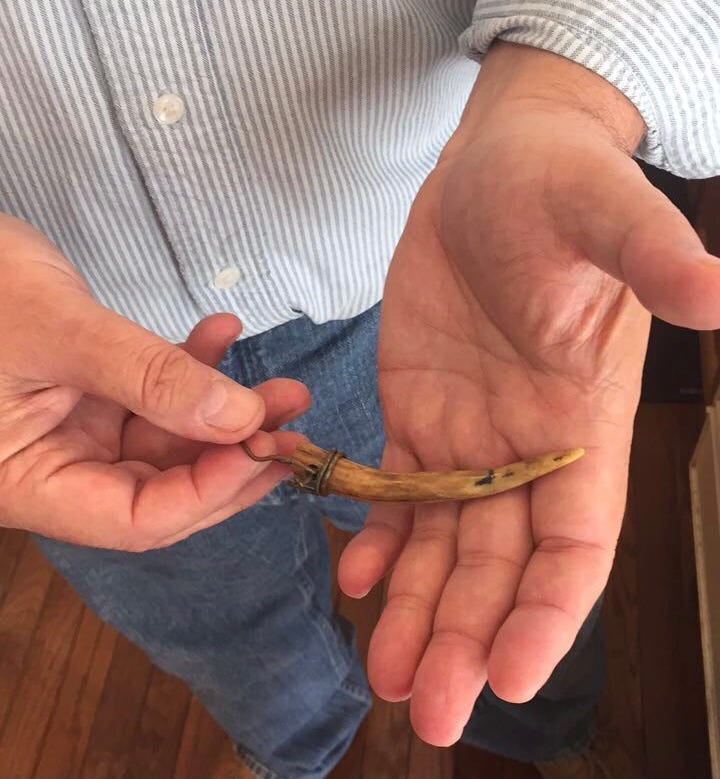
All Italians are aware of Il Malocchio, or the evil eye. The evil eye is a curse that is cast on you by your enemies and can cause illness, bad luck, or even death. There are many protective measures to prevent from getting Il Malocchio, including wearing a cornetto or cornicello, or a goat's horn. I’ve seen many Italian Americans wear this as a tiny gold necklace. My father has one that was given to him as a child by his great aunt that is an actual goat horn with metal wire to wear as a charm.
There is also a method of diagnosing Il Malocchio. Take one small bowl of olive oil and another larger bowl of water. Dip the first three fingers of your right hand, the index, middle, and ring fingers, in the oil, and then hold your hand over the bowl of water. Let three drops fall from your fingers naturally, do not shake your hand to make them fall. If the three drops disperse from each other and stay apart, you do not have the evil eye. If they all gather together to form one blob of oil on the water, you have the Malocchio.
If you’re unlucky enough to have the Malocchio cast on you, there are ways to remove it. There was a method passed down in my family that involved taking a bath with special herbs while chanting and praying. Luckily, I have never felt it necessary to rid myself of the evil eye, so I haven’t experienced this ritual.
Another way to prevent yourself from catching the Malocchio is by making a symbol with your hands to deflect the Malocchio back to its caster. If you’re around someone who is especially jealous of you or wishes you ill will, you can deflect their curse by turning your hand into horns and pointing the horns at the person. It will look similar to the ‘rock on’ hand.
A Donkey That Craps Money
For some reason, a large amount of Italian folklore contains donkeys or l’asino. There are even lots of idioms and parables about donkeys. This happens to be my favorite donkey-centric tale.
There is a young boy whose family was struggling to survive. They were poor farmers and had a bad harvest, so they were starving. The boy’s mother advised him to visit his wealthy uncle to get something to eat so he didn’t starve to death.
When the boy arrives at his uncle’s house, the uncle gives him something better than food. He gives him a donkey that craps money. Every night, the uncle advised, you’ll wake up with a pile of money under the donkey’s rear.
On the way back home, the boy stops at an inn to rest for the night. When he wakes up, he's delighted to find a pile of gold under the magical donkey. He pays the innkeeper for his stay and leaves. Little did he know that the innkeeper watched the donkey… erm… produce the money overnight and swapped his normal donkey with the magical one before the boy left.
Once the boy realizes this, he returns to his uncle, who, aside from calling him an idiot, gives him a magical table cloth that produces food when laid on a table. The boy turns out to truly be an idiot because he once again returns to the same inn to rest. He tells the innkeeper he doesn’t want any food, and once again the innkeeper spies on the boy and watches his magical tablecloth produce a feast out of thin air. He once again swaps the magical table cloth his regular one before the boy leaves.
The boy returns to his uncle for the third time, and the uncle angrily gives him a wooden stick that will magically beat whatever person he asks it to. When the boy returns to the inn, the innkeeper automatically assumes that the stick will do something cool, so he sneaks into the boy’s room to steal it. This time, the boy has smartened up a bit and as the innkeeper attempts to steal the wooden stick, the boy commands it to beat the thief.
After getting beaten by a magical stick, the innkeeper gives the boy back the money-pooping donkey and magical table cloth. The boy returns home to his mom and invites his uncle over for dinner so they can all enjoy the magical food and money.
La Befana
La Befana in my house growing up was not a replacement for Santa, but more of a sidekick to Santa. I was told that if I was bad, La Befana would find out and I would get coal instead of presents for both Christmas and la Festa dell’Epifania on January 5th, which was the night La Befana brought gifts.
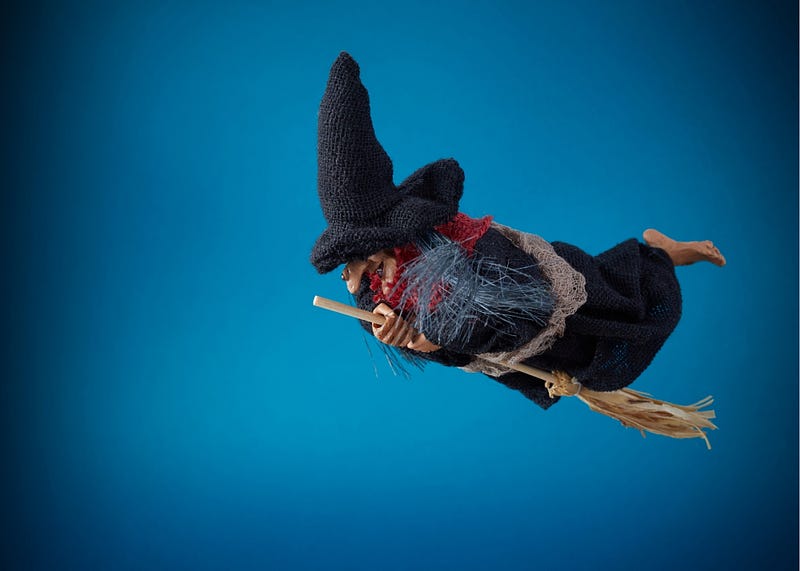
La Befana was an old, haggard-looking witch. We even had a statue of her in my home that went up around the holidays. He had a hunchback and carried a sack of gifts and a walking stick. In some depictions, she’s flying on a broom.
I’ve heard some more sinister versions of this tale from more Northern Italian traditions, including one where La Befana eats bad children. She definitely provides an incentive to be good, whether she’s eating you or not giving you gifts as a punishment.
Bocca Al Lupo
The belief that saying ‘good luck’ brings bad luck is rampant in Italy. Similar to saying ‘break a leg’ to performers before a show, Italians say Bocca Al Lupo, which means into the mouth of the wolf. Instead of saying thank you back, the person is supposed to say ‘crepi’, which roughly translates to ‘it dies’ or ‘may it die’.
Folk takes are a fascinating way to learn more about a culture and its history. I was always eager to hear the tales my ancestors were told when they were young, and like most folk tales, they usually contained a lesson. Well, the donkey story, I’m not really sure what the takeaway is for that tale, but it’s definitely entertaining.


