
5 Ways We Can Use Past Mistakes As Future Success and Stop Blaming Ourselves Till the End of Time
Everyone makes mistakes, so why not teach ourselves to look at things from a different perspective?

I’m sure you’ve all heard the expression that there is no such thing as a mistake, only experience. I used to misinterpret this in my youth. You know — when we are young, we think we have immunity to screwing up.
Well, sooner rather than later I realized that’s definitely not the case. I’ve screwed up big time many times. And so did my fellow peers. Be it at university or in our future career lives, we all did mistakes.
At first, we all enter the stage of denial. We think to ourselves that this last screw-up wasn’t technically a mistake. We were just misunderstood. Undervalued. Not supported. Taken for granted. Humiliated. But never wrong.
But let me tell you one thing. I’ve learned the hard way that acknowledging that you’ve made a mistake can be quite liberating. At one point we all just start to feel exhausted from always having to defend our stupid life choices. Facing a mistake doesn’t mean you have to undervalue yourself and blame yourself for the end of eternity. It simply means accepting you’ve got plenty of lessons to learn.
Accepting your mistakes doesn’t mean blaming yourself for years

I think this is a very common problem in today’s society. Once we accept we have made a mistake, we immediately start to blame, shame, and guilt-trip ourselves. As if there aren’t enough people already doing that!
But the important thing is that by blaming and shaming yourself you drift apart from your initial goal. That goal should be learning from your screw-ups. If you start to blame yourself, it’s quite likely you’ll enter this stage of trying to forget what you’ve done or said. (Oh, the cringe!) And that’s what is keeping you off track. In order to carefully and successfully learn from our mistakes, we first need to acknowledge them and then to observe them in their wholeness. As painful and cringe-worthy as this might be, it’s essential and pivotal for your future development and growth.
But what is stopping us from confessing we made a mistake?
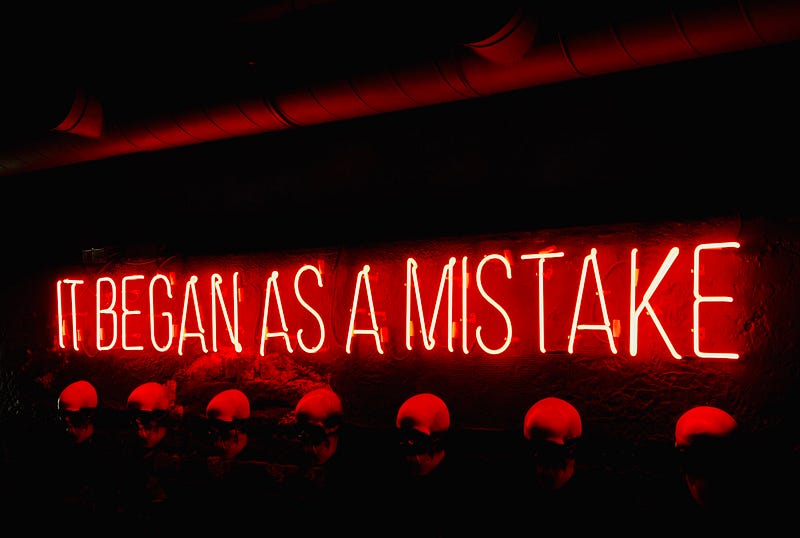
Let’s say you’ve insulted a friend by making a harsh remark about their looks. Of course, they feel offended and storm off. Now, there are several possible scenarios here. In the first one, you may decline the possibility that you are at fault at all. You might say:
“But I was telling the truth! They have no right to feel offended! Maybe they got offended because deep down they know I’m right!”
If you stick to this stage, you’ll never learn from your mistake.
People have all the right to get offended if they feel like so. Your words and actions matter. A different scenario is just saying “Sorry”. Learning from your slip-up simply means preventing yourself from ever making harsh remarks about someone’s looks. This way you are acknowledging your mistake because you realize that people have different emotions and sensitivity. What one person finds as a joke may be deeply unsettling for another.
This process can be seen in various situations and various subjects. You may say or do something wrong at your dinner table while sharing a meal with your family. You may screw up at school or university. You can make a mistake both in your personal and professional lives. We all do them. Don’t let anyone convince you of their mistake-free existence. While we all screw up, not all of us are good at taking the so important lessons out of any situation.
So here are 5 tricks that can help us learn from our mistakes without self-judgment
- Your mistake is actually an experience. We all know that success in life goes along with development and growth. They both require experience in order to elevate our skills and abilities. Once you acknowledge you’ve made a mistake, forgive yourself for doing so and quickly appreciate it as additional experience that will likely come in handy further in life.
- They are this great warning sign. Have you ever wondered why sometimes we keep on ending in the same situations all over again? Be it unprofessional companies, toxic relationships, or toxic friendships — somehow we always end up facing the same scenario. Well, perhaps the reason behind it all is that we keep on making the same mistakes that led us to failure in the first place. If something doesn’t go according to plan, it would be naive to expect a different result if you don’t change anything.
- You can refer to mistakes as trial periods. See, sometimes you have no idea what your actions may bring. So if things go downhill, you shouldn't be so hard on yourself. You didn’t fail deliberately. You didn’t hurt anyone deliberately. It was just a trial period that went wrong. You will nail it next time.
- There are instances when your mistakes actually show you the real faces of your inner circle. Imagine making a mistake. Then, all of a sudden, everyone who you expected to support you start blaming you and judging you. They start to scold you and tell you what would they do. Relationships like these are toxic and no one needs them. So sometimes making a mistake can actually help you free up some space in your life, both personal and professional.
- They are a great tool for some soul-searching. After making a mistake and the end results are not fulfilling at all, you can spend some time evaluating your actions. What made you say or do the things you’ve said and done? What emotions, beliefs, thoughts, and expectations stand behind them? I believe making mistakes is a great source not only for building stamina and further experience, but also a great chance to try to get to know yourself better.
To wrap things up
When you come to think about it, there is incredible wisdom in making mistakes. We can learn from them and change our life course for the better. What we need to do is to stop being too hard on ourselves since this behavior will likely put us way down. Instead, let’s try to focus on how we can improve the next time around.
Hi, guys, I’m Ivan and I’m here to share with all of you my passion for words, great content, entrepreneurship, personal development, management, hobbies, and everything in between.
I serve as the CEO of my WordPress Development Agency @ Vipe Studio where I have the pleasure to lead a diverse, wonderful and energetic team of experts. Feel free to contact me anytime — I would love to exchange new ideas and inspire each other!