
5 ways to use GPT prompts to invest in the stock market
Investing in the stock market can be an exciting and profitable venture, but it can also be a nerve-wracking experience. With the constant ups and downs of the market, it can be challenging to make informed decisions about where to put your money.
However, with the rise of artificial intelligence and machine learning, new tools have emerged to help investors navigate the complex world of investing.
One such tool is the GPT, a language model that uses deep learning to generate human-like text.
In this article, we will explore five creative ways to harness the power of GPT prompts to invest in the stock market and stay ahead of the game. So, buckle up and get ready to learn how to leverage this cutting-edge technology to make smarter investment decisions!
One such tool is the GPT prompt, a language model that uses deep learning to generate human-like text.
In this article, we will explore five ways to use GPT prompts to invest in the stock market.
Generating Financial Reports
One way to use GPT prompts is to generate financial reports. Financial reports provide crucial information about a company’s financial health, including its earnings, assets, and liabilities.
GPT prompts can be used to analyze this data and generate reports that can help investors make informed decisions about buying or selling stocks.
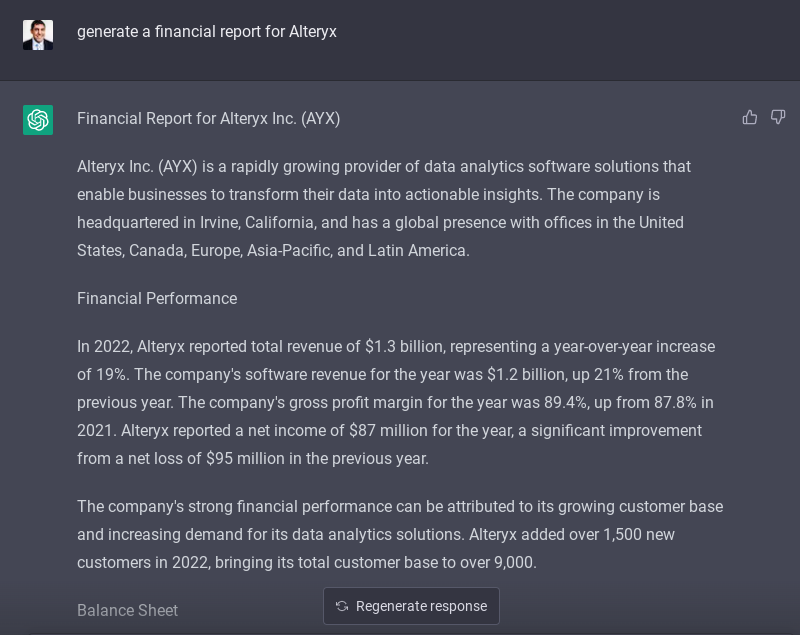
Remember that a financial report typically includes a balance sheet, income statement, and cash flow statement. The balance sheet provides a snapshot of a company’s assets, liabilities, and equity at a specific point in time.
The income statement shows a company’s revenue, expenses, and profit or loss over a specific period. The cash flow statement shows how cash flows in and out of the company during a specific period.
Chat GPT can also help you with this:
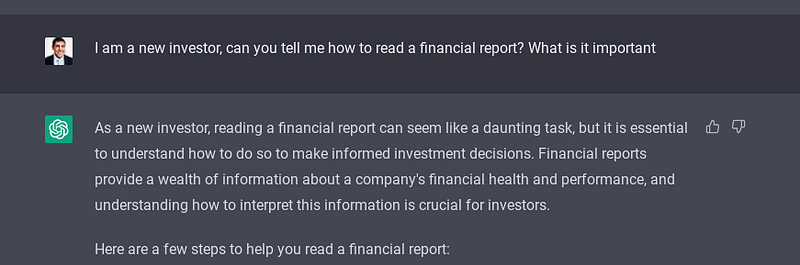
Reading a financial report is important because it provides critical information about a company’s financial health and performance. Investors use financial reports to assess the potential risks and rewards of investing in a particular company. By understanding how to read financial reports, investors can make informed decisions about where to invest their money.
Predicting Stock Prices
GPT prompts can also be used to predict stock prices. By analyzing past performance and other relevant data, GPT prompts can generate forecasts of a stock’s future value. These predictions can be used to inform investment decisions and to develop trading strategies.
Generating forecasts of a stock’s future value is a common practice among investors and traders. While no forecast can guarantee future returns, generating forecasts can help investors make informed decisions about buying, selling, or holding a particular stock.
Here are a few ways you can generate forecasts of a stock’s future value:
- Technical Analysis: Technical analysis involves analyzing charts and historical price and volume data to identify trends and patterns. Technical analysts use various tools and indicators to identify potential buying and selling opportunities. By studying past market behavior, technical analysts generate forecasts of a stock’s future price movements.
- Fundamental Analysis: Fundamental analysis involves evaluating a company’s financial statements, industry trends, and economic conditions to identify its intrinsic value. Fundamental analysts use various metrics, such as price-to-earnings ratio (P/E), earnings per share (EPS), and return on equity (ROE), to evaluate a company’s financial health and forecast its future growth prospects.
- Quantitative Analysis: Quantitative analysis involves using mathematical models to predict a stock’s future price movements. Quantitative analysts use various algorithms and statistical techniques to analyze market data and generate forecasts. Some common quantitative analysis methods include regression analysis, time series analysis, and neural networks.
Let’s try to use Chat GPT and Python for quantitative analysis!
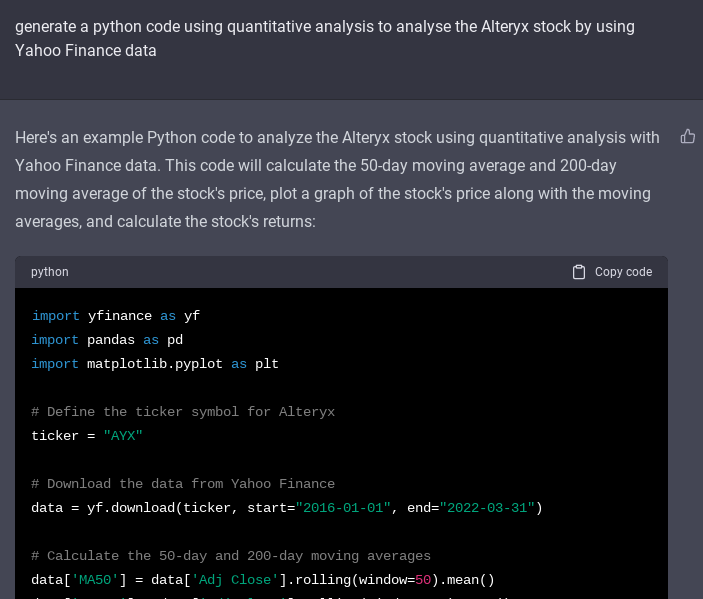
This is the full code:
import yfinance as yf
import pandas as pd
import matplotlib.pyplot as plt

# Define the ticker symbol for Alteryx
ticker = "AYX"

# Download the data from Yahoo Finance
data = yf.download(ticker, start="2016-01-01", end="2022-03-31")

# Calculate the 50-day and 200-day moving averages
data['MA50'] = data['Adj Close'].rolling(window=50).mean()
data['MA200'] = data['Adj Close'].rolling(window=200).mean()

# Plot the stock's price along with the moving averages
plt.figure(figsize=(12, 6))
plt.plot(data['Adj Close'], label=ticker)
plt.plot(data['MA50'], label='MA50')
plt.plot(data['MA200'], label='MA200')
plt.title(ticker + ' stock price')
plt.xlabel('Date')
plt.ylabel('Price')
plt.legend()

# Calculate the daily returns
data['Returns'] = data['Adj Close'].pct_change()

# Print the average daily returns and standard deviation
avg_returns = data['Returns'].mean()
std_dev = data['Returns'].std()
print("Average daily returns: {:.2%}".format(avg_returns))
print("Standard deviation of daily returns: {:.2%}".format(std_dev))
In this code, we import the yfinance library to download the data for the Alteryx stock. We specify the ticker symbol and the start and end dates for the data. We then calculate the 50-day and 200-day moving averages of the stock's price using the rolling function of the Pandas library. We plot a graph of the stock's price along with the moving averages using the matplotlib library.
Finally, we calculate the daily returns of the stock by taking the percent change of the adjusted close price from one day to the next. We then calculate the average daily returns and standard deviation of daily returns using the mean and std functions of the Pandas library and print the results.
It’s important to remember that generating forecasts of a stock’s future value involves a certain degree of uncertainty and risk. No forecast can guarantee future returns, and investors should always conduct thorough research and analysis before making investment decisions.
Conducting Sentiment Analysis
Another way to use GPT prompts is to conduct sentiment analysis. Sentiment analysis involves analyzing public opinion and other indicators to gauge how people feel about a particular company or stock. GPT prompts can analyze news articles, social media posts, and other sources to generate sentiment reports that can help investors make informed decisions.
Developing Trading Strategies
GPT prompts can also be used to develop trading strategies. By analyzing market data and other relevant factors, GPT prompts can identify patterns and generate strategies that can help investors maximize their returns. These strategies can be customized to individual investors’ risk profiles and investment goals.
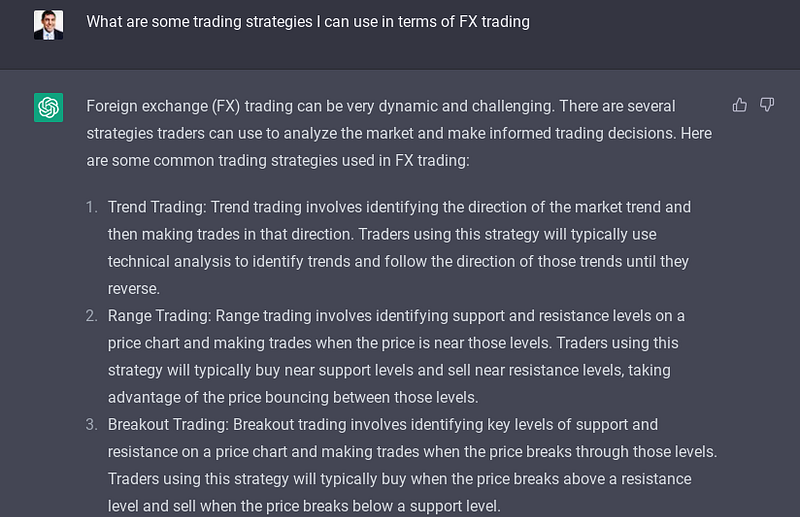
Learning about an Specific Topic — let’s say Economic Indicators
Chat GPT can be a useful tool for learning about economic indicators that are important for investing. You can learn about any other topic as well or even ask Chat GPT what are some topics to learn in terms of investing and trading?
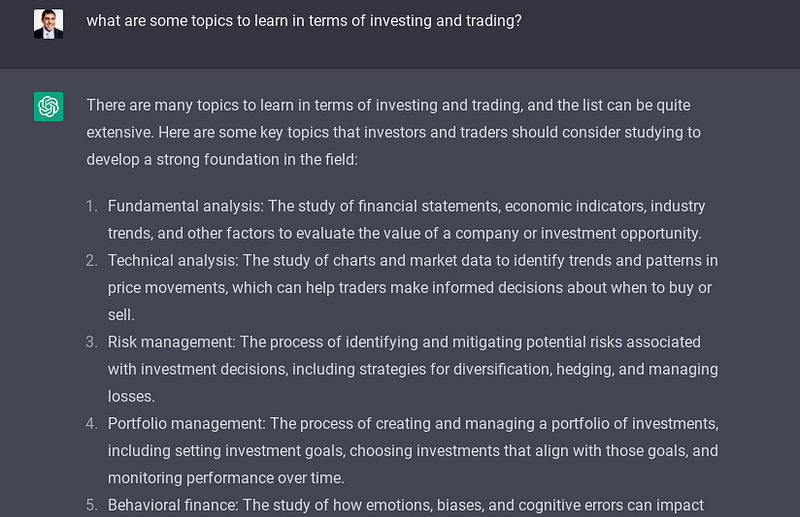
Here are a few prompts that you can use to get started in terms of Economic Indicators:
- “What are the most important economic indicators that investors should pay attention to when making investment decisions?”
- “Can you explain what GDP is and how it can impact the stock market?”
- “What is the significance of the unemployment rate for investors, and how does it affect the economy?”
- “How can inflation impact investments, and what indicators should investors monitor to track inflation?”
- “What is the significance of interest rates for investors, and how do changes in interest rates affect the economy and stock market?”
By using prompts like these, Chat GPT can provide you with an overview of economic indicators and their potential impact on investments. Keep in mind that these responses are generated by an algorithm, so it’s always a good idea to verify information with additional research and analysis. Additionally, there are many other economic indicators beyond those listed here that could be relevant to specific investment strategies or industries.
Subscribe to DDIntel Here.
Visit our website here: https://www.datadriveninvestor.com
Join our network here: https://datadriveninvestor.com/collaborate