
5 Ways to Make Grounding Work for an Overactive Mind
How I use barefoot walking to restore my mental clarity during the pandemic
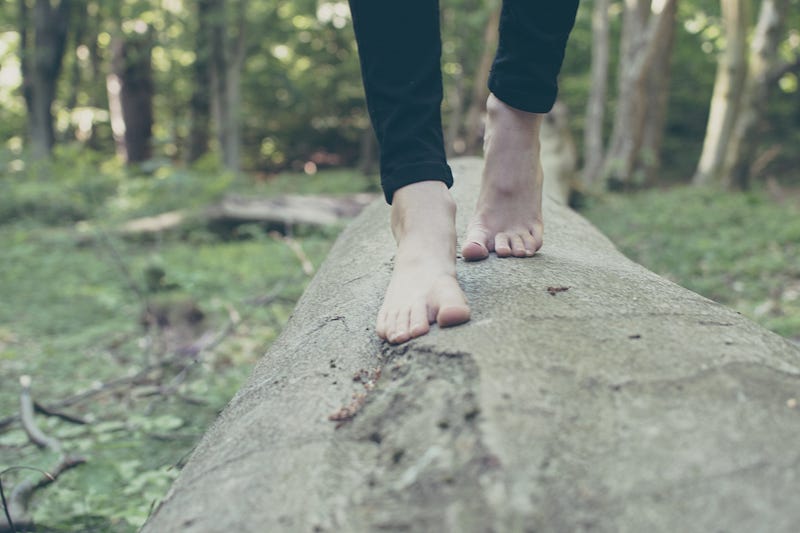
I have always been described as an overthinker. And I don’t like that adjective. It was my “trigger” word as it made me feel ostracized and misunderstood. As a counter-productive measure, those words “stop overthinking” made my mind work harder to “think”, accentuating the turns of my mental cogwheels.
With the uncertainty of the ongoing Covid-19 situation still looming over my head, those overwhelming thoughts, brain fog, and poor decision-making are slowly creeping back again.
My usual grounding practice ceases to work…
I am fortunate that I live just 3 minutes by foot to a small beach, where I can just sit by the sand or a bench, staring out into the blue sky and sea lined up with container ships. Sometimes I will walk along the shoreline. Usually, this helps to clear my mind and get my mental energy back, but lately, it has stopped working for me effectively.
Perhaps it is the blues of the ocean and skies that my mind got used to or perhaps it is too “Neptunian” as vast waters tend to evoke more illusions, dreams, and abstract mystical thoughts — great when one needs a mind holiday to de-stress, not so when an overthinker like myself needs a way to clear mental fog and overwhelm.
It was at this moment that I realized during chaos, it is akin to one’s foundations being shaken, just like how the song by Carole King aptly describes, “I feel the Earth move under my feet.”
And in such times like these, in order to clear that brain fog and an overactive mind, I knew I needed to find a way to anchor myself to a “stable base”, one that makes me feel safe, supported, and connected.
This is when I found grounding to our big planet Earth, through barefoot walking on green grass and touching trees might work.
What is grounding and its benefits?
Grounding, or earthing, is a form of therapy, where one has direct skin contact with Earth’s surface, usually using their bare feet or hands or with related grounding systems.
There’s some interesting science behind how grounding works, via how electrons are moving from Earth’s surface to our skin creating a dynamic equilibrium, which in turn enhances our natural immunity and anti-inflammation response. The electrons help to neutralize the positively-charged oxygen atoms (“free radicals”) in our body which are formed during the natural process of metabolism. In other words, grounding could be a natural (and inexpensive) source of anti-oxidants for humans.
It is an age-old practice often seen in our early ancestors of various cultures, where indigenous people dedicate their practices, ceremonies, and daily activities in nature, whether by choice by circumstance.
Though it is not yet a heavily researched area, with some shun grounding as nothing more than just a pseudo-science, some small-sized sample studies have revealed that grounding (earthing) activities have multiple benefits including better chronic stress and pain management, reduced inflammation with delayed onset muscle soreness and autoimmune diseases, improvement in cardiovascular and mental health, and even in childhood and adolescent development.
Why is mental clarity important to overthinkers like myself?
Some studies have shown that overthinking or rumination has detrimental effects on not just one’s mental health but also physical health. Although some thinking is healthy, as in the case of self-reflection, too much of it or the practice of poor mental habits can lead to depression, anxiety, and binge-eating. These can have spillover effects physiologically, mainly targeted at our nervous and hormonal systems, throwing our stress levels off-balance, resulting in other stress-related symptoms.
It may also lead to poor decision-making, decline in one’s creativity and problem-solving ability, impaired mood and energy levels due to poor sleep. These can impair our daily performance at work or in school.
Whenever I catch myself overthinking, I also noticed how I get distracted easily. I let my inner critic take over my every move, worrying about everything that, perhaps, either does not need worrying in the first place or is out of my control.
If I want certainty during uncertainty, getting mental clarity is definitely the key to success and productivity, not just simply adopting a positive mindset.
After all, one cannot climb towards success with a bag full of indecisions and what-ifs.
And how can overthinkers restore mental clarity with just barefoot walking in this current climate of social distancing?
I personally have found mindfulness-based stress reduction (MBSR) methods effective for my overactive mind. Founded by Jon Kabat-Zinn in the 70s where he is still currently teaching at Massachusetts Medical school as a professor emeritus, the evidence-based MBSR program is now widely practiced to various degrees in schools, hospitals, corporates, and sports.
Though the main tenet in MBSR is, of course, an emphasis on being mindful, there are more than just “getting mindful”. According to Kabat-Zinn, mindfulness is not a “technique” but a way of being in a relationship of being, and therefore there are different ways and degrees of how we can practice mindfulness, without being so “hard on ourselves”. There are 5 MBSR ways that work particularly well for me which I used during my current barefoot walking exercise.
1 — Focus mindfulness This is perhaps common for most of us where we place our lens or perspectives inwards to observe what’s going through our mind, like being in the character of a stage actor. We also ground ourselves throughout the practice by using an external stimulus, say our own breath, or a slow rhythmic sound like a metronome.
2 — Awareness mindfulness The lens is now shifted away from the internal towards the external world, and without as much judgment as possible, we observe the thoughts in our head, as if we are “watching a movie”.
3 — “Surfing” the thoughts This is an imaginary exercise. Basically, just like surfing, we let the waves of negative thoughts and emotions approach with its crests and fade away with its troughs. And as the “wave” ebbs, we also let the negative emotion go with it little by little, celebrating the tiniest moment when that happens. To keep things realistic, we also acknowledge that the “next” wave will come and we repeat this exercise.
4 — Walking meditation As the name implies, this is performed during walking. However, the emphasis is on feeling your 5 physical sensations of touch, smell, taste, hear and sight, as you walk.
5 — Body scan meditation Another imaginary exercise. Here we lie down comfortably and just “scan” the body from head to toe or vice versa, stop whenever we feel any discomfort in our body. Where there is tension or uneasiness, we pause and focus our breath in that area until it goes away. We can also visualize a beautiful and calm light into that area if that works for you.
Combining it altogether
I decided to listen to my body, stop fighting the mind, and let my intuition guide me. The next day, I returned to the beach and change up my scenery a little. Instead of going to the waters as I always do, I started walking barefoot along the cemented pedestrian path while searching for a nice green patch of grass.
Along the way, I would touch the bark of the trees with my bare hands, closed my eyes, and uttered the Hoʻoponopono words of “Please forgive me”, “I am sorry”, “Thank you”, “I love you”, under my breath as a way to reconcile and reconnect. With each tree, a wave of good energy flowed seemingly into my heart as if I have been touched by an angel. I found myself smiling freely a little more.
About 30-minutes into my walk, I finally found a green spot, or the spot found me? With my bare feet, I walked on the green grass. My feet felt gently pricked by some twigs, some gravel, and dry sand. I smelt the freshness of the chlorophyll-filled leaves of old and young trees in the middle of the tropical heat.
Most trees in the spot have a ring of brown compost around them, full of rich nutrients thanks to the activity of flora of microorganisms in it. It was a beautiful sight to see.
I followed the rings, walked barefoot on each circular compost, which felt soft to the skin. A nice tactile change from the pricks and twigs. A loving touch to feel.
I did this with a few trees until I got fairly tired.
With a thin squared groundsheet, I sat inside a ring with my body facing a particular tree trunk, and both my feet still in contact with the grass. I started breathing deeply yet gently with the intention of grounding my entire body and mind to the Earth through visualization. I must have been in that seated position for about 20 minutes until I sensed the heavy fog in my mind lifted, the body well-supported, and a boost to my mental energy.
I left the spot, walked home barefoot, of course.
TL;DR steps to regain mental clarity during barefoot walking
- Location (Choose somewhere that is safe and where you feel safe. Nature works best but be cautious if it’s too late at night. Exercise common sense.)
- Intent (Breathe deeply. Let your heart lead today as you begin your walk barefooted with MBSR methods.)
- Be an actor in your own story. (Focus inward, watching “yourself” in your thoughts using your breaths or a rhythmic sound to pace your walk.)
- Be a spectator. (Focus outward and watch your thoughts play like a movie. “Surf” the thoughts and watch the “waves” of thoughts ebb and flow.)
- Observe the 5 physical sensations as you walk. (They are sight, smell, hear, taste, touch.)
- Touch the trees, better yet, hug if you want to. (Be careful of fire ants and poisonous insects.)
- Recite any gratitude mantra. (I use the Hoʻoponopono words.)
- Do a body scan. (When tired, where possible, find a patch of grass and lay down, and do a body scan imaginary exercise. Repeat above again if desired.)
Hello there, Thanks for reading. I am grateful for your time. I don’t claim to know everything, but I will always strive to share every single bit of truth with thought and humility. Sometimes, humor too.