5 Ways to Avoid Being In A Career Treacle
We like to think we’ve got our careers together, right? Maybe you have, and that’s great. You’ve probably invested much time and resources into your career path.
However, many people are currently going through a ‘career treacle’.
These people have broad ideas about their career aspirations but probably need clarity around the steps to take to get from A to B, as the path has become increasingly complicated after the pandemic. It’s not because they don’t know or care; they’ve not spent enough time thinking about it.
Career Treacle
So many people tell me that they’re great at helping their company make significant decisions, but when it comes to their career decisions, they don’t put the same effort in. Why? Is it because they don’t have time? They don’t care? Or they’re afraid? I’d say a good percentage are unsure about their career after the Pandemic.
What’s going to happen to these people? They’ll experience ‘Career Treacle’. What do I mean by that? They’ll be slowed down when they must step up on the gas. How? They didn’t invest time in their careers the smart way. Instead, they worked harder, hoping their skills, knowledge, and experience would be recognised.
Quiz
Whose job is it to make your career decisions?
a) Your Boss
b) You
c) Leave it to chance
If you’ve answered a or c, I’d invite you to have a serious think. Who’s responsible for your career? You. It always has been your responsibility whether you agree or not.
Think Of Your Career Like A Jigsaw
When you start a new jigsaw, there’s great excitement in seeing all the new pieces, but jigsaw fatigue sets in after a while, especially if you’re working on the jigsaw for a long time. Why did I give you the jigsaw analogy? Many people approach their career like this, too.

People get excited about potential opportunities, but life gets in the way for many, and all good intentions get waylaid. I believe there’s a better way to avoid being stuck in a career treacle and make better career decisions
Five Ways To Make Better Career Decisions
- SWOT
- Do Your Research
- Job Crafting Your way to success.
- Networking
- Build Your Online Brand
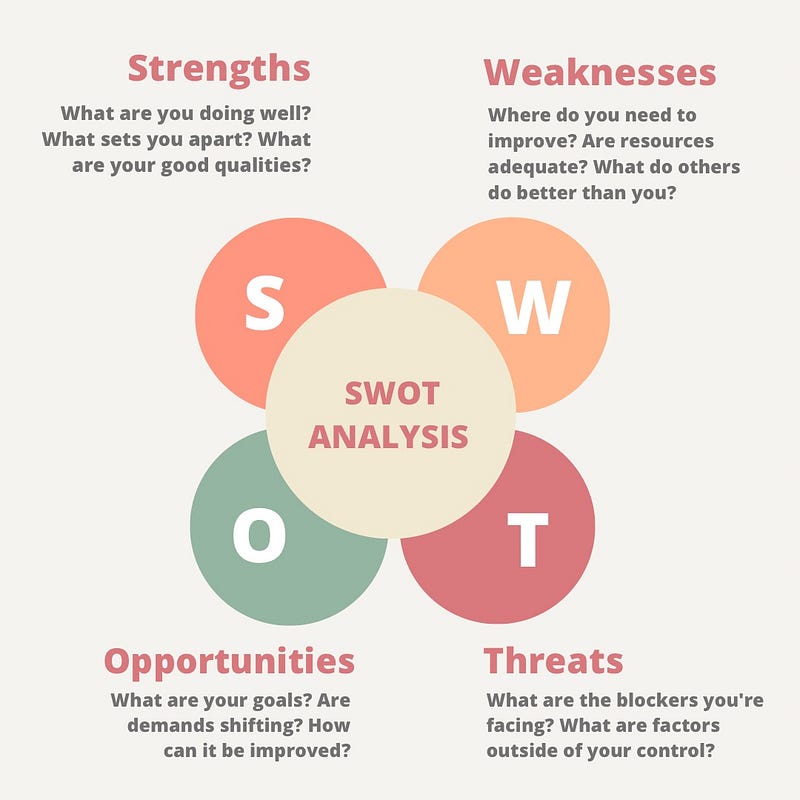
- SWOT — Do a SWOT (Strengths, Weaknesses, Opportunities and Threats)
It’s essential to do a career SWOT regularly. Why? It helps you understand what you need to be working on and when.
Call to Action
Get a piece of paper, or do it online. Draw a quadrant like the graphic below. Take each one and add items to each quadrant.
❇️Start with identifying your strengths
❇️Weakness
❇️Opportunities
❇️Threats
Then, look at your values. Understand what’s important to you when it comes to work.
Ask yourself the following questions
- What does work mean to you?
- What’s not working for you right now?
- What could be better?
- What’s your dream job?
- what’s the one step you need to take to make the necessary change?
- Who could help you?
2. Do Your Research
Research your industry. Look for emerging trends, growing sectors, and areas with a high demand for talent. Identify transferable skills and potential areas where you could apply your existing expertise.
Try the following:
- Analyse 15–20 job postings in your desired field and list the skills and qualifications they seek.
- Identify Gaps: Identify the gaps and the areas where you need improvement or new learning.
- Check the market and Know your worth, especially if you’ve been clocking up the years
- Call a headhunter if unsure and find out what the market is doing
Do you know what’s going on in your industry?
3. Job craft your way to your next best stretch.
The grass isn’t necessarily greener elsewhere. You may find that watering your patch may lead to better and bigger opportunities.
Do you have a passion project? Take a leaf from Google’s book and spend 20% of your time on innovation.
You don’t need to be working on Google-type projects; it could be something you’re very passionate about.
What happens if the Boss says no to your passion project? If your Boss won’t let you do it on your own time.
4. Network
Networking is one of these activities that many want to do, but it ends up being on the sidelines for maybe tomorrow. I hear a lot, ‘I know I should, but…..’
Networking becomes fun if you do it regularly versus ‘doing two hours networking’ one afternoon.
You’d be surprised how powerful your network can be. In today’s world, it pays to build bridges with different people. Why? It’s not because you want something from them, but it’s worth remembering that people buy people based on trust.
Instead, tear the rule book up, start building relationships online, and continue developing offline relationships. Building and maintaining relationships is an essential skill that AI cannot replace. How? Humans can empathise, understand nuances, and make connections that AI cannot replicate.
5. Build Your Online Brand
People buy people based on trust. An online presence, especially on LinkedIn, will enhance your brand and help you build trust with an audience who doesn’t know you.
Be Proud Of Your Online Brand. You don’t need to be an influencer or showbiz icon to think about your online presence. Anyone and everyone who has access to the internet can build a personal or professional brand. I believe it’s a great way to document your journey, especially if you’re aspiring for more visibility.
However, creating your online brand doesn’t happen by magic. Instead, you have to do your bit to craft your legacy because no one has a vested interest in your career than you. It is easy to get complacent, but in today’s world, you can be anything except complacent.
Imagine The Following
Alex worked in a Fortune 500 Big Bulge Bracket Bank in Canary Wharf. He was an ambitious professional but found himself in a career treacle. Despite his prestigious position as a ‘mover and shaker’, a sense of stagnation had set in, which was reflective of what many faced in the post-pandemic era.
Determined to break free, Alex decided enough was enough. He had lengthy discussions about career options with his Boss, but the MD had other priorities, which included meeting Q1 2024 targets. Alex felt he needed to engage in self-reflection and strategic planning, recognising the need to piece together the jigsaw of his career with the same zeal with which he once approached new projects.
The turning point for Alex came with a comprehensive SWOT analysis, carefully identifying strengths, weaknesses, opportunities, and threats. This exercise helped him understand himself better. He caught himself saying, “I do this for clients all the time. Why haven’t I done this for myself”?
Alex undertook deep industry research and approached the process as if he were doing it for a client. He outlined a strategic mapping of his skills with the changing market demands. It wasn’t just about understanding where he stood but about charting a course towards where he aspired to be, combining ambition with a workable action plan.
Alex then decided to apply some job crafting to his existing role. He arranged a meeting with his Boss later that afternoon. He wanted to take on a new project that would allow him to showcase his leadership, innovative capabilities, and the value he brought to the team.
The project would allow him to network with internal and external stakeholders. He now saw the power of networking. Instead of seeing networking as a chore, he considered it a vital tool for growth, building meaningful connections that extended far beyond the professional level.
Alex very rarely paid attention to his online presence. He had a Facebook account and a LinkedIn profile. He seldom used either. He read Pervin Shaikh’s article on LinkedIn and Building Your Online Presence. He started using it to showcase his industry knowledge, thus establishing himself as a thought leader.
With a bit of effort and adopting a can-do attitude, Alex transformed his mindset, which helped him get out of a career treacle that would hamper his long-term career progress.
Parting Comments
Yesterday’s mindset is already obsolete for tomorrow’s world. What does this mean? What you learned yesterday won’t be enough to deal with the challenges of tomorrow. What’s even more surprising is how quickly this lack of positioning creeps up on you, too. How? It’s easy to leave learning off for ‘Maybe Tomorrow’, but there’s a significant danger: you end up playing the never-ending catch-up game.
When you jump into the driving seat of your career, you’ll feel more confident in dealing with career uncertainties. When you are proactive in learning and seeking new skills, you’ll learn as you go along on the playing field instead of watching from the sidelines. The playing field is where the action is.
Thank you for your attention.
Follow me for more valuable tips.
Pervin
linktr.ee/AimHighLtd


