

5 ways Scrum Masters can help make Scrum Values part of a team’s culture
Scrum masters are in a unique position to influence the culture of an organisation or a team. Organisational culture can be liberally seasoned with the scrum values, and this post suggests a few ways that scrum masters can make that happen.
Ed Schein’s model of organisational culture is a layered visualisation. When we first interact with a team at the outermost layer, all we can understand are physical artefacts and symbols. For example, if you walk around an office, you might see groups of people having odd meetings every morning where they stand up, face each other, and point at a whiteboard. Hmm.
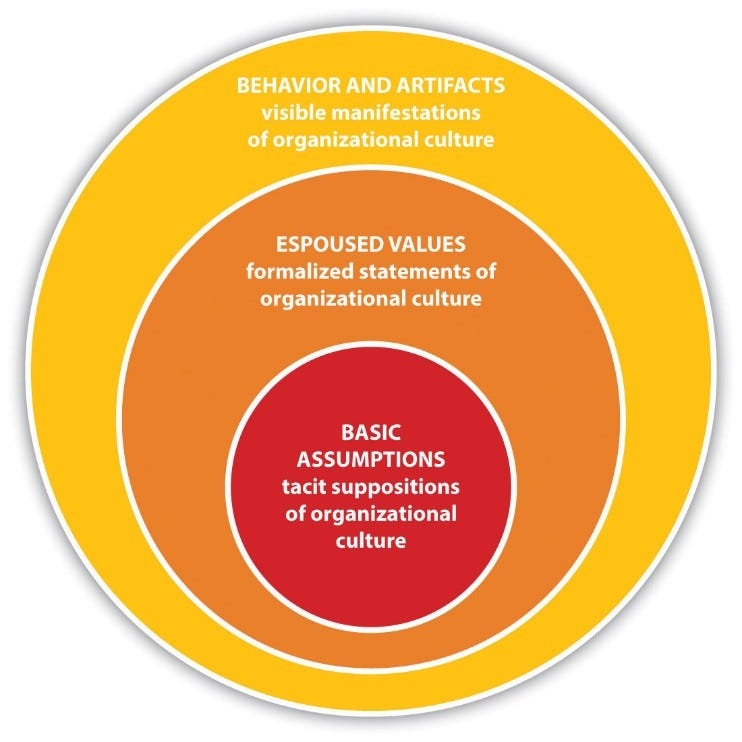
If you poke around a little bit, and ask a few questions about what’s going on, you’ll hopefully learn a little more about the next layer in, the organisation’s ‘espoused values’. In other words, what is important around here? Which behaviours are rewarded, and which are discouraged?
In order to understand the values demonstrated by a team, it is helpful for a scrum master to ask silly questions that start with ‘why’, such as ‘why does our team have that stand-up every morning?’ for example. The answers to these ‘why’ questions can help us to understand what teams and organisations value.
If we continue to probe, and ask why, we are on track to gain a deeper understanding of how an organisation or team really works, we will learn more about the underlying assumptions that are present. These assumptions drive people’s beliefs about what behaviours are important.
Sometimes these assumptions are tacit, and difficult for people to even be aware of, let alone verbalise. To make these assumptions more visible and transparent could require many conversations. Techniques such as ‘the five whys’ might get a scrum master to the core of an assumption in play, but that technique might also rub some people up the wrong way too!
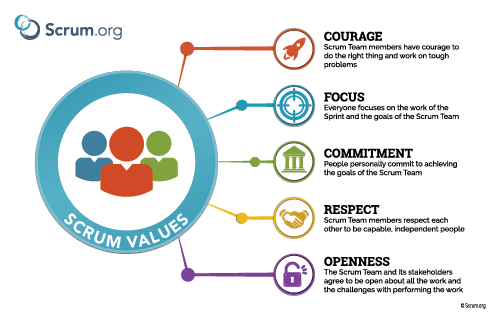
How does this knowledge of culture help a scrum master? Well, thankfully, the scrum guide provides an interesting point of intersection with the culture of a team: the 5 scrum values of focus, courage, commitment, respect and openness.
It is a key part of a scrum master’s role to find ways to propagate these values in teams, across teams, and in organisations. In this way, a scrum master can use tools and techniques to gradually and intentionally align an organisational culture more with these values.
Doesn’t that sound great? I’m like, totally pumped to be a scrum master, charged with such an important mission! So… I just have one question… how do I do that? :)
0. Pre-requisite: get support from the top
First question: do you have support at the top of the organisation for adoption of scrum and agile approaches? Without this, your mission as a scrum practitioner is going to be very difficult. If the C-Level is bought in to understanding what is required for scrum to succeed, then conversations can happen about that. Without that openness and commitment from the top, it is very difficult for scrum masters to stimulate it at lower levels.
Here’s another thing to watch for: if there is a clash between the espoused values of a CEO or Executive group, and their behaviours, then that can make it very difficult for an organisational culture to stick. For example, if the CEO says ‘we are an agile organisation now’, then there must be a corresponding openness to understand what that really means. Demanding 12-month project plans with GANTT charts after making this kind of declaration… that can ring hollow! Scrum masters will need the courage to find the opportunities to have conversations about this if it is happening.
1. Create psychological safety
Amy Edmondson describes psychological safety as ‘a shared belief held by members of a team that the team is safe for interpersonal risk-taking’, and a recent piece of research in Google has indicated that psychological safety is critical in order to make teams work.
Scrum can help with the creation of psychological safety, by using retrospectives to tease out ideas for improving. The scrum master needs to ensure that these ideas gain traction, for if they fall by the wayside, the team will lose trust.
In addition, the scrum master needs to interact with the team and the product owner to ensure there is capacity in the sprint backlog for spikes and investigations. This helps to create an environment where experimentation is acceptable, and failed experiments are tolerated.
2. Be wrong
A scrum master is a servant leader, and part of that paradoxically inverted leadership role is permission to make and acknowledge your own mistakes too. Lead by example. Be confident when you are wrong. Use it as an opportunity to learn. Vulnerability is strength!
For example, in a retrospective, openness and courage can be enhanced by simply holding your hands up when you make a mistake. Ask the team if the failed experiment taught us anything, and ask if they want to try another. At the subsequent retro, we can examine the results once again. This is really at the core of transparency, inspection and adaptation.
3. Protect against the desire to do too much
Scrum can help a team to focus on finishing, and take on smaller batches in order to move forward one step at a time. However this requires understanding from the whole product delivery team, and the scrum master will have many challenging conversations with product owners in order to make that happen more often. These conversations can be difficult, but they have to happen if the team is to focus.
Naturally, removing impediments can help here too!
4. Have those difficult conversations
Build respect with your colleagues by consistently and openly sharing your expectations, and by delivering on your own commitments. These basic behaviours will lay foundations for any scrum master if difficult conversations are needed.
5. Keep on keeping on
As scrum masters, we lead by example, not by rank. This is part of humble leadership, and servant leadership. By remaining committed to delivery, but also to the fact that scrum can facilitate and expedite successful delivery, your commitment will spread. If you are consistent in your behaviour, and your espoused values match your behaviours, you will influence the level of commitment in your team.
So to recap, Ed Schein’s model of organisational culture intersects with the scrum values. Scrum masters are in a unique position to influence the adoption of these values, and change the culture of an organisation. There are practical ways to make this happen, but it won’t happen overnight! Also, it requires top-down support. There are many ways for a scrum master to make the scrum values part of an organisation’s culture, and this is not an exhaustive list! What others would you suggest? I’d be very interested to hear!
But scrum masters, know this: you are making a difference! Please have the courage to keep on keeping on!
