
5 Ways Fiction Can Be Better Than Self-Help
Sometimes it’s a richer source of wisdom.
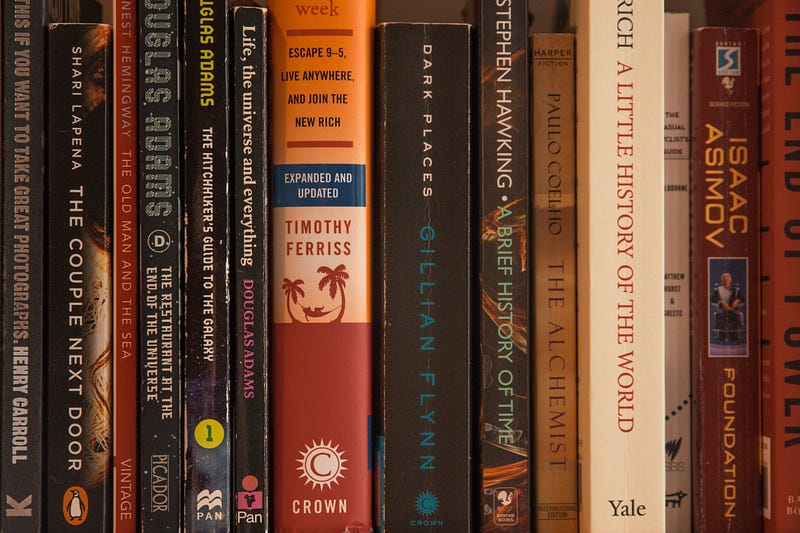
As an avid reader, I devour at least 2–3 books per week. One year has 52 weeks, so if you multiply that number, it equals to around 100–150 books a year. At least 80% of those are self-help books.
I’ll be honest with you: At this point, I’m sick of self-help books.
Some of you might think that reading all those books must have made one smarter and wiser, and maybe it’s true, to some degree.
But here’s the catch: Almost all self-help books talk about the exact same thing.
Turns out, reading 100 books doesn’t mean you’ll gain 100 pieces of new knowledge — it means you’ll learn one idea 100 times over, or two ideas 50 times over. Or another combination of numbers. You get the point.
Furthermore, if you think about it, today’s self-help authors are just repeating what past thinkers and philosophers have said before. As a philosophy geek, this realization is blindingly clear to me.
You can see it for yourself. Compare the writings of Simon Sinek, Malcolm Gladwell, Mark Manson, and other modern authors to philosophers like Aristotle, Marcus Aurelius, Kierkegaard, Nietzsche, etc. They more or less express the same ideas, just in different retellings.
I guess that’s why people tell us to learn from history. Us humans, at least when viewed on a grander scale, we never change. We always have the same old problems with the same old solution.
Now, I prefer to ditch self-help and return to my childhood pastime: Reading fiction. Novels, short stories, even comics. Other than entertaining, works of fiction can also be informative and educational. Sometimes even paradigm-shifting, or straight away life-changing.
Here are some ways fiction can be better teachers than self-help, summarized in five simple words:
- Freedom
- Empathy
- Insight
- Imagination
- Synthesis
Let’s dissect them one by one.
Freedom
This is the first and foremost advantage fiction books have over self-help.
The thing I dislike the most about self-help books is that they preach. They tell you what’s right. What to believe, and what to do.
Usually, the authors try to find our pain points, then use cautionary tales and subtle fear-mongering to tell us “If you don’t do what I say, bad things will happen.”
And, annoyingly, it works. It is scientifically proven that pain is a greater motivational force than pleasure. That’s why this technique is highly common in marketing and advertising strategies.
Fiction, instead, doesn’t tell you to do anything — it just tells stories.
We are free to interpret those stories. To take the parts that resonate with us and discard the rest. To absorb whatever we make of it, and translate the lessons into our own lives.
Empathy
The world of fiction books is comprised of myriad characters. The hero, the companion, the mentor, the villain — these characters mirror ourselves, and our relationships in real life.
Usually, in self-help books, the narrative is one-sided: It’s the author’s voice telling you his thoughts.
In fiction, however, the narrative is weaved around the characters, whether it’s in first-person or third-person perspective.
Thus, we comprehend the story from the words and acts of these characters. We try to understand how they see the world, why they do what they do, what reasons are driving them to live. We learn to empathize with them.
This nurtures our empathy. By learning to empathize with these fictional characters, we’ll also learn to empathize better with our friends and families in reality.
Sounds far-fetched? Maybe. But, at least for me, it’s true.
Insight
The world is full of valuable lessons, even in places that we don’t expect.
That includes fiction. Before, I’ve written a piece about how you can learn from anywhere if you empty (and adjust) your cup.
In self-help books, the lessons are structured. They tell you what (they think) you need to know, straight to the point.
In fiction, it’s not so easy — and as they say, nothing worth having comes easy. You’ll need to pay attention to the scenes, the dialogues, the nitty-gritty details. Somewhere in there, a life-changing lesson lies in wait.
There are always facts even within fiction. No matter how imaginative or absurd the story is, some part of it must parallel reality.
In some cases, this parallel can be really minuscule, almost unnoticeable — and it’s up to you to notice it. It’s up to you, to find the hidden gems smack-dab among the chaotic tapestry.
Once you get used to doing this, you’ll be able to gain insightful wisdom from anywhere.
Imagination
Among all the other points, I believe you’ll find this one the most obvious.
Fiction is born of imagination, and in turn, it fosters imagination.
Self-help is normally born of experience or research. It’s a summary of lessons from the author’s personal life, or from his work. Don’t get me wrong, these things are absolutely important. But they’re not everything.
You already know why, don’t you?
Experience represents what we already understand.
Research represents what we do to attain understanding.
Imagination, however, represents how we make sense of what we don’t understand.
Each has its own use. And none should stand by itself.
To this end, fiction provides you a fun and thought-provoking method to cultivate your imagination.
Synthesis
Here’s the last one, and the one that convenes all the others.
Unlike self-help books, which aim to fill your mind with pre-cooked knowledge, fiction provides you with raw ingredients. You can pick which ones cater the best to your tastes and dietary quirks.
As we have discussed, fiction can be a rich source of valuable lessons, but it takes a keen eye and an inquisitive mind — which gives one the ability to notice the subtle, then to expand, mix, and develop those subtle points into a full-grown amalgam.
In most instances, the lessons within fiction books will be scattered all over the place, in tiny bits and pieces.
Therefore, the most important skill which you need in — and will gain through — reading fiction is the ability to connect the dots. To pick up the puzzle pieces and match them to form a whole picture.
Fiction doesn’t spoon-feed you with knowledge. It sprinkles the knowledge in front of you, and encourage you to synthesize your own learning.
One Last Note: Choose Good Books
While I said that I’m sick of self-help books, I have to admit that they also have their merit. A lot of self-help books are trash, but some can truly be intellectual goldmines.
Likewise, not all fiction books are amazing. Some of them are not worth reading at all. To truly experience the points we’ve discussed above, first, you need to choose good books.
Don’t worry, though. It’s so easy nowadays. You can find reviews on Amazon, Goodreads, or other similar sites.
And of course, it’s always better to ask for firsthand accounts from a friend. You can even ask me if you want to.
Happy fiction reading!


