
ARTIFICIAL INTELLIGENCE & EMOTIONAL INTELLIGENCE
5 Ways AI Can Allow Us To Be *More* Human
Can this communications tool make us better people?

How quaint to look back to the early days of developments like the fax machine, email, and smart phones. People sincerely thought, “We’ll finish our work more quickly and have more free time!” Instead, the ability to send a message instantaneously meant we’d come to expect instantaneous responses. We now have work in our purse or pocket or on the nightstand 24/7. In a world where we can connect from anywhere, we often do — and instead of more free time, we can work all of the time.
So you’ll forgive my initial skepticism of artificial intelligence (AI) as a new tool, particularly for communications, to improve our lives. Ok, so we can write language for websites, social media, press releases, and presentations in one-fourth of the time we used to need… what’s to stop us from writing four times as much language? Sure, we can generate an email in one-tenth of the time… will our teams expect us to write ten times as many emails? And that’s not to mention the environmental impact of searches, the bias baked into open source models, and the need for industry standards, including usage disclosures (though kudos to the Pulitzer Center for its AI Accountability Network).
Yet, amidst those valid and pressing concerns, I began to see rays of hope during the Communications Network (or ComNet) conference last week. In session after session, a theme emerged:
- What’s the best way to connect with a journalist to amplify news about your organization’s work? Develop a real relationship.
- Do you want to thoughtfully, respectfully, and ethically share the story of someone impacted by an event or policy that needs to be changed? Develop a real relationship.
- Need to onboard a new team member in a way that equips them to be effective and ensures they feel supported? Develop a real relationship.
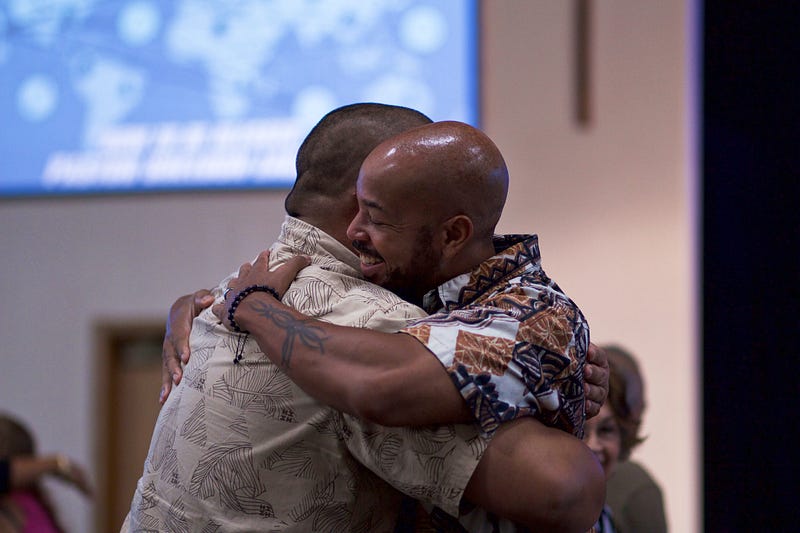
In short, human relationships are essential to doing our jobs well, and the emotional intelligence of developing a real, personal, human bond is one thing artificial intelligence will never replace. Yes, we can use technology to remind us when to email people and help us craft compelling, grammatically correct messages when we do, but we humans are the hearts and brains behind the curtain who must have the courage to connect with other humans — be they journalists, communities impacted by issues we seek to address, voters, or policymakers, to name a few. These are relationships we must build if we are to create a just, equitable, and peaceful shared future.
There is no question that, like the fax machine, email, and smart phones, AI is going to transform our workdays. But with my recent shift in perspective, I realized AI gives us another opportunity to make a tech-powered transformation a humane one. With AI, we can skip over a rough drafts and spend more time ensuring a quality final product that better incorporates what we know of the people who need to read it — or whose stories are reflected in it. Because here’s the thing any experienced communications professional will tell you:
The world does not need to be inundated by more content.
What the world *does* need is more QUALITY content.
And what people need to create quality content is quality time with other people — both professionally and personally. The connections between real people in a way that only real people can have are the heart of effective communication. Need an example of a real human connection? Here’s one of hundreds you’ll find from Story Corps, whose team captivated an entire room at the conference last week:
Reflecting on recent conversations, including a discussion led by Aimee Rinehart of the Associated Press and Mikhael Simmonds, Executive Director at the Center for Community Media at CUNY, I now see at least five ways teams can use AI to be more human:
1) IMPROVE ONBOARDING — Too many offices still take a sink-or-swim approach; they throw new hires into the deep end to “learn on the job” and “figure it out.” Now, regardless of the size of your team and HR department, AI can help develop solid onboarding materials and allow more time to talk with new team members on a regular basis to answer questions and get to know each other along the way.
2) DEVELOP AN LLM — Think of a Large Language Model (LLM) as a ChatGPT personalized to your organization; rather than pulling from the entire internet (the good, the bad, and the ugly), an LLM learns only what your organization wants it to learn. From a communications perspective, it can be a Style Guide with “only the good stuff” that ensures your team can find what they need and your final products consistently use your organizational voice. The time your communications team would have otherwise needed to finalize materials (ever timed how long it takes to add Oxford commas throughout an 80-page report?) can be used on more creative endeavors.

3) SPEND MORE TIME WITH COMMUNITIES WHOSE VOICES YOU ARE AMPLIFYING. There are myriad reasons organizations need to share deeply personal stories. For example, as a human rights lawyer, I helped prepare victims of torture to testify in court. In communications roles, we may share stories of people who have survived violence, lost everything in a hurricane, are experiencing homelessness, or other traumatic situations.
To share such stories is to take on serious responsibilities. Do your homework to fully understand those responsibilities before undertaking them. For a sense of where to start, listen to this podcast with Tara Todras-Whitehill and see these five questions I drafted in the prior iteration of my nonprofit. (Also, remember you can “give people a platform” or “help them find their voice,” but you are never “giving someone a voice.”)
AI can help your team better understand the communities with whom you are working, develop a thoughtful, respectful, and ethical approach, and allow you more time to truly get to know the people entrusting you with their stories.
4) SPEND LESS TIME DEVELOPING MEDIA LISTS AND MORE TIME GETTING TO KNOW EVERYONE ON THEM. The media landscape has changed dramatically over the past several years. Journalists cover a wider array of topics from a shrinking number of newsrooms. Well-intentioned communications professionals may try to convince someone — anyone! — to cover a topic by sending a greater quantity of generic emails, but that’s precisely the wrong approach. Effective pitches begin by identifying the right person (perhaps they work for one of the 425+ independent news organizations associated with the Institute for Nonprofit News?), getting to know them, and framing the issue you want to share as a compelling story. AI can help with that research and crafting so you can be as helpful as possible, both to the journalists you contact and to your cause.

5) ENJOY MORE FREE TIME. Earlier technology gave us a chance to shorten our work days — and we failed. As we shorten the time it takes to generate content, AI could be a second chance. I’ve noted above several areas where additional time can support building professional relationships, but perhaps there could be space for personal relationships as well? While some still scoff at the idea of a four-day work week, perhaps that’s an idea whose time has come?
Personally, I’ll continue to eschew AI for my writing here on Medium. Call it the equivalent of black-and-white instead of technicolor, but I prefer the mental journey of staring down a blank page and cobbling together a post “brick by brick” in my personal writing. For professional projects, I’m open to letting technology get me started if it means opening up more time for the things only we marvelous humans can do.
I said it before but it bears repeating: The world does not need to be inundated by more content. But we do need more quality content… and we do need each other.
WHAT DO YOU THINK? This is my first foray into the possibilities of AI and I’d love to start a conversation. I know others, including communications pros, have been thinking about and experimenting with various platforms for quite some time. What do you think of using AI to create more space for human relationships? What did I miss here? Let me know!
Through Stories Change Power workshops and trainings, I share my passion for advocacy, storytelling, and bridging divides. To ensure your mission-driven organization is making the most of its time, talent, and opportunities to reach hearts and minds, let’s connect.
Quick note: I do not use AI at any stage of my writing (even in this piece about AI). For better or worse, everything you read in my posts is 100% me-generated.


