
5 Valuable Lessons from Phil Knight’s Shoe Dog
4. Fail Fast
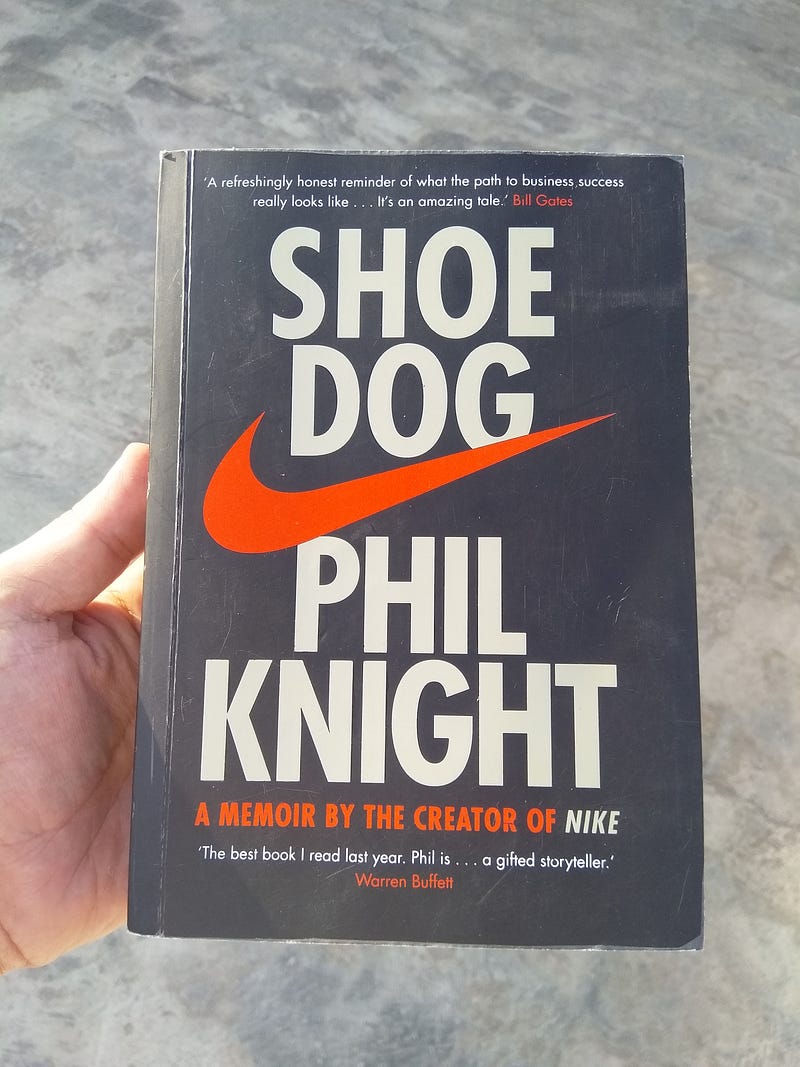
A couple of months ago, I bought Phil Knight’s Shoe Dog from a roadside stall and the main attraction for me to buy this book was that infamous Nike ‘swoosh’ on the cover. For those who don’t know me, I’m a huge Nike fan and anything with a Nike ‘swoosh’ on it doesn’t fail to allure me. So, I bought the book with the hope of reading it one day.
Luckily, that day happened to be the very next day. I had a lot of free time on my hands and the book also ‘appeared’ to be worth-reading so, I started reading it right away.
However, there was a minute problem.
Back in those days, I had this bad habit of leaving books just after reading a couple of pages/chapters, without ever finishing them. In other words, I wasn’t a passionate reader. For instance, before starting Shoe Dog, I already had about 20 books, sitting on the shelf, unread. I had no problem in terms of starting a book, but after a few of pages/chapters, I used to bog down, leaving the book unread.
Fortunately, it was a completely different story this time. As I started reading the book, I got hooked. And within a week, I finished it. I know, there a lot of people, who could’ve finished it in a day but given my poor track record with books, it was a kind of achievement.
Moreover, I enjoyed the book to such an extent that I thought of writing a review. However, I didn’t get the chance to write it. I, being a professional procrastinator, thought of delaying it and all of a sudden, six months had passed and I hadn’t written the review. Until yesterday!
So, what was so special about Phil Knight’s Shoe Dog that I couldn’t discard it like all these books and also ended up writing a review of the book?
First off, Shoe Dog is not like all these autobiographies. Don’t get me wrong, there are a number of great autobiographies such as Alex Haley’s Malcolm X, Walter Isaacson’s Steve Jobs to name a few but most of the autobiographies lack certain elements of story-telling to engage the reader.
Also, most of the autobiographies are written by successful people, be it sports moguls, entrepreneurs, showbiz figures or whatnot, and most of them center their autobiographies on one common theme; a success/struggle story.
Although Shoe Dog isn’t an exception, yet it’s quite different from most of the autobiographies. Phil Knight’s style of story-telling is candid, unfiltered and gutsy, making Shoe Dog an engaging and worth-reading piece of literature. Phil has told his story by making all the accounts in the most systematic way, remembering all those who contributed to his success and then by leaving the readers with something to ponder on.
It’s not a review of Shoe Dog though. Rather, this piece is centered on five key takeaways, five valuable and worth-sharing lessons, which I learned from this book.
1. Surround yourself with a right group of people and value your team
Throughout the book, Phil kept mentioning his friends, his coaches, his team members, his coworkers, his family and everyone else, who contributed to his success. Be it his coach and co-founder of Nike, Bill Bowerman, company’s (Blue Ribbon at that time) first full-time employee, Jeff Johnson, or one of his early hires at Nike, Bob Woodell, Shoe Dog is loaded with the accounts/stories of Phil’s faithful friends and colleagues.
Interestingly, Phil made this great effort to tell readers his story, not only from his perspective but also from the standpoint of his co-worker, friends and family.
Phil, being eloquent about the efforts and commitment of his team, made it clear to the reader that all the success, which Nike brand has achieved in the last five decades, was not only an individual’s work. Rather, it was a team that really made it the brand, which we all know and love today.
So, what does it tell? Irrespective of how talented or passionate you’re, without a great supporting cast, you can’t achieve success. You need a team, a team of like-minded, growth-loving people, who can join you in all these ventures and can bail you out, when you make mistakes.
2. Ideas are cheap, Execution is all that matters
I can’t stress it enough that ideas are nothing, if one fails to execute them. From having this idea to start importing running shoes from Japan to establish/start a company of his own to make track shoes, Phil never lacked execution. He never hesitated. Instead, he listened to his instincts and took risks.
Because at the end of the days, ideas do matter but their execution is something which makes these ideas worth-telling.
I mean, we wouldn’t be telling the success stories of the Nike, if Phil only had the idea of importing track shoes but hadn’t executed it. What if Phil didn’t take the risk to start his company by compromising his relation with Onitsuka?
Bottom line is, your ideas can be great, but unless you show some action and take necessary steps, success will keep you at bay.
3. Be patient, it takes time
Phil started working on his ‘crazy’ idea in 1962 and it wasn’t before the late 1970s that his ‘crazy’ idea turned into a massive success, ascending his net worth to $178 million at the end of 1980.
It wasn’t an overnight success. It took Nike and Phil almost two decades of persistence struggle, coupled with a number of set backs and failures, to have a multi-million dollar company, eclipsing all its rivals.
Phil’s path to success wasn’t a smooth one either. He and his group of loyal friends and workers had to make a lot of sacrifices along the way. But they remained steadfast. They didn’t know exactly where they headed or what they were trying to accomplish but they kept their footing.
The cowards never started and the weak died along the way — that leaves us!
So, irrespective of whatever your goals are, be patient. Work for them but remember, it usually takes time.
4. Fail Fast
When I first read this phrase, ‘Fail Fast’, I couldn’t get the true essence of it but then Phil explains it in the most comprehensible manner.
“But my hope was that when I failed, if I failed, I’d fail quickly, so I’d have enough time, enough years, to implement all the hard-won lessons. I wasn’t much for setting goals, but this goal kept flashing through my mind every day, until it became my internal chant: Fail fast.”
Phil was very clear that failure doesn’t hurt. It’s the timing that does. So, there is no shame in failing but make sure that you fail fast.
Thus, it is quite imperative to try things and take risks at the right time. Because, even if you fail, you’ll have a lot of time to recover and try new things.
5. Seek a calling
Nike started as this ‘crazy idea’ before it turned into this multi-billion dollars brand and a lot of this is based on Phil’s calling and his passion.
As Phil explained in the book, he shared this ‘crazy idea’ with his father and borrowed $50 from him to start this whole thing. He didn’t have a plan but he had a ‘calling’. He was passionate about shoes and so his coach and his friends, who decided to accompany him on his extra-ordinary yet risk-laden journey.
Phil, Bowerman, Jeff, Woodell, everyone was passionate about making shoes and selling them. They had this ‘calling’ and they worked hard enough for to make their company one of the most renowned and valuable brand.
“I’d tell men and women in their mid-twenties not to settle for a job or a profession or even a career. Seek a calling. Even if you don’t know what that means, seek it. If you’re following your calling, the fatigue will be easier to bear, the disappointments will be fuel, the highs will be like nothing you’ve ever felt.”
So, before you do anything, seek your calling. Look for your passion and then invest yourself accordingly.
To conclude, if I have to summarize the whole book in a few lines then it will be something like,
Don’t discard your crazy ideas, believe in them and nourish them. Don’t feel shy about your schemes, be confident about them.
Don’t hesitate, take risks. You might fail, but make sure that you fail fast.
Have faith and don’t lose hope. Don’t settle, keep moving. And remember, hard work, persistence and true commitment provide the best pathway for success.


