
5 Unsuspecting Ways To Be A Miserable Person & Stay There
Most People Never Really Grow Up

“One of the saddest things in life is to get to the end and look back in regret, knowing that you could have been, done, and had so much more.”
-Robin Sharma
Since I can remember, I’ve always observed people — especially their faces and tone of voice. From what I can tell, most people are miserable.
I know I personally was for a long time.
I lived a life in fear of what people thought of me. Because of this fear, I always walked around on eggshells trying my best not to piss anyone off. What this did was hold me back from reaching my full potential and living a life with many regrets.
We live in the most blessed country in the world, and we are still miserable as hell.
Why is this?
You’d think that everyone’s puppy just died or something.
Below are 5 reasons why most people stay miserable and what you can do instead to live your life with no regrets.
We Love Playing Hide & Seek
Do you remember that game from when you were a child where one person would close their eyes and count, and the other person would hide? Then the kid counting would have to try and find the one hiding.
Hide & seek was my favorite game to play as a kid. I spent most of my life still playing that game and never really grew up because of it.
When I was growing up, I was taught by the movies that I watched, the kids at school, and to some degree, even my dad, that it was not cool to show your feelings. You must hide them. It was even worse because I was a boy.
I have lived most of my life stuffing my feelings, and I have a tough time expressing my feelings because of it. Hell, even knowing what I’m feeling is complicated. I struggle with emotional intelligence, which is more important than IQ.
Unfortunately, this hiding stunts our growth, and the only way to grow is to be ourselves. To be vulnerable.
John Kim (a.k.a. The Angry Therapist), a licensed therapist turned life coach, said,
“Everything starts with your truth. Nothing can be built without it.”
Try This
Ask yourself, “Am I being vulnerable? Am I showing myself?” In all relationships. Be honest with yourself, and if you’re like me, and spent your entire life hiding, then read Daring Greatly: How the Courage to Be Vulnerable Transforms the Way We Live, Love, Parent, and Lead, by Brené Brown, Ph.D.
This book changed my thinking on what it means to be a husband, father, and leader. It helped me realize that I was shamed by others and even myself most of my life. I had the mindset that I was not enough. This book helped me realize that it is okay and healthy to be vulnerable and allow others to see my mistakes.
We Don’t Ever Get Off the Gripe Water
If you have children, then you are probably familiar with Gripe Water. It’s a liquid that you give to your infant that helps with gas to get them to stop whining.
I work with a guy who is constantly complaining about something. He’s so damn negative. It could be a perfect day where everything seems to go right, and he would still find something to complain about.
Unfortunately, he is not the only person that whines about everything. The world is full of adult whiners.
Are you that person in the room?
To stop being a whiner, you must take responsibility for your own happiness. No one is going to do it for you.
Try This
Ask yourself if you are a whiner, and then narrow down what aspects of your life you are the most whiney in. Once you narrow it down, you can begin to change yourself and your life in those areas.
You could start by spending your first 5 — 10 minutes in the morning meditating on what you are thankful for. Write these down as bullet points in your journal. This will remind you of all the things you are blessed with and how you have so much to be happy about. No matter where you are, there is always someone who has it worse.
Another suggestion is to list the areas that you want to work on and write out some affirmations in that area to read every morning.
We Dwell In A Place We Have No Business Being
When I went through my divorce in 2013, one of the first things I did was get the hell out of town. Unfortunately, it was my hometown, and I was very comfortable there.
Moving to a new city was one of the best things I did.
You have no business dwelling on your past mistakes and can’t move forward and become the person you are destined to become until you stop. Get the hell out of town!
Most people make the mistake of dwelling on past mistakes, past relationships and live a life in misery and regret.
I know I sure did.
It took me a while of journaling and digging before I realized that one of the reasons that I was so miserable was because I unconsciously was beating myself up for not finishing college.
I also spent a lot of time focusing on the wrong thing, what I didn’t want for my life rather than what I did. I was stuck in the past.
Try This
I used the 5-Step process that Dr. Caroline Leaf teaches in her book, Switch On Your Brain: The Key to Peak Happiness, Thinking, and Health. Dr. Leaf calls it her 21-Day Brain Detox Program, which kickstarted my journey to healing and transformation. I would not be writing this if it were not for this program.
5-Step Brain Detox
To do the exercise, dedicate the next 21-days to wake up an hour earlier so that you have quiet time in the morning for examining your thoughts, journal, and go through the following 5-steps.
Step 1: Gather
Your main objective during the gather stage is to get used to picking up information entering your mind. In this step, you sit still and examine the thoughts that are entering your mind from your environment. As time goes on, you will start to select what thoughts you allow to enter your mind subconsciously.
Step 2: Reflect
In this step, you take some time to do some deep thinking and meditation to concentrate on the thought patterns that came up in the previous step. If the thought pattern is positive, you will want to spend some time building it up, and if it is negative, you will want to destroy it.
Step 3: Write
Writing is an important step because it is the way the brain does generic coding. Writing down what you learned from gathering and reflecting is vital because it helps you store what you learned into your long-term memory bank.
Tip: Be as creative as you would like. The more creative you are, the better you will remember. Use graphs, diagrams, and any other illustration you find helpful.
“The human brain tends to remember creative patterns more than the normal writing patterns we learned in school.”
-Dr. Caroline Leaf
Step 4: Recheck
In this step, you take the thought that you focused on in the first three steps and asked yourself the following questions:
What can you change in your life?
What advice would you give to someone else if they came to you with this issue?
What toxic patterns or habits are you noticing?
What assumptions are you making in your thinking?
Record your answers in your journal.
Step 5: Active Reach
This is the final step in the process where you take action towards renewing your mind. This step is the most important because it doesn’t matter what great revelations you find if you don’t do something to make it better.
It’s not just making a decision but instead actually committing and then doing something.
It’s signing up for that weight loss program rather than just deciding that you want to lose weight.
Try to do this 5-step process every day for at least 21 days. Take your time, and don’t get discouraged. It took me several weeks before I got to the root cause that many of my issues were due to my self-hatred and thinking that I was stupid because I did not finish college.
Accountability Shortage
When we were growing up, we did not have to put much thought into when to wake up, brushing our teeth, eating our vegetables, and much of anything else, for that matter. Our parents held us accountable.
If they didn’t, would you have done these things? Probably not. Believe me; I still have to remind my 13-year-old son to brush his teeth every night.
Most people lose all accountability when they move out on their own. You might get a little accountability from your spouse or partner if you are in a relationship but probably not as much as would be beneficial.
Try This
Get an accountability buddy.
Talk to one of your friends and tell them that you want an accountability partner to help you reach your goals.
Simply text your goals for the following day to your accountability partner every evening. The next day, send a text letting your accountability partner know whether you accomplished your goals or not. Keep it simple and on most days, try only to have three goals.
You will be amazed at how much more you accomplish just by having an accountability partner.
We Live A Life of Recoil
“Responding is a form of taking responsibility. By choosing to respond instead of react, you are taking care of your own shit.”
-John Kim
Growing up, I never learned how to respond but rather react. I’m not blaming my parents because they did the best they could, but I don’t recall having too many conversations when I did not meet expectations. I remember being “yelled” at quite often.
This, along with the low self-esteem that came from me always telling myself what a piece of crap I am and how I can’t do anything right, led me to be a walking time bomb — constantly reacting rather than taking the time to think things through and responding instead.
Usually, I would stuff and stuff until one day, and I lashed out on anyone who got into my path. Unfortunately, it was usually those who I care about the most.
It took me a while to realize how defensive and reactive I was and how it hurt those I love. There are steps that I am currently taking to learn to think through my responses and respond, and you can too.
Don’t live a miserable life anymore!
Try This
Like mentioned previously, start waking up early and spend at least 5-minutes in mindful meditation. Sit quietly and focus on your breath for five minutes. When your mind begins to wander, and it will, speak gently to yourself and say something like, “I’m thinking” or any word that you choose. Then bring your attention back to your breath.
As you get better at keeping your focus, begin to increase your time to as much as you’d like. I try to meditate for a minimum of ten minutes each morning.
You will be amazed at how clear your mind will get and how much easier it is to think before speaking as you practice meditation.
A couple of years ago, I’d tell you you are crazy if you thought I’d ever meditated. Don’t knock it till you try it. There are plenty of guided meditations on YouTube if you think that might help.
Another thing to do is write out affirmations and read them every morning after you meditate. I started doing this a few weeks ago, and I can tell a huge difference in my attitude.
Take some time and write out your purpose, mission, goals, and anything else you need to remind yourself daily. I have a section at the end of my affirmations titled, “Do Respond, Don’t React.” I keep them in a notebook on my phone to access them quickly, and I read them every morning.
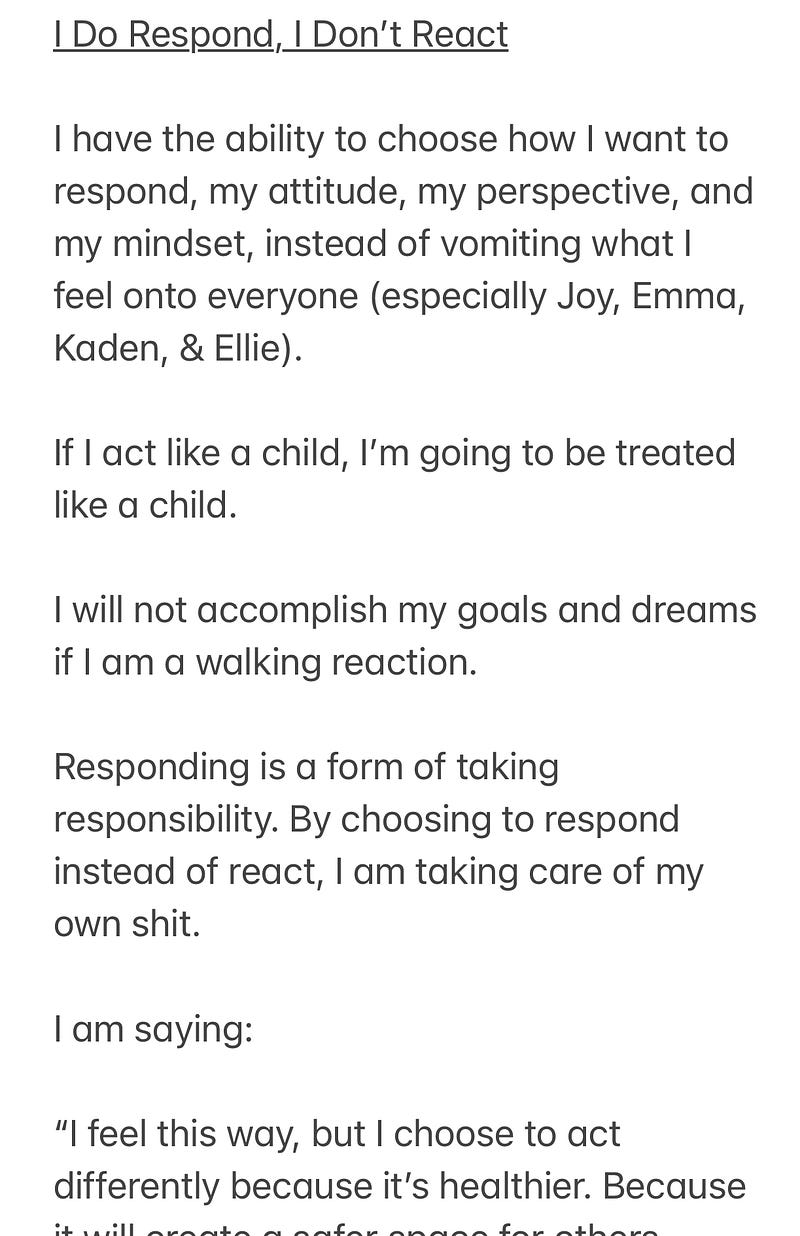
Lastly, remember the acronym P.L.A.C.E.
Pause
Label your feeling that lead to the reaction
Ask yourself why or what triggered you
Choose a skillful response
- What matters the most in this situation?
- What is your goal?
- How can you respond productively?
Empower yourself
In Summary
Do not live a life of regret. Take life by the balls now while you still can!
“Remember this truth: now matters more than any other time in your life because it’s what you are doing today that is determining who you’re becoming, and who you’re becoming will always determine the quality and direction of your life.”
-Hal Elrod
If you do the same thing tomorrow as you did today, do you think you will become the person you want and deserve to be? No, you won’t.
You must commit today. Now.
Make a decision today what you will start doing differently tomorrow and the rest of your life to slowly boil into the person you desire and deserve to be.
Ask yourself, what am I currently doing that my future self would disapprove of?
Ready to get unstuck?
If you’re ready to upgrade your life and get at least 1% better every day, all by only spending a few minutes of effort, check out my guide.
Additional Resources
Brene Brown’s TedTalk; The Power of Vulnerability
25 Tiny Lessons I’ve Learned from a Daily Mindfulness Meditation Practice by Nick Wignall


