
5 Types of Copywriting Prospects
And how to sell to them successfully

One of the hardest parts of copywriting is knowing how to communicate effectively to your target audience.
If you’ve ever produced any sales materials or online content, you know the dilemma. Do you focus your writing on an individual “persona” or write more broadly to cover a range of potential prospects?
On the one hand, we can attempt to speak to all of our different prospects, but we risk overwhelming them with too much content. But on the other, we can offer a bespoke pitch to an individual customer and risk alienating another portion of our audience.
So is there a solution?
Well, fortunately for us, there is. It’s called audience segmentation, and it involves splitting up customers based on their different attributes.
In copywriting, the most useful form of audience segmentation is called the “stages of awareness.” It breaks down customers into five distinct stages of awareness:
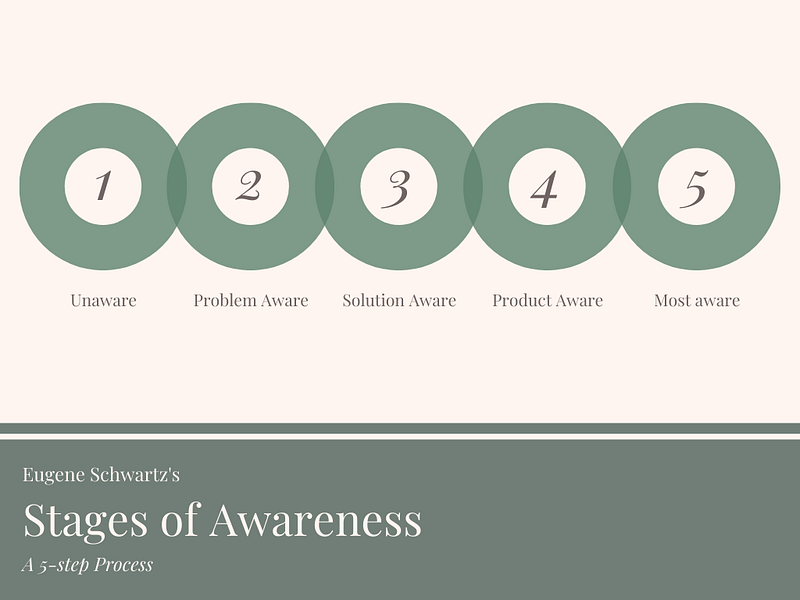
In this post, I’ve broken down the different stages of awareness and provided a top-performing sales letter that effectively targets each segment.
1. Unaware Stage: Be Informative
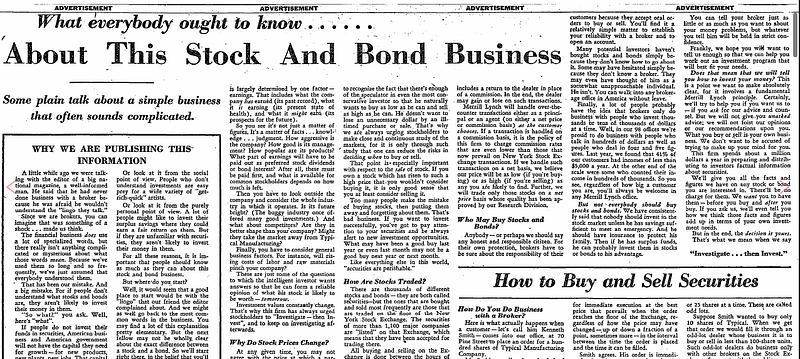
At 6,450 words, this piece written for stockbroker Merrill Lynch looks like a terrible advert. But don’t judge a book by its cover. It was a huge success and resulted in 10,000 responses, becoming one of the best direct mail pieces ever written on stock investing.
So what made this piece so effective?
The introduction starts off with a humble apology. After doing their research, they tell us that they’ve discovered a key part of their demographic didn’t want to invest money.
Why? Because they didn’t understand the technical jargon.
According to the stages of awareness, their prospects were in the unaware phase. They didn’t really know there was a problem (poorly managed finances) or a solution (investing).
So what did they do?
They devoted their sales letter to making amends. Instead of discussing high-level investing tactics, they delved into the absolute fundamentals. They painstakingly broke down the whole process and clarified technical terms. And most importantly, they illustrated the benefits of investing.
“But surely people won’t read that much text!”
It’s easy to feel overwhelmed by the size of the piece at first — I know I was. But the truth is, the length of copy is irrelevant if it’s valuable.
In reality, it takes a lot of trust-building to win over expensive investing prospects. If you were selling lawnmower services your ad may be a fraction of the size, but that’s because there’s less to say.
This sales letter was tirelessly condensed into the most crucial information. It’s more akin to a resource than an advert. It’s closer to an online guide or PDF than a sales letter. And at the time this was revolutionary.
Lots of qualified prospects saved this advert and studied every word. And guess who they would call when they were ready to get started? That’s right — Merrill Lynch.
How to use it: This stage of the funnel has mostly evolved into content marketing. But if you invest time into becoming an authority, you’ll soon build reputation and loyalty. Be sure to have resources that empower your customers to make the best decision — not simply buy from you.
2. Problem-Aware Stage: Be Inspiring
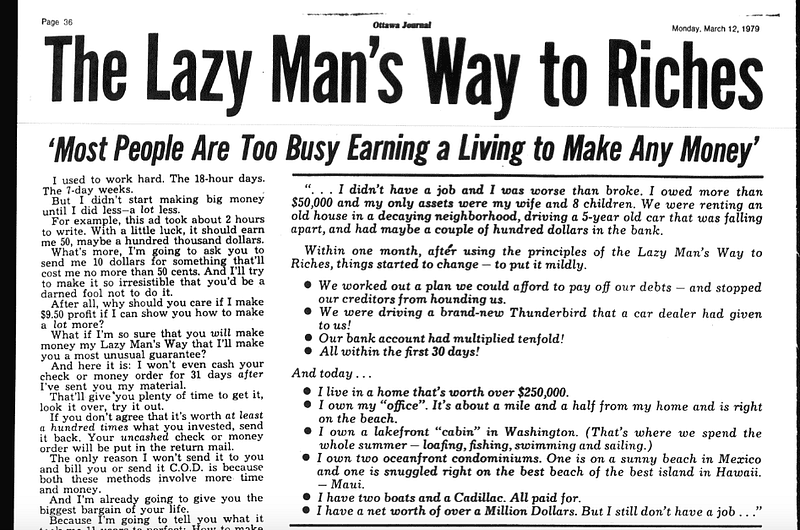
Rumour has it that Joe Karbo wrote this massively successful letter in one sitting. Originally published in 1973, it went on to sell over 3 million copies of his book. It’s the ultimate “rags to riches” story.
So what made this piece so effective?
There are so many things that this piece perfectly executes:
A big promise: In his advert, Karbo makes a bold promise: with access to his knowledge, it’s possible for us to replicate his success. He even challenges us, stating that he’s making a $9.50 profit on his book, but he promises us he can make even more.
Credibility: If you’re going to make an ambitious promise, it’s essential that you immediately back it up with evidence. Karbo does this in three ways:
- Unusual guarantee — He won’t cash your cheque for 31 days. (A novel display of confidence in the product.)
- Personal anecdotes — There’s a fine line between bragging and inspiring. And Karbo is quite honest about this distinction, informing us that he’s about to boast so he can emphasise that his system works. By taking us into detail about his obscene wealth, we can’t help but wonder whether we could do this too.
- Quote — To close off the letter, when we question whether everything’s too good to be real, he drops a credibility bomb. His accountant (a trustworthy position of authority) can verify that he’s being truthful about his wealth and we’re led to believe that maybe his big promise is real too.
Counter objections: Every great copywriter anticipates their customer’s objections to maximise their chance of selling — and Karbo does this effortlessly.
In the letter, Karbo goes to great lengths to emphasise that his strategy doesn’t require “education,” “capital,” “luck,” or “youth.” As he rattles off these obstacles, it builds our curiosity — we’re eager to find out the secret.
Note: Although today we’re over-sensitised and distrusting of moneymaking schemes, at the time, it was a ground-breaking idea to send adverts like this to the mass market.
How to use it: You need to be very charismatic if you want to persuade people that you hold the solution. You’ve got to hook their attention for long enough to encourage action. Like Joe Karbo’s letter, it’s vital to make your prospects picture a solution to their problem. You’ve got to get them salivating for an answer.
3. Solution-Aware Stage: Be Entertaining
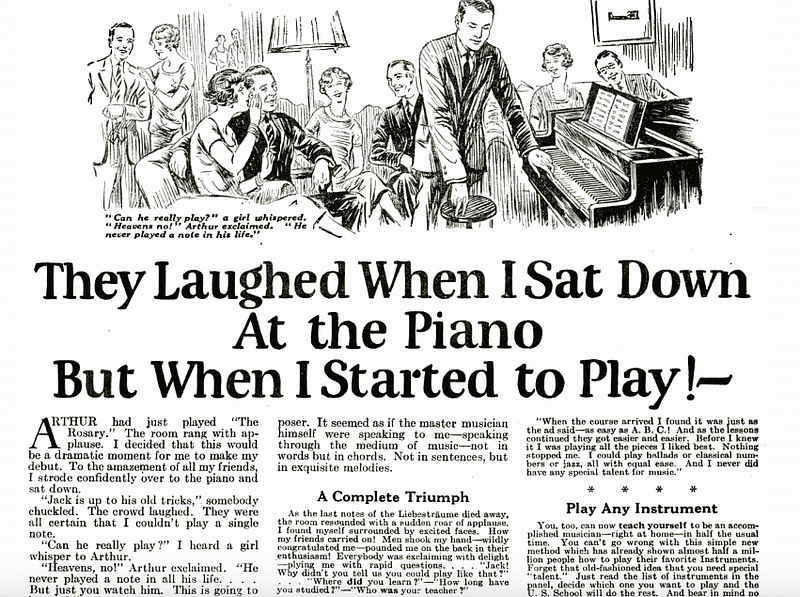
This advert has one of the most compelling stories ever created in copywriting. The school received over 10,000 requests for the information booklet for what appears to be a fairly mundane product.
What makes this piece so effective?
Pro copywriter Joseph Sugarman once said, “You sell on on emotion and justify a purchase with logic.”
And this advert certainly knows how to evoke our emotions.
Through masterful storytelling, we’re pulled into the advert. We can’t help but want to follow and see how it plays out. It reads like a novel, and before you know it, you’re sucked in.
By using word pictures, short sentences, and lots of dialogue, it’s so entertaining to read that it almost doesn’t feel like advertising.
The author, John Caples, masterfully tells an exciting story that manages to serve almost like a testimonial. We picture the product through the character’s eyes, and it’s only once we’ve been swept through the advert that it attempts to sway us with enticing benefits, like a free booklet and the ability to “learn any instrument.”
How to use it: Most people are fed up with the problem and bored with the solutions. You need to make your writing exciting to read. Whether that’s through storytelling, audience participation, or quizzes, it’s important to bring energy into your advertising.
4. Product-Aware Stage: Be Relevant
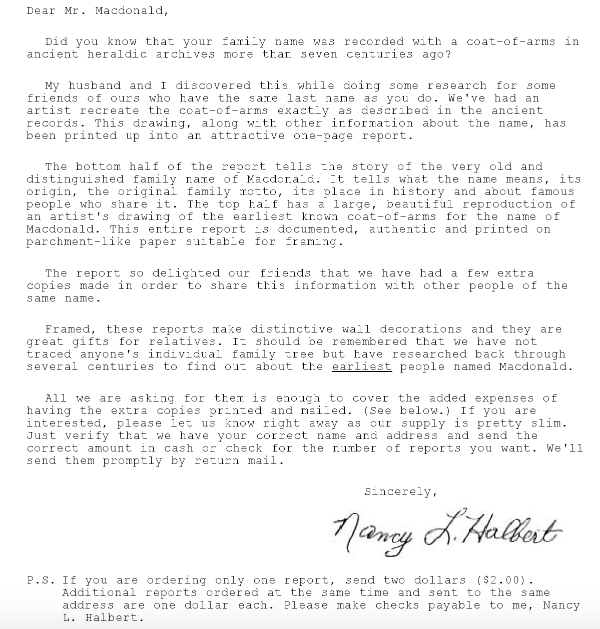
Arguably one of the most successful direct mail pieces in history, this letter by Gary Halbert is a masterpiece. It’s been mailed to 600,000,000 prospects and in its prime was turning over the modern equivalent of $300,000 a day.
So what made this piece so effective?
This sales piece reads just like a personal letter from a friend. And that’s where the magic lies.
Gary Halbert famously said in the Boron Letters that all mail is separated into two piles:
- A-pile: Read immediately
- B-pile: Maybe read later, but probably discard
And this letter played every trick in the book to make it onto the A-pile:
- Unbranded brown envelope with a handwritten name of the recipient
- Sending address at the top of the letter
- Recipient’s name clearly addressed
- Personally signed
But he didn’t stop there. Gary goes on to construct an exemplar sales letter that follows the AIDA formula — all with a single side of A4.
Attention: Directly address prospect and hook their attention with a highly personalised offer? Check
Interest: Clarify the offer and its value, emphasising personal significance? Check
Desire: Get the prospect to visualise life with the product and drop subtle hints of credibility? Check
Action: Share an irresistible offer with simple instructions? Check
What this piece does so effectively is to establish trust by respecting its audience. In copywriting, it can be tempting to oversell, but this letter is a great reminder that sometimes less is more.
How to use it: In most cases at this stage, we’re suspicious of our options. Overwhelmed with choices, you want to do as much possible to stand out. As Gary Halbert demonstrates, the best way to get attention from a wary audience is by being attentive, genuine, and relevant.
5. Most-Aware Stage: Be the Best
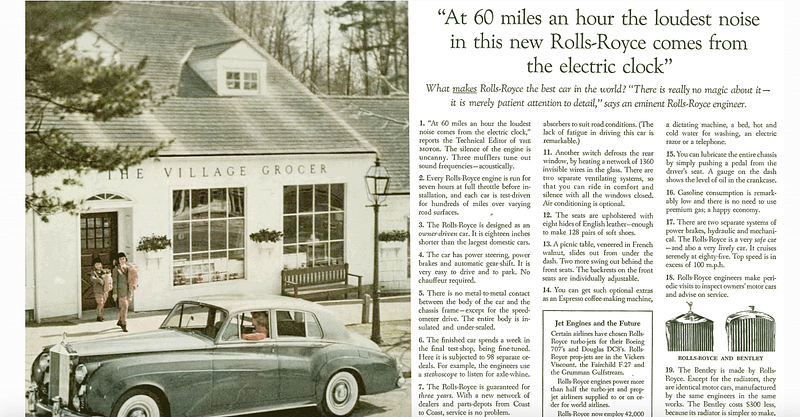
David Ogilvy referred to this advert as one of his finest — even declaring the title as “the best headline I ever wrote.” And it’s no wonder. After publishing the advert in 1957, Rolls-Royce sales increased by 50%.
So what made this piece so effective?
Meticulous attention to detail.
Ogilvy reportedly spent three weeks studying every possible fact about Rolls-Royce cars. That’s right, it took him three weeks of research before he stumbled upon his selling point.
Ogilvy needed to find a golden nugget. A USP.
That’s when he stumbled upon the quietness of the engine. A clear demonstration of quality.
The beauty of this advert is that it doesn’t just say, “we are the best car in the world” (like previous advertising attempts). Ogilvy knew that he had to prove it.
And this advert is a masterclass in the use of benefits over facts. Instead of relaying trivial car statistics, Ogilvy meticulously frames each one as an exclusive benefit that oozes quality.
Ogilvy couldn’t just say that Rolls-Royce was the best; he had to prove it. Prospects know what their choices are and also how much they cost. So at this stage, you need to go to great lengths to find that diamond in the rough that will put your product at the top of the list.
How to use it: Spend time drilling down into the nitty-gritty of your product. It takes time to find the little gem (USP) that will inspire your next piece — but trust me, it’s worth it.
Conclusion
So next time you have a copywriting task, consider your prospect’s mindset and adjust your copy based on their awareness. If you can anticipate and address their needs you’ll dramatically increase the power of your copy.