
5 Things I Learned from 8 Months of Daily Duolingo
About language acquisition, memory, and the imperfect pace of progress
I’ve had Duolingo off and on since 2013, which I suppose makes me an early adopter since Duolingo was originally released in 2012. But until 2021, I used it primarily to keep up on my Spanish and French, languages I’d studied in school and already had varying levels of fluency in.
Last year, in anticipation of a trip to Vietnam this fall, I picked up Duolingo again, this time to learn a language from scratch. One that wasn’t a romance language, has few cognates with English, and where tones and accent marks matter significantly. (Remember how one of my bad habits is mispronouncing words?? Yikes.)
To top it all off, the Vietnamese Duolingo teaches is the northern accent, while I’ll be traveling to southern Vietnam, where letters are pronounced differently and whole words are different. From what I can tell so far, it’s like learning American English and then traveling deep into the highlands of Scotland. People might understand me, but I’ll have trouble understanding them.
Even then, I figured it would give me a head start, at least, on reading menus and signs. Plus, I like learning languages! So I gave it a try off and on in 2021, and (nearly) every day of 2022 thus far.
Here are the main things I’ve learned from trying to pick up a new language from nothing but Duolingo.
1. You Get Better When You Practice
It seems almost silly to mention this, but it’s the fundamental design behind Duolingo in the first place. Practice repetitive content, get used to the repetition, and, with some variation, begin to learn what each individual word means and how the grammar comes together.
Particularly in the beginning of learning something new, especially something as complex as language, pretty much the only thing that matters is repetition. Duolingo even recently redesigned their levels to intentionally space out lessons this way. You practice a concept often when you are first exposed to it, but the practice gets spread throughout later lessons at a tapering frequency as you master each skill.
This is because once you have a foundation for something, it’s stored in your long-term memory. Repetition when you’re still in the short-term memory phase is vital for moving it into the long-term vault.
2. You Memorize Before You Understand
I learned to say “Where is the elephant?” before I understood the difference between ở đâu (where) and ở đây (here), or between con voi (the elephant) and với con tôi (with my children). I didn’t even know the word for “with” for ages, so I didn’t know why my Vietnamese keyboard kept autocorrecting voi. I just kept changing it back.
But with enough repetition, I can both memorize and understand. At one point, I learned that the Vietnamese word I was taught for “gullible” was a compound word made up of “all/both” and “believe.” All Duolingo told me was that “cả tin” was gullible. But I remembered using cả to mean both or all, and I’d learned tin meant believe. I drew the etymological connection on my own, and I was delighted.
3. Duolingo Teaches Weird Phrases You Don’t Need
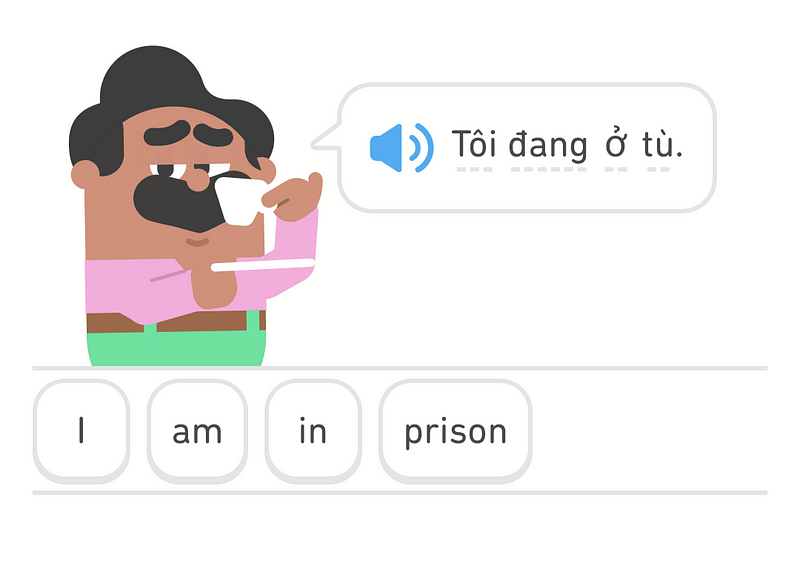
There’s a lot I’m unsure about when it comes to the ten days I’ll spend in Vietnam. It’s a new place, after all. A whole continent I’ve never been to before. But I’m fairly certain I won’t need to say, “The elephant writes a book about happiness.” Yet that’s one of the sentences I’ve learned, right alongside the header for this article, “I am in prison,” that I very much hope I never have to use.
In addition to near-nonsense and unlikely situations, Duolingo inserts pop culture references, ones that change depending on the language you’re learning (and the teams who write the phrases). Vietnamese taught me “one hundred and one dogs,” (if not dalmatians) and “You have to ask yourself, do you think you are lucky?” (which is pretty close to the actual Dirty Harry line, which gets Mandela-effected as “Do you feel lucky, punk?”)
There are huge listicles noting the funniest, the most 2020, and the weirdest phrases one can learn in Duolingo. If you’re learning Russian, for instance, you get an Eddie Izzard reference.
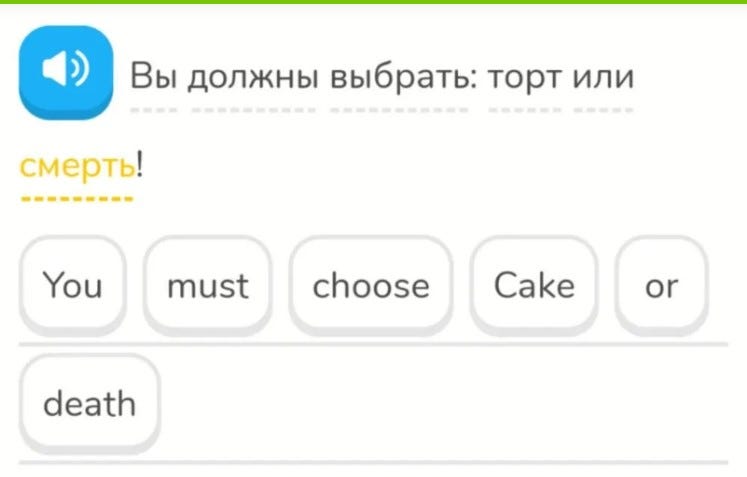
It turns out there is a method behind this madness. In an interview for Slate, a linguist that works for Duolingo notes
When there’s a conflict between your expectation and the reality, that triggers responses in the brain. …It forces you to attend more carefully to what you’re seeing.
The whole time, Duolingo is grounding you in the linguistic particularities of a language. Where adjectives go. How to reword something as a question. Verb tenses. It’s all there, despite the silly sentences that get you accustomed to it.
4. You Will Hit Several Plateaus
In late May of this year, I almost gave up on Vietnamese. I was doing great, and then suddenly I couldn’t do it anymore. I would try my best at translating a sentence, get it wrong, and not even understand why what I did was different than what they expected of me. I didn’t feel like I was learning anything.
Verbs in particular were killing me. See, most verbs (and adjectives) in Vietnamese are two words long. And sometimes the ending word of one verb is the start of another. Not to mention that the difference between one word and a completely different one is nothing but the accent marks.
I was lost. I was confused. I had to check every single verb because I couldn’t remember any of them offhand. For a month, I did the minimum I needed to keep my streak, which was usually practice older lessons, while ignoring this plateau that seemed it would be my death.
Eventually, I trudged through it to the other side. And I went back several weeks later to try to get the legendary status on these verbs. When you’re going for legendary, you get zero hints.
It… wasn’t even hard.
I messed up a few times, but it was “I can’t remember this one. I think it’s this?” And my mistake would be getting the words backward, which, considering where I started, was not a bad place to be.
Turns out, learning plateaus are a known phenomenon. They come with good news and bad news, too. The good news is it’s rare to hit a plateau as a beginner. Which means hitting a plateau at all means you’re progressing into an intermediate place with what you’re learning. The bad news is you could get stuck there without strategies to push through.
I kept going. And it got me to the final thing I learned about trying my hand at a brand new language.
5. There’s a Celebration in Reading in the Wild
One day, I went to the library with my kids. While there, I found a handout available in several languages. I looked at the Vietnamese one first.

Every child, I read. Every day. Read, Speak, Sing, Write, Play.
That was the whole cover. I read the entire cover of something, in Vietnamese, that was written for a Vietnamese audience. I grabbed a flyer and took it home. Honestly, I can’t remember the last time I was so excited about something. I still can’t read all of the inside, but I feel amazing knowing that fluency is coming as long as I keep working for it.
A few weeks later, it was time to start booking things for our trip, so my husband and I ended up on a website written in Vietnamese. A pop-up covered the page at first. I looked at it and told my husband, “Click đồng ý. You’re agreeing to cookies.” He did. The website loaded, we got it translated into English, and all was well.
As we looked at pictures of places to stay, many included snapshots of the surrounding area. One had a huge red sign on the door. “năm mới, nhà mới, sofa mới.” It didn’t take long for me to parse it out. “New… year. New… house. New sofa. Oh! It’s an ad for a furniture store!”
As much work as learning a new language has been, these little moments of understanding have been more than worth it for me.