
5 Steps I Took To Becoming A Digital Minimalist

The Cambridge Dictionary defines minimalism as follows:
“A style in art, design, and theatre that uses the smallest range of materials and colours possible, and only very simple shapes or forms”
It is very easy to feel overwhelmed by everything going on in our lives; I know the feeling very well. Our lives have become jam-packed with work schedules, Zoom meetings, and a constant supply of social media updates and news headlines.
Covid-19 has not only changed the majority of our lives, but it has also made us more dependent on technology than ever before. In order to work, chat with friends & family, relax, or find out what the latest Coronavirus numbers are, we are constantly relying on a piece of hardware or software.
The impact of social media, video-conferencing and mobile applications depends on how we use this technology to either be more productive or more distracted.
I am an information systems graduate, and as you can obviously tell from the articles I post, I am an advocate for technology and what it can do. However, I am also aware of the over-reliance we place on social media and the constant need we have for more and more.
Let Me Explain
Every single time we post onto Facebook, Instagram, Twitter, or TikTok we are gambling. We wonder how many likes or comments our post will receive and feel the endorphin release when we finally get the public approval on our latest post on something news-related or a screenshot of our latest meal. There is nothing wrong with this and I am not saying you should go on a social media cleanse. Technology and social media, in particular, do a lot more good than bad on a macro level. However, on a personal level, it is important to be aware of what you allow into your life.
Some Stats
- A study in 2017 indicated that the average person spends 7% of their workday (yes, their 9 to 5 job) on social media.
- According to a 2012 study, 75% of home garages in the United States had no space for a car to park.
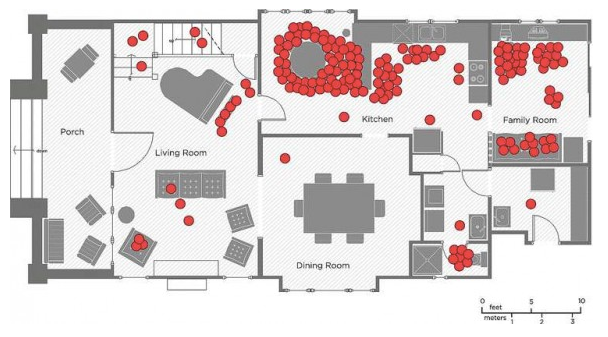
- The following displays a heatmap of where the average family occupies their house. As you can see the dining room and living room are barely used, whilst the porch is not used at all.
Digital Minimalism
Digital minimalism explores the need to close the door on what we accept digitally. It forces us to make purposeful decisions in what technology we gear our focus towards rather than allowing anything and everything in with the idea that only what we want to stick will. Being a digital minimalist means being hyperconscious of what technology and social media we allow into our lives.
Instead of me going on and on about the abstract concept of digital minimalism, here are a few things I did, and that you can do right now in order to be more digitally minimal:
1. Digitally Spring Clean
Digital clutter is just as bad as physical clutter. It’s funny how we judge people who hoard items in their homes or garages, but find it perfectly acceptable if someone has hundreds of unused or time-wasting mobile applications on their phone.
Have a good look at your phone and de-clutter. Similar to a piece of clothing, if you haven’t used it in a while, remove it. I personally used 1 week as my testing period. Whether it is a banking app, Facebook, Medium or an Activity tracker, if I didn’t utilize the app weekly then I put my iPhone on “jiggle mode” and deleted it.
2. Perform a 30-Day Experiment
After you have digitally de-cluttered, take a break from the mobile applications that are not essential to your productivity (i.e. you may need your email application for work).
For 30 days, delete the apps that don’t matter and apply your time to something else (reading, spending time with friends or family, etc.). After the 30 days have passed, re-evaluate whether you want the mobile applications back.
I tried this personally and found myself not re-downloading a number of apps. I am also human, so I ended up re-downloading a couple.
3. Do Nothing
I am the biggest fan of podcasts, books, and Medium articles; these all have a positive impact on building my knowledge pool and adding to my overall productivity. However, it doesn’t matter how much you love these things and how much they help you, every now and again you need to DO NOTHING.
Take a break from everything, go for a walk by yourself, meditate, whatever works for you and just take in the moment. Nobody else but you and the present. Nothing gives you a mental reboot like this, trust me.

4. Call, Don’t Comment
I will be honest, this was a tough one for me. The next time you are swiping through social media and you see a post from a friend announcing something major (pregnant, engaged, starting a new job, etc.) instead of commenting, why not give them a call. The connection of a 5-minute phone call is worth all the likes and comments in the world.
5. Engage in high-quality leisure
There is nothing like working an exhausting week to come home on a Friday and dive deep into a TV series marathon (I am busy with Billions and it is brilliant!) but, this is a low-quality leisure activity. Instead, consume your time in a high-quality leisure activity. By this, I mean doing something that has more substance than just lounging about, staring into a Netflix abyss. Some great high-quality leisure activities include learning a new language, trying out a new recipe, or taking a free online course (Harvard University offers a couple here: https://online-learning.harvard.edu/catalog/free)
I personally just started the journey towards getting my open-water scuba diving license. Aside from engaging in a high-quality leisure activity, I am doing it with my mom and sister which makes for great family time.
Minimalism, and specifically digital minimalism, is not this crazy hippy movement where people go on a social media cleanse and hate technology. It is about being more aware of what you let into your digital life, with the goal of using these powerful mediums to improve your life in every way possible.
I will leave you with a quote from Uncle Ben, “With great power comes great responsibility”