
5 SMART Reasons Why Goal Setting Is Essential When It Comes To Any Physical Activity
Where M is for Motivation so that we measure our progress, and know when we have achieved success.

Setting SMART Goals have always had a long history used to track progress, by working through small milestones that are met to achieve each goal set.
Whether it comes to productive work environments, physical sports, academia, business, or personal motivations. Goals are everywhere. They shape us and push us towards achieving growth and success.
SMART Goal is a relevant methodology that is used in various fields and is the go-to technique when it comes to traditional goal setting in any scenario.
It is generally accepted that the S.M.A.R.T acronym was first written down in November 1981 in Spokane, Washington. George T. Doran, a consultant and former Director of Corporate Planning for Washington Water Power Company published a paper titled “There’s a SMART. Way to Write Management’s Goals and Objectives”.
In his paper, Doran provides clarification for readers on applying the S.M.A.R.T Technique:
‘How do you write meaningful objectives?’- that is, frame a statement of results to be achieved, Managers are confused by all the verbal from seminars, books, magazines, consultants, and so on.
Let me suggest, therefore, that when it comes to writing effective objectives, corporate officers, managers, and supervisors just have to think of the acronym SMART. Ideally speaking, each corporate, department, and section objective should be: (SMART).”
— George T. Doran
A recent academic paper by McEwan D, Harden SM, Zumbo BD, et al. from Vancouver in Canada showed that goal setting is also beneficial in improving physical activity behavior.
In the paper, Included studies consisted of controlled experimental trials wherein participants in the intervention conditions set Physical Activity(PA) goals, and their PA behavior was compared to participants in a control group who did not set goals.
A meta-analysis was ultimately carried out across 45 articles (comprising 52 interventions, 126 effect sizes, n = 5912) that met eligibility criteria using a random-effects model. Overall, a medium, positive effect (Cohen’s d(SE) = .552(.06), 95% CI = .43-.67, Z = 9.03, p < .001) of goal setting interventions in relation to Physical Activity behaviour was found.
Certain effectiveness was calculated for the people who set goals during their physical activity to have more productive results, than those that did a physical activity on a whim. They also concluded that those who set goals during a Physical Activity are more prone to feel motivated to finish their exercise and become autonomous of the process that follows.
As it seems more natural for them to follow daily physical activity when they proceed towards SMART goals that are worked over on a timeline.
What is A S.M.A.R.T Goal Setting?
The definition for S.M.A.R.T goals has changed over the years as the use of this technique has been diversified in all professional fields — thus the value and meaning it provides adjusts to the field it is used in.
SMART goals are used in Business, Technology, Education, Academia, Engineering, IT, Health Sciences, and vice-versa. The applications of SMART goals have transformed over the years with its use of the application in almost every field there is.
People who tend to set SMART goals are more prone to achieve more tangible results than those who do not.
S.M.A.R.T at its core is divided into the following steps, but not limited to as follows:
S for Specific
You need to set specific goals that need to provide a precise output towards yourself. This way you can create a goal that you can commit towards. Not a big goal that would just tire you out.
But a goal that will be specific such as walking a mile every day. Either before going to work or walking a mile during breaks in between work and leisure can be a specific goal.
The goal needs to fit this requirement as it is essential for you to be able to commit to it with minimal effort. You can add unto that afterward, as you see fit by increasing the output by a marginal percentage every day.
M for Measurable:
We need our goal to be motivational, it should serve some form of a record of achievement that we can recollect and emphasize upon. To know that we have improved or crossed a specific milestone in our progress.
A goal needs to be measurable so that we know that we are successful or on the right path towards success. It keeps us on our toes and pushes us in the right direction.
Being able to quantify our goals is helps such as counting the number of steps through a pedometer, knowing the number of calories we have burnt, and even how much we have improved by writing and noting down our progress as a record using memos or a simple notepad.
This can serve as an example that we can measure our goal. Also serving as a reminder and record of what we have achieved during our goal progress.
A for Attainable/Agreeable/Assignable:
A is for either of the above — regarding our scenario, it is agreeableness. It means that you consciously are resolute that you are going to be the one doing the work and putting in the effort.
It specifies who will do what thing in a team-based environment. It also means that you might discuss your goal with another to find relevant feedback.
The important factor is that you agree with the goal, so write it down. Take action afterward, using an action plan as a commitment to yourself that you can achieve it.
R for Realistic/Reliable/Relevant:
R is for realistic or reliable. Aim for the goals that you can realistically achieve. They should be interesting and challenging at the same time. But you shouldn’t set goals like running for an hour every day.
As you may not be able to because the goal isn’t realistic — especially if they haven’t run ever before or if they suffer from a chronic illness or have been sedentary for long periods.
Your daily life experiences might cease such difficult goals to even being exercised or performed. Don’t set yourself up for failure with a difficult goal just because it is challenging.
Instead, set up a goal that you can realistically commit towards with minimal effort and ease of mind. Do challenge yourself often to make a change, breaking free from the norm.
A realistic goal can be walking an average of 15 minutes during lunch or walking five times every week in the evening for a brisk walk.
T for Time-Bound/Time-Phased/Time-Related:
T is for time-bound. Basically, the essence of T is setting a deadline to achieve a milestone(sub-goal or an objective) that you will set every day to achieve your weekly goals, and so on.
A Time-bound goal needs to be met in a specific timeline. Such as walking 15 minutes every day whether during lunch of in the evenings. This exercise daily will contribute towards the weekly goal you set.
Conclusion
Over the years, SMART goals have been used and substituted for many professions and scenarios. Thus the reasons for the SMART have changed to meet their designated needs.
Though many critics believe that SMART goals may tend to cause a lot of trouble down the line when it comes to long term goals that keep ever-changing with newer information being passed into the pipeline.
SMART goals are usually effective when it comes to day to day goal-setting basis. This is where they tend to perform the highest. As it is something that you can measure, meaning that you can easily commit towards.
SMART goals are an essential process in helping us reach our physical activity goals.
Advice: Start a goal this week, and then set a milestone daily to achieve your weekly goals. Tomorrow set another milestone, and vice-versa. It is illustrated as follows,
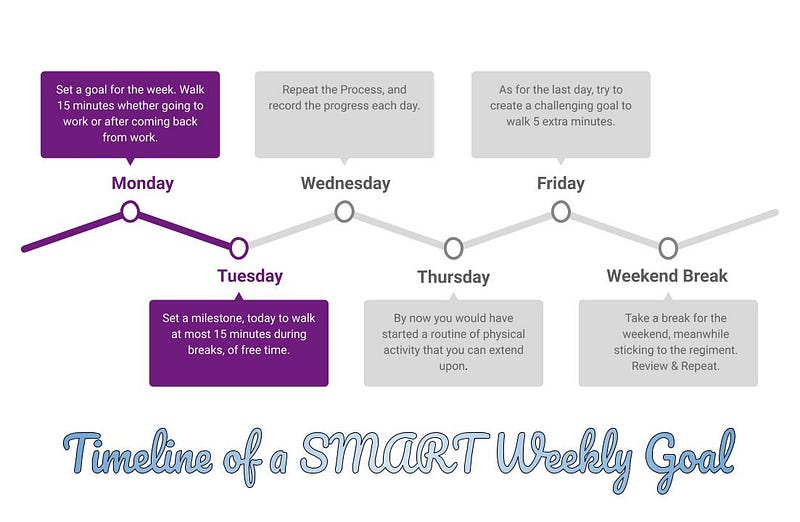
These daily goals are milestones to achieving your weekly goal. Your weekly goals are milestones to achieving something even bigger. Over time, review your goals so that they are still SMART to maximize your performance along the journey.
The Takeaway
- Be precise and specific towards what you want to achieve, and what you can commit.
- Create your SMART goals having this mindset.
- Create a SMART milestone daily that will contribute towards your weekly goal.
- Monitor your progress, by either getting a pedometer or by storing the results on pen and paper to track how much exercise you have done daily.
- Reevaluate your progress at the week’s end by crafting another goal on top of what you have achieved making the progress a precursor to achieving the next goal.
References:
Doran, G. T. (1981). “There’s a S.M.A.R.T. Way to Write Management’s Goals and Objectives”, Management Review, Vol. 70, Issue 11, pp. 35–36.
Project Smart was the first website to put the SMART definition online. Shortly after, the site was contacted by George T. Doran’s son, Sean Doran, who confirmed that his father had developed the SMART acronym in November 1981.
McEwan D, Harden SM, Zumbo BD, et al. The effectiveness of multi-component goal-setting interventions for changing physical activity behavior: a systematic review and meta-analysis. Health Psychol Rev. 2016;10(1):67–88. DOI:10.1080/17437199.2015.1104258
Murray JM, Brennan SF, French DP, Patterson CC, Kee F, Hunter RF. Effectiveness of physical activity interventions in achieving behavior change maintenance in young and middle-aged adults: A systematic review and meta-analysis. Soc Sci Med. 2017;192:125–133. DOI:10.1016/j.socscimed.2017.09.021
GOAL SETTING AND SELF-CONTROL. By: RAIA, ANTHONY P. Journal of Management Studies, Feb 1965, Vol. 2 Issue 1, p34–53, 20p; EBSCO . 31 Oct. 2008
Thank you for reading.
Stay Blessed and Stay Safe! ❤️


