
5 Simple Ways We Can Improve Our Articles
Small enhancements add up to positive results

Our ability to create high-quality content consistently and frequently is the hallmark of a professional freelancer, since both quality and quantity are necessary for enticing readers to keep coming back for more of our work. This can be challenging, especially when we factor in other demands that eat away our time and energy. As a long-time freelance writer and editor and someone with an autoimmune that sucks my energy dry, I rely on a few tips and tricks from colleagues, experts I’ve worked with, and my own experience, that improve the quality of my writing and my ability to produce work consistently and often. I hope you find them helpful, also.
We want to answer these questions in the introduction.
Every reader approaches a piece of writing wondering if they should read it or not, so we must grab their interest and hang onto it. Early in my career, I wrote a lot of boring human resources stuff, so finding ways of getting employees to read it was a major challenge. A wise editor who was my mentor told me that the reader always has 3 questions they want answered upfront:
- Why am I getting this? When it comes to feature writing, the answer to this question zeroes in our reason for writing it. Why do we think it has value for the reader.
- What am I supposed to do with it? This lets the reader know how they can use the information that follows; it adds practicality to the piece.
- Why should I care? This last question is the most important one because it promises the reader something they want if they continue reading.
There’s an added benefit here. By thinking through the answers to these 3 questions, we begin to solidify what we need to do when researching and writing the piece. This makes the process more efficient.
We want to write first and then fix it.
A first draft is just that. It’s throwing spaghetti on the wall. It’s a brain dump after having made some decisions about what I want the piece of writing to be and do and have done some initial research.
This has always been a challenge for me since I find messy first drafts annoying. When I let a mistake lie on the page, I get itchy. It’s like a mosquito bite I must scratch. But stopping to fix the writing interrupts my flow, so I make myself soldier on to a natural stopping point. In an article like this, it would be the end of a subsection. Now, I can scratch the itch and fix what I wrote.
In his TedTalk, Steve Kotter describes how flow states produce a potent soup of neurotransmitters in the brain: dopamine, norepinephrine, endorphins, anandamide, and serotonin. This increases productivity, performance, motivation, creativity, and satisfaction. We want to take advantage of it by writing first and then fixing it.
“The first draft of anything is shit.” — Ernest Hemingway
We must never assume that we wrote what we think we wrote.
I learned this the hard way. My very first assignment as a brand-new communications officer for the bank where I worked, was to write and produce 5,000, 48-page booklets for retiree health plan open enrollment. The booklets arrived, and the customer service manager noticed a typo — a missing word. NOT. The sentence read, “Cosmetic surgery is covered,” instead of, “Cosmetic surgery is not covered.”
We can never be sure that we wrote what we intended to write, especially when we are working quickly or on a tight deadline. Often, our brains are the culprit because we know what we mean, but the reader doesn’t have access to our knowledge. Here are a few mistakes we can easily fall into.
- Pronoun usage is a good example: Jon and Erik met his wife at work. Whose wife? I see this type of mistake a lot. As the writer, we know which male, but our reader is left hanging.
- Dangling and misplaced modifiers are another trap we can fall into: The bus hit the mailbox, but it wasn’t hurt. What it? The bus? The mailbox?
- There is a huge difference in meaning between In Spain, Sala is recovering from her vacation and Sala is recovering from her vacation in Spain.
We usually find these types of mistakes only with close editing and proofreading, so we need to beware of them.
We achieve comprehension by testing readability.
A client once hired me to write a brochure on their retirement savings plan for employees. I was charged to bring it in at a sixth-grade reading level. When you have to work with words like Bond Investment Fund and Diversified Equity Fund, you’re quickly blown out of the sixth grade.
Readability is the grade level of the writing. Comprehension is the reader’s ability to understand the content. Even if we can read something, we may not understand it. For example, I can read how a linear accelerator works, but I may not understand a word of it.
According to the Center for Plain Language:
“The average American is considered to have a readability level equivalent to a 7th/8th grader (12 to 14 years old)….In the UK, the central government encourages content writers to aim for a readability level of age nine. Their reasoning for this is that around the age of nine, children stop reading common words and just recognize their shape. This allows them to read faster. By reducing long sentences and words, you can help keep text simple and easy to read.”
We can check for readability with the paid version of Grammarly or the free Hemingway App. We also can get readability stats by turning it on in the preferences for the MS Word spell and grammar check tool.
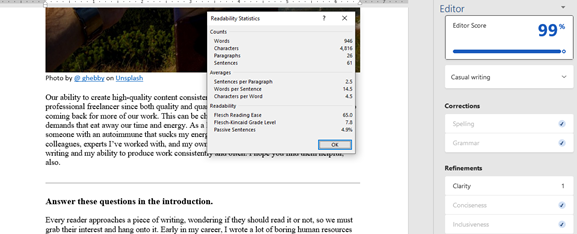
This is the result of a test I just ran for this article up through this section. It’s at a 7.5-grade level, so most readers can read and comprehend it. If the grade level is too high, we need to revise using shorter, less compound-complex sentences and simpler words.
We want to set the right tone.
We all sound out words when we are reading, and the tone is what we hear. It triggers an emotional response, and many factors contribute to our tone. Generally, if we want to hit the sweet spot for readability and comprehension, we want to use a conversational tone.
The advice, “Write the way you speak,” is bad advice; it doesn’t mean to write literal speech. Rather it refers to a conversational style that has an informal tone as if it were speech. This greatly influences how a reader reacts to our message — positively or negatively.
Shorter sentences create a lively, punchier tone while longer sentences set a more sedate, softer tone. I’ve had people accuse me of writing abrupt, in-your-face emails, so all I did was use longer sentences to soften the tone.
Most of us are either a naturally positive or naturally negative writer, and we only know which by paying attention to how we phrase sentences. Positive writing uses upbeat wording and structures; negative writing is the opposite. Notice the differences:
- When I receive your comments, I can finalize the draft for publication. (positive)
- I can’t finalize the draft for publication without your comments. (negative)
Readers prefer positive writing, and it is easier to understand since they don’t have to translate a negative into a positive to process it. I’m a naturally negative writer, so I have to pay attention to this when I edit and flip it around when I find it.
One final tip: We can’t trust grammar checkers.
I find Grammarly valuable for catching wrong words or misspelled ones that I may miss when editing and proofreading. But as I wrote this article, it kept telling me that things were wrong when they weren’t, and it recommended changes that altered the meaning of the sentence.
Not only will they steer us in the wrong direction, but they also don’t catch everything and are no replacement for sound editing and proofreading. Relying too heavily on them can give our writing a robotic, artificial style, and we want our personal writing style to shine through our work. It’s important that we use these automatic checker things judiciously and not blindly accept what they tell us to do without careful consideration.
“Learn the rules like a pro, so you can break them like an artist.” — Pablo Picasso


