
5 Simple Ways to Invest in Yourself for $0
Small changes can often lead to big results.

Even though stress is a universal human experience, statistics prove that stress levels have been rising in the past years.
The World Health Organization even classified stress as the health epidemic of the 21st century.
The most common causes of stress are money, work, the economy, family responsibilities, relationships, and personal health concerns.
The bad news is that we can’t change our financial situation, career, or the economy in the blink of an eye.
The good news, however, is that we can still invest in our mental and physical wellbeing through small daily changes.
And as James Clear writes in Atomic Habits, small acts can often lead to significant results:
“Changes that seem small and unimportant at first will compound into remarkable results if you’re willing to stick with them for years.”
How you breathe is how you live
In a recent podcast episode, former monk Jay Shetty explains how the first thing young monks learn at school is how to breathe.
The reason is simple: Every single emotion in our lives is connected to our breath.
When we’re happy, our breathing changes.
When we’re sad, our breathing changes.
When we’re stressed, we sometimes even forget to breathe.
According to Shetty, your breath is the only thing that stays with you from the moment you were born until the moment you die.
Your home can change, your family can change, your job can change, your goals can change, but your breath will always stay with you.
If you know how to navigate your breath, you essentially know how to navigate your life.
Whenever we feel out of breath or stressed, it’s mostly because our body and mind are not in sync.
That’s why Shetty recommends bringing your body and mind in alignment through conscious breathing. This is the easiest (and cheapest) way to add mindfulness to your daily life without craving any extra time.
You don’t need to meditate for hours to be more present and mindful.
You need to breathe.
Take a deep breath before writing an email and another deep breath after sending the email.
Take a deep breath before joining a video call and another deep breath after finishing the call.
Breathe in for four seconds and breathe out for more than four seconds.
Use your breath as your superpower for overcoming anxiety, fear, and stress.
Don’t confuse happiness with smiles
Thanks to social media and unrealistic expectations, our definition of a good life is completely screwed.
We see flawless selfies of celebrities with perfect skin and beautiful homes.
The problem is we compare those highlights to our daily life and end up feeling frustrated, even if we actually have everything we need.
Instead of focusing on our own happiness and contentment, we compare ourselves to fake smiles and luxury goods on the web.
But a huge smile can be miles away from a genuinely satisfying life.
Living a good life full of satisfaction is not about smiles and perfect pictures but about what you feel deep inside.
It’s about how you feel when you start your workday and how you feel when you go to bed late at night.
It’s about the quality of your relationships and about the possibilities you have.
It’s about how good you feel, not about how loud you laugh.
Next time you find yourself feeling unsatisfied, ask yourself if it’s really because you lack something in your life or if it’s based on absurd expectations and comparisons.
Leave your biggest enemy in the other room
According to The Guardian, we pick up our phones 58 times per day and spend more than three hours on our mobile devices.
While that might not sound like a shocking number, it adds up to more than an entire month per year, which we spend glued to our smartphones.
The solution? Leave your phone in another room — or at least across the room.
Leave it in the living room when you go to bed.
Leave it in your bag during work sessions.
Mute your phone and disable notifications.
Make sure your phone is a helpful companion instead of an enemy stealing your time and energy.
Smartphones are great, but they’re not great enough to justify that we spend an entire month per year glued to them.
Just imagine how much more peaceful your life could be if you’d spend the majority of that time doing something good for yourself: A short meditation routine, gratitude journaling, enjoying your favorite drink, cooking a fresh meal, a quick workout, listening to an uplifting podcast,…
Next time you feel the urge to check your phone, take a deep breath first.
Breathe in for four seconds and breathe out for four seconds. Do it one more time. And maybe one more time.
Spend more time in flow
According to the Gallup Institute, less than a third of all employees use their strengths at work. Yet, those who do use their strengths daily are six times more likely to be engaged in their jobs and more than three times more likely to have an excellent quality of life.
And the truth is we all have unique strengths and skills, even if we’re not aware of them yet. Making use of these strengths might not only make your work-life easier, but it’ll also improve the quality of your life.
According to Mihaly Csikszentmihalyi, author of the book Flow: The Psychology of Optimal Experience, we mostly experience a so-called flow state when our skill level is slightly below the challenge we face or the task we complete.
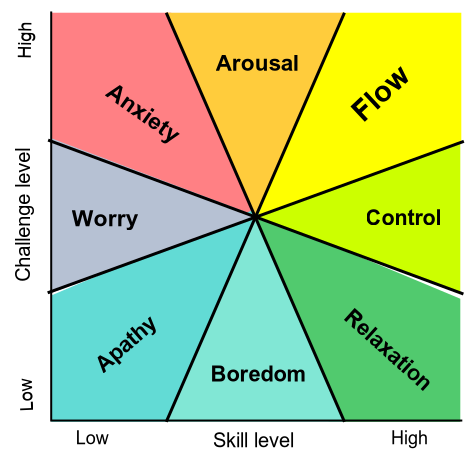

When a job or task seems too challenging, we often suffer from anxiety.
When the task seems too easy, we get bored.
But when we play to our strengths and get slightly challenged, we can deliver our best performance and enjoy the process.
Ideally, you’ll be able to experience flow states and a sense of satisfaction in your job. But if that’s not possible, you can also pursue a hobby or do voluntary work that allows you to use your strengths and experience those flow states more frequently.
Cross one thing off your to-do list without looking back
How often do you feel overwhelmed and stressed when you look at your to-do list?
Let me guess: Quite often.
Here’s the more relevant question: Do you really need to do everything that’s on your to-do list?
Do you really need to update your website?
Do you really need to reply to every single email?
Do you really need to do that favor for your colleague?
Do you really need to meet those high school friends you actually never liked?
And most importantly, do you really need to do all these things now?
Most ambitious people experience the pressure and desire to be busy all the time. Busyness and stress are not punctual negative experiences but their daily state of mind.
But here’s the truth: You don’t have to be busy all the time.
You can relax. You can take some time off. You can spend some time on activities that don’t make sense.
Final thoughts
Quite often, we get manipulated and believe that a good life comes with high expenses.
And we believe it’s bubble baths and luxury treatments that lead to more satisfaction and joy.
The truth, however, is that investing in yourself and your happiness is about time and effort, not money.
You might not be able to go on a vacation or treat yourself to a massage, but you can use your breath to lead your life.
You might not be able to eat in the most expensive restaurants, but you can choose to ignore toxic social media content and instead focus on your inner satisfaction.
You might not have your dream job yet, but you can do fun activities or voluntary work that help you to spend more time in your zone of genius and experience flow states.
Don’t make life more complicated than it is. Take a deep breath, and enjoy your day.
Want more? Download 40+ lessons from bestselling books for free.