
5 Simple Stoic Practices to Overcome Whatever Life Throws At You
Ancient Stoic Wisdom for Modern Times

Stoicism has seen a resurgence in the last decade, thanks to the interconnectedness of our modern world and the efforts of entrepreneurs such as Ryan Holiday from the Daily Stoic. Yet, with all these articles, books and podcasts about Stoicism, it seems like we are overloaded with stoic advice. My goal in this article is to declutter and simplify all the teachings of Stoicism into five essential stoic practices that can help you overcome whatever life throws at you.
These practices can be applied to any problem by anyone and at any time. The idea is to explain these stoic practices through a real-world example and help people better relate to them.
Setting the Stage
Let us consider an aspiring writer as the subject of our case study. Let’s suppose that our aspiring writer has dreams of pursuing his passion for writing and, in doing so, turning his passion into profit.
The problem, however, is that despite writing day and night, he is not getting the traction he thinks he deserves. As weeks turn to months, the writer starts losing confidence in his ability and is contemplating giving up on his dream. He eventually begins writing for the algorithms and becomes a puppet of the platform, leading him to heavy burnout. How would the stoics tell him to tackle this?
Practice #1 — Focus on What You Control
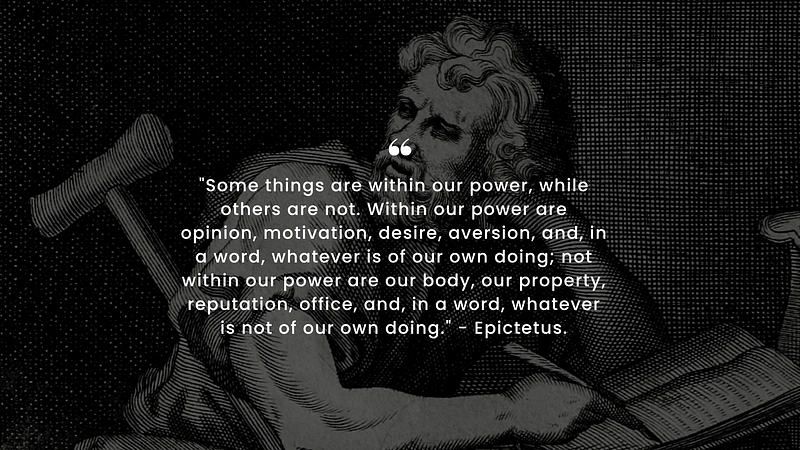
The first practice the stoics would advise the writer is to focus on what he controls. The whole practice of Stoicism is to identify what is within your control vs what is not and to focus exclusively on what is. According to the stoics, the only things you control entirely are your:
- Actions
- Beliefs
- Virtues
Everything else is out of your control and is inconsequential. Unfortunately, though, we often try and control the things in life that we have no control over, such as:
- Other people opinions
- The weather
- Traffic
- Politics
In the case of our writer, the stoics would tell him to focus on the writing process and leave the rest to fate. By identifying his self-worth to how many views, likes, and claps an article gets, he is trying to grasp something outside his control. This leads to frustration because no amount of worrying will change how readers view his work. By focusing on what the writer controls, he can reclaim his time, preserve his tranquillity and be happy no matter the outcome.
Practice #2 — The Stoic Reserve Clause
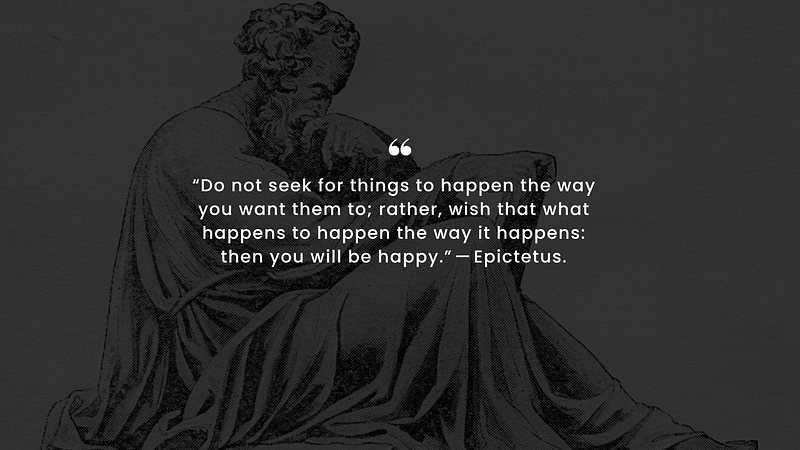
The stoic reserve clause can be thought of as saying “Fate Permitting” or “God willing.” The idea here is that when you face an obstacle, you go into it with an attitude that you will do whatever you can, and the outcome is not entirely up to us. This creates acceptance for whatever life gives us and for making the best out of any circumstance, no matter how challenging. Taking it a step further is not just accepting our fate but loving it (Amor Fati).
By accepting our fate, we are creating a sense of anti-fragility in us. We are not upset, frustrated or swayed easily. We understand that everything happens for a reason, and we can change our perspective to one of growth. As the saying goes, “Do what you must, let happen what may.”
In the example of our writer, practicing the stoic reserve clause would look something like this. I will write the best article I can and, fate permitting, it will be well received. Or that I will try to publish my article with this established publication, which, fate permitting, will be accepted.
Practice #3 — Cognitive Distancing
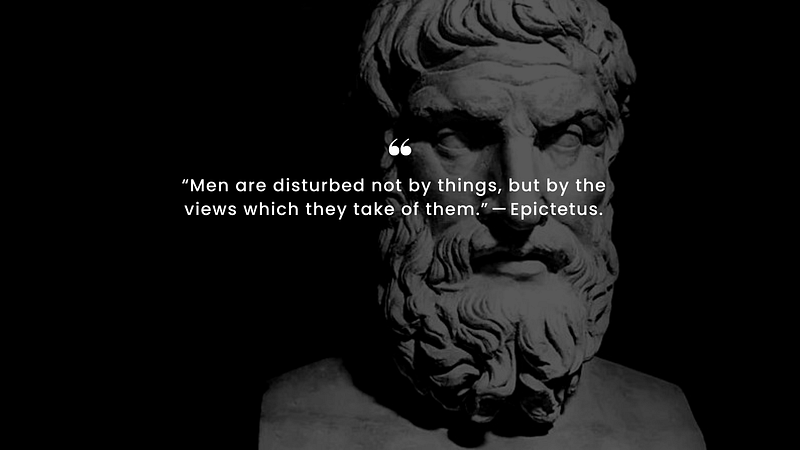
Cognitive Distancing can be summed up in the famous quote by the Stoic philosopher Epictetus “It’s not things that upset us but rather our opinions about things.” The stoics believed that events, whether good or bad, don’t by themselves affect us, but instead, when we assign a judgement to them, we get into trouble. In other words, cognitive distancing is the ability to view one’s thoughts as a construction of reality rather than reality itself.
The stoics would advise the writer to consider the analogy of coloured glasses. The writer could look at his problems through positive rose-tinted glasses or sad blue ones. Depending on the glasses, he has a different perception of the world and all that happens to him. Cognitive Distancing is the ability to take the glasses off and realize that they colour his vision.
For example, if the event being looked at is his article not getting accepted into a popular publication, he could choose what glasses to see this event through. He can consider not being accepted as a sign that he needs to improve his craft and will get in next time.
Practice #4 — View From Above

The view from above is a stoic technique that advises us to shift our view from a first-person perspective to a broader third-person perspective. Looking at life from a third-person perspective helps us disconnect from our daily pains and tackle them objectively.
The idea is to imagine looking at our lives from a mountain top. By distancing ourselves from our daily worries and pain, we can reduce the effects of frustration as we can see how our problems are tiny when held up against the vastness of our world and the universe. When we change how we look at things, the things we look at change.
In the example of our writer, this would mean taking a step back and looking at how his writing frustration is just a tiny obstacle compared to the entirety of his life or the vastness of the cosmos. It allows the writer to put things in context and gain tranquillity. It also allows him to objectively view his writing frustrations and shift the perspective into one of growth.
This concept is summed up beautifully by the American astronomer Carl Sagan in his famous speech, The Pale Blue Dot, which asks us to reflect on our existence in the universe.
“Consider again that dot. That’s here. That’s home. That’s us. On it everyone you love, everyone you know, everyone you ever heard of, every human being who ever was, lived out their lives. The aggregate of our joy and suffering, thousands of confident religions, ideologies, and economic doctrines, every hunter and forager, every hero and coward, every creator and destroyer of civilisation, every king and peasant, every young couple in love, every mother and father, hopeful child, inventor and explorer, every teacher of morals, every corrupt politician, every “superstar,” every “supreme leader,” every saint and sinner in the history of our species lived there — on a mote of dust suspended in a sunbeam.” — Carl Sagan.
Practice #5 — Negative Visualization
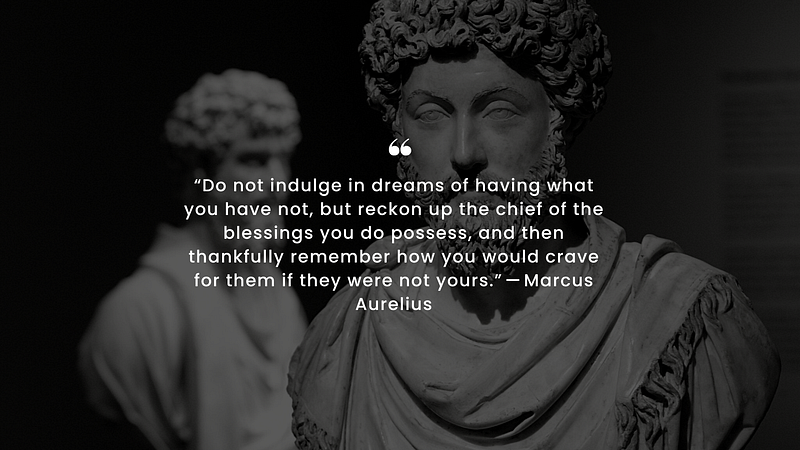
Negative Visualization is a stoic practice that involves voluntarily contemplating what you value in your life and visualizing your life without it. Engaging in negative visualization makes you want what you already have. It creates a sense of gratitude and helps us embrace whatever life we are already living.
To practice, negative visualization, set aside 5 minutes per day early in the morning, as this is when we are preparing for the day. Next, pick a topic and stick to it. This can be a loved one, a possession, a basic need or your mortality. Think about what your life would be like without it and write it down. At the end of the practice — set an intention for the day. This can include being more present, showing more appreciation for loved ones or just being more grateful in life.
For our writer, this means imagining what life would be like without his health, family and existing audience. The idea is to remind the writer how lucky he already is in life and to not take that for granted. The fact that he can exist on a mote of dust suspended in a sunbeam is a miracle, and everything else is just a bonus.
Bonus Practice — Memento Mori
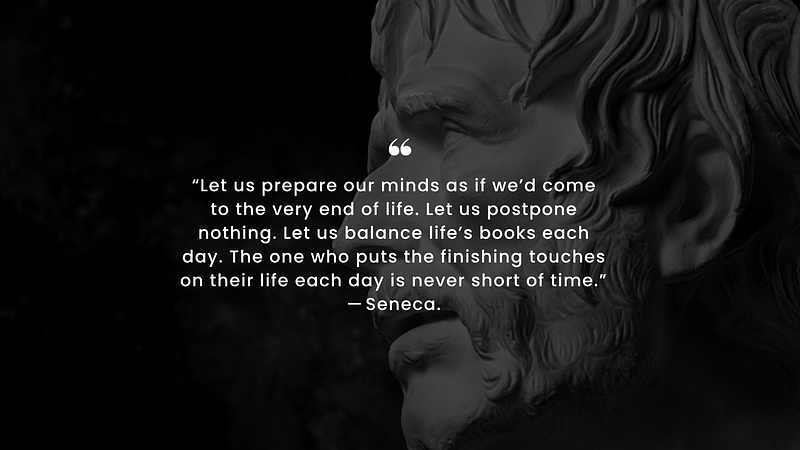
I decided to add Memento Mori as an honourable mention as I believe it’s more of a reminder than a practice. Memento Mori is a Latin phrase that translates directly to “Remember you must die.” Contemplating our death can empower us to live each day to its fullest and help us appreciate what we have in our life.
Our writer would be wise to remember that one day his time will come, and he should not spend the precious time he has worried, angry and frustrated with the world. Instead, he should make the most of whatever time he does have, as it is not guaranteed.
Closing Thoughts
As I wrap this article up, I wanted to quickly remind you of the five exercises and how you can think of them as questions to ask yourself in challenging situations.
1 — Is this in my control?
2 — Am I accepting whatever fate has in store for me?
3 — Am I adding judgements to this obstacle? If so, is it harmful?
4 — Does this obstacle matter in the grand scheme of things?
5 — Am I practicing gratitude for what I already have?
By asking yourself these questions and practicing the exercises mentioned above, you can live a resilient and tranquil life. As for our writer, let’s hope he is reading this somewhere and reflecting. I would love to hear your thoughts on this topic. Feel free to comment below or follow me on Medium for more ancient wisdom.
P.S — If you enjoy reading stories like this and want to support me as a writer, consider signing up to become a Medium member. It’s $5 a month, giving you unlimited access to all stories on Medium. I’ll earn a small commission if you sign up using my link.