
5 Reasons Virtual Learning is Terrible, and How We Can Change It
There are better ways to teach children in schools, and the education system can easily adapt.
Knowledge is power. It’s essential to gain valuable life skills, but we also need to have a basic education level. Even though most of us don’t like school, almost everyone gets a chance to finish high school. Education isn’t debatable with our families, because our parents want us to succeed in school and have decent jobs. It means that, whether you like it or not, you have to attend classes and collect the high school diploma. And if you have good grades, you may consider entering University.
2020 has been a difficult year for many industries, but it proved to be particularly hard for the education system. Numerous changes came into play, and the entire world had to do a massive switch to virtual learning. Schools were not prepared for this adjustment, but they did their best. Unfortunately, many students aren’t happy with the new learning approach. I believe we can do a better job teaching children and young adults.
I want to highlight the negative aspects of the 2020 learning experience and offer solutions. The Internet has been a learning medium for many years, and if it stays this way, we should provide educational materials in the best possible form. There is a better way to study from home.
Hi, I’m Joanna, and I write stories about relationships, politics, interesting facts, and a variety of other topics. Please subscribe, so you can read my articles the moment they are published. Your support helps me write more often. P.S. I’m also sending all my writing income to Ukraine. 💛 💙
Sitting in Front of a Computer the Entire Day is Nonsense
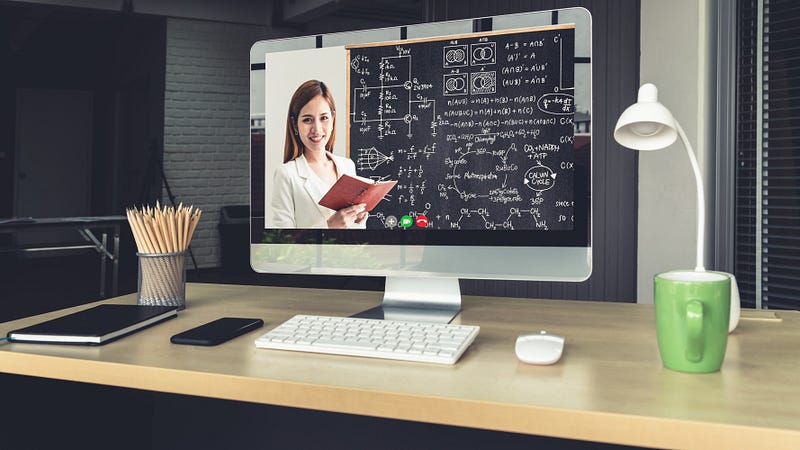
Kids are required to attend virtual classes in real-time. It means they must sit in front of the computer and have the camera on for the class’ duration. It allows the teacher to see what every student is doing, and they aren’t always pleased with what they see.
Let’s be honest: none of us can endure an hour of a class without getting distracted or tired for a little bit. Sometimes you need to close your eyes, or to yawn, or look out the window — there are many examples of what else you may do during a class. But how are you supposed to act while in front of a camera? If you dare to yawn, the teacher will see it right away. Students who look elsewhere or have their eyes shut attract the instructor’s attention as well. It has nothing to do with them disrespecting the teacher; children simply cannot look at the same spot while maintaining focus for an entire hour. University students can’t do that either! It’s tedious, it’s boring, and the amount of new information can be overwhelming.
Not only it frustrates the students, but it also upsets the teacher. The lecturer gets distracted once in a while, too — after all, we’re all human. But the perspective of sitting in front of a computer for a prolonged period, with small breaks, for half of the day sounds like torture. Most importantly, what’s the point of that? Most students will stay silent 95% of the class, counting minutes till the end, and still have to go through all the material on their own.
I believe that virtual classes conducted in real-time constitute a total failure. Teachers aren’t comfortable, students are unhappy, everyone is tortured, and productivity falls like the stock market in an economic crisis. This cannot be the only way to approach virtual learning.
Video Conferences are Glitchy
Another reason to forgo video conferences is technical issues. In the class of 20 students, someone will have a connection issue at least once during the class — or, most likely, multiple times. Even the best Internet provider is bound to have tech difficulties. It means that a video conference would constantly have students dropping out.
But the worst part is, it makes collaborating with classmates nearly impossible. Some students would have a fast Internet; others would not. Certain kids may have tech issues more often than others. Moreover, applications like Zoom and Skype are not perfect and can fail at any point. It means that working as a group is extremely difficult, and having a conversation presents a challenge. Even when the instructor asks a question, the student may not hear it right away during a real-time class due to the connection issues and Internet speed. What about echoes, loss of sound, some other issues? Collaboration might be entirely out of the question.
Living Arrangements Don’t Always Work with the Study Schedule
Having a strict school schedule is tiring, and sticking to that schedule while studying from home is exhausting. Let’s be honest: at a regular school, if you’re tired, you can sit at your desk and daydream for a little bit. But no sleeping during virtual classes! The teacher can see everything.
How are you expected to sit through five hours of video conferences almost every day? How can you stick to a strict schedule while studying from home, where many other family members have to coexist? Don’t you think a student would have difficulty finding a quiet place to stare at the computer for many hours? What about kids who share the room with a brother or sister, and that sibling may also study virtually? How about students living with a lot of family members in a very loud environment?
There are many difficulties related to living arrangements. Not only virtual studying presents a challenge, but sharing your family life with others is something no one wants. School is school; personal life should be separate.
Lack of Resources for Practical Classes

How are you supposed to complete a practical assignment for a chemistry class while in a Zoom conference? You can most certainly write and read, but practical tasks pose a challenge. Even if you could set up your laptop or phone properly to let others see what you’re doing, the teacher won’t have the opportunity to correct you if you’re making a mistake. Not only it makes practical classes useless, but it also presents a safety issue.
The traditional education system doesn’t have the proper resources for practical tasks. No one expected a pandemic to come around, so we can’t blame the government or anyone else for this. But the bottom line is: we don’t have what we need. Schools are only equipped to conduct theoretical classes, and that’s not good enough.
Outdated Teaching Style
Studying from home is vastly different from what students are used to doing. But unfortunately, the teaching style hasn’t changed. Giving a lengthy lecture, with most students staying silent and possibly falling asleep. Barely asking them to speak, being unable to have proper conversations due to technical issues. And then the impossibility of collaboration! All this shows how outdated the teaching style is centered around theoretical education.
We cannot blame this on teachers — they are doing the best they can. But we certainly require new ways to teach kids and young adults.
Solutions
I wouldn’t say I like approaching people with a problem — instead, I prefer to come with ways to solve it. Without further ado, I would like to present you with solutions to the issues highlighted above.
Moving to Online Education Without the Real-Time Presence
There is a huge difference between virtual and online education. Virtual education constitutes a real-time studying style that involves the instructor and students being present. It’s inconvenient, it’s tiring, it’s annoying, and the application often shuts down due to tech problems. The worst part is it’s a complete waste of time. This is precisely why we need a change.
Online studying doesn’t necessarily need to happen in real-time. Students can have access to educational materials and online classes, but they don’t need to be present at a conference at a particular time. Universities have been offering online courses for many years before the pandemic occurred — it’s not a new concept. Kids can study online without sitting in front of a computer for many hours, staring at a screen and trying not to upset the teacher.
A school can set up a learning portal with a list of classes. Each class can have several materials attached:
- Video recordings of the teacher explaining the material of each chapter.
- An online discussion forum where students can collaborate in a text format. The teacher can post a question, and each student would have to respond.
- Files related to the assignments, with a comprehensive schedule for the entire course.
- Recordings of the instructor explaining the assignments.
- Online quizzes, midterms and exams.
- Online labs allowing students to review the material for practical assignments, with the opportunity to record a video of them completing the task at home, without being tied to a particular day in time.
- Other resources that we can learn from different communities and countries.
Studying from home doesn’t have to be torturous and exhausting — on the contrary, it can be quite enjoyable, convenient and productive.
Eliminating Video Conferences
Is there a need for video conferences? Can’t everyone complete the assignments in their own time and then submit them to the learning portal? Connecting over Skype or Zoom doesn’t seem like a necessity, especially when it presents an array of issues.
The instructor can schedule a bi-weekly or monthly collaboration class, if necessary. It can present a chance for students to work together, considering the technical limitations. All the other time, every child can study on their own.
Adopting a Flexible Schedule

Being online at 8:00 AM on Wednesday doesn’t sound too appealing. What if the student is a night owl and usually goes to bed at 3:00 AM? Is it absolutely essential for the entire class to be in front of their laptops at a very specific time so that they could stare at a camera and daydream?
Real-time classes are ineffective, in my opinion. But what’s also doubtful is a strict schedule without any leeway. Does the student need to submit a short assignment at exactly 2:30 PM on a specific day? Or is it possible to give them a more flexible schedule, so that they would stress less and structure their week properly?
A flexible schedule is not difficult to accomplish. The students will still complete the assignment and learn from it, which is the main goal. It doesn’t matter which day of the week they do it, as long as the work is completed. Midterms and exams, of course, should be scheduled at a specific time.
Allow Collaboration Using Out-of-the-Box Methods
Since collaborating over a video conference may not be a good idea, the teacher should allow students to utilize outside-of-school methods to complete group assignments.
Can Jessica and Amandeep meet together at home while wearing masks, complete the art class project, record the whole thing and e-mail it to their teacher? If their parents deem it safe, they can! How about learning to edit videos and combining several of them where students present small parts of the presentation, while adding text and notes to the video? It’s an option too.
There are many options and opportunities, as long as the instructor doesn’t mind students trying an innovative studying method.
Learning Something New
Studying from home is new to everyone, and there is no right way to approach learning. If someone comes up with a fresh idea that proves to be effective, it would be great for the teachers to implement it. Maybe instructors can learn from students as well, especially since the younger generation is more tech-savvy?
Open your mind to new ideas and studying methods. Sitting on a couch with the laptop on your lap for half of the day, while barely moving, is not good for anyone.
Conclusion
The old saying teaches us:
“Where there’s a will, there’s a way.”
It’s simple yet very accurate. We don’t know how to approach the situation we were presented with, so we need to educate ourselves and modernize our learning styles. We have to adopt new methods and open ourselves to brand new ideas.
Some say the education system has been broken for a long time. There is no need to make it even worse. Schools should teach students valuable life skills, and one of those is making the best out of a miserable situation. Another useful skill is to adapt to changing circumstances and come up with the best possible solution. Looking at a camera for many hours on end and learning almost nothing doesn’t constitute a good solution.
The world is changing, and technology is leading the way. We need to embrace that, not hold on to the dinosaur methods.