
5+ Reasons I Fell in Love With Math — Part I
People are often prone to portray Math as a terrifying experience, sometimes even spread monster stories. In other words, instead of coping with it, they choose the simple way and transform Math into an evil instrument.
Although my affection was born in a few hours, and we had no Youtube, Google, Facebook, or Pinterest, I will lay out my motivation chronologically.
The first part was the most emotional for me, not just because I was 11 years old. I was a real book-eater hungry for any information and subconsciously learning to classify what I read. I came across an old book full of engaging stories about Math. It was probably fateful I spotted a young genius boy story first.

It was the renowned story of young Gauss. Carl Friedrich Gauss is considered one of the greatest mathematicians ever. After his seventh birthday, he had reached the arithmetic class, and his teacher needed to keep the kids busy for a significantly longer period. The teacher gave his class an assignment to sum the first 100 integers, hoping for quiet at least half an hour. You can guess his disappointment when a young pupil produced the correct answer almost immediately.
No, the young pupil wasn’t a living calculator or a well-trained calculation prodigy. He was something much greater. He was able to perceive one of the most crucial Math principles — patterns.
Instead of summing integers one by one, he was trying to find some pattern. And indeed, he came up with it soon. He was quick to observe that adding the first and the last integer results in 101. Then he added second integers from both ends, and the result was the same. This pattern worked for all integers in this progression. Finally, he realized 50 pairs are resulting in 101 in the list given. That’s why he was sure the result would be simply 101 multiplied by 50.
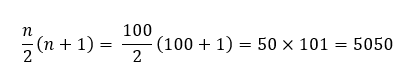
So it happened that he announced the correct answer 5050 in less than a minute or so. That day Gauss laid the cornerstone of arithmetic progression theory.
Can you believe I was really shocked and highly excited about it? After rereading the story, I immediately derived the formula. My heart was racing, and I couldn’t keep up. Of course, the first steps were to check the formula for different n integers. It worked! When the excitement had transformed into a normal state of mind, I was deriving formulas for any starting integer, etc.
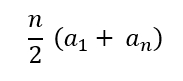
It happened probably by accident that I could use the formula in my exercise at school very soon. Although I received no credit, I was done ages before other students. I was so proud I found the book and learned the principles.
That day I fell in love with Math, and I’ve started to look for patterns and exciting practical usage everywhere. I was able to calculate my annual savings if I managed to save 50 cents every week easily. Suddenly, I could see arithmetic principles almost everywhere. I used my knowledge wisely, and I was hunting for the following skills impatiently.
If you’d like to read more content like this, become a member:
Or you can subscribe to my newsletter below. Thank you.


