5 Quantum Machine Learning Resources not to miss
Useful things beyond the two hypes
A recent controversial paper tried to define a new formalism for deep learning in terms of quantum fields. Indeed, qubits are described naively as a state between zero and one, and each node of a neural network, similarly is a value between zero and one meaning probability or something alike. It is intuitive to imagine an overlap. Both topics have been overly boosted by (unmotivated?) hype, though they are both useful technologies. Beyond the hype(s), there might be some opportunities combining the two approaches.
Indeed, the idea is not new, and several authors have already tried to reframe existing machine learning algorithms (see list below). Improvements in machine learning algorithms can be achieved by using some quantum computing components, or quantum computing can reduce some hardware noise by using machine learning. Therefore, it is worthwhile to consider the combination of the two formalisms. I report here 5 useful resources if someone wants to delve into this cocktail.
Those resources are:
- Reviews or Introductions
- The online course by Dr. Peter Wittek from Toronto University
- Relevant Github/Gitlab repositories on quantum machine learning
- List of relevant papers
- Books
1. Reviews or Introductions
As a review summarizing what has been done (up to 2017) already exists, it is advisable to start from there. The paper written by Jacob Biamonte, Peter Wittek, Nicola Pancotti, Patrick Rebentrost, Nathan Wiebe and Seth Lloyd, focuses on quantum basic linear algebra subroutines (BLAS) — as Fourier transforms, finding eigenvectors and eigenvalues, etc — which are heavily used in machine learning algorithms, highlighting the advantages of using quantum rather than classical hardware. Indeed, the achievements are mainly in computational speed, although discussions on quantum support vector machine and quantum kernel appears. There is a very good introduction to quantum annealing and quantum Boltzman machine. An updated version (2018) is available on arXiv, although you cannot expect an over-comprehensive summary as the field of quantum computing is having a revolution each week. Nevertheless, the authors are among the pioneers thinking about the combination of both fields. Therefore, worth reading especially for the beginners in quantum computing who are familiar with machine learning.
Moreover, thinking first about the WHY before the HOW, a notable lecture is freely available on youtube by Max Henderson from Rigetti about “the Emerging Role of Quantum Computing in Machine Learning”. It is really recommended.
If you want to see the otherway around perspective, machine learning can be used to reduce noise of quantum computing:
2. MOOC videolectures by Dr. Peter Wittek
Peter Wittek was an assistant professor at the University of Toronto. He passed away in September 2019 when an avalanche hit their camp during an expedition on Mount Trishul. He is mostly known for his book “Quantum Machine Learning: What Quantum Computing Means to Data Mining” (discussed later), and his video lectures. Indeed, he left a really nice course of 41 lectures (each less than 10 minutes though), comprising quantum Gaussian processes and the Harrow-Hassidim-Lloyd (HHL) algorithm, and so on.
3. Relevant Github/Gitlab repositories on quantum machine learning
There are already quite few repositories about quantum machine learning. I was impressed first of all by the material collected by Krishna Kumar Sekar in his Gitub. There is really a lot comprising pictures, code (or link to other repo) and documents. It is maybe too much for a Github repo, but you might find something useful.
If you are looking for quantum neural networks, some scripts are available here. Those are from the Paddle Quantum project, which aims at establishing a bridge between artificial intelligence and quantum computing.
The HHL code in qiskit for the implementation in IBM Quantum Cloud and the in Pyquil and Grove for the implementation in Rigetti, are instead easily accessible on the Gitlab Bayesian-dl-quantum.
4. List of relevant papers
If you are coming from a background in machine learning and want some updates about hybrid implementation of quantum computing, I recommend the following papers from arXiv and on other journals:
- Unsupervised Machine Learning on a Hybrid Quantum Computer (J.S. Otterbach et al., 2017)
- Quantum algorithms for supervised and unsupervised machine learning (Lloyd, Mohseni & Rebentrost, 2013)
- A Machine Learning Framework to Forecast Wave Conditions (James, Zhang & O’Donncha 2017)
- Quantum Neuron: an elementary building block for machine learning on quantum computers (Cao, Guerreschi & Aspuru-Guzik, 2017)
- Quantum machine learning for quantum anomaly detection (Liu & Rebentrost, 2017)
- Proceedings of the First Workshop on Quantum Tensor Networks in Machine Learning (NeurISP 2020)
- Training deep quantum neural networks (Beer et al. Nature communication 2020)
If you are coming from the other end of the spectrum and would like to know how to use all your physics knowledge in machine learning
- Quantum machine learning: a classical perspective (Ciliberto et al. 2018)
- Parameterized quantum circuits as machine learning models Benedetti et al (2019).
5. Books
Despite there are quite some excellent books on quantum computing, specific textbooks on quantum machine learning are still missing.
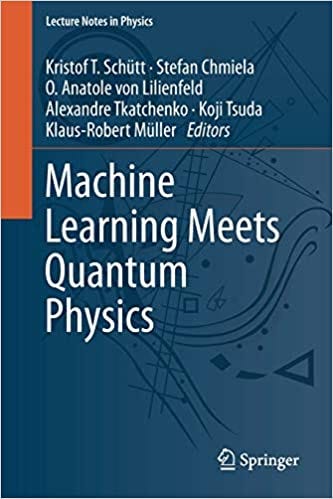
The only one I feel confident to recommend is “Machine Learning Meets Quantum Physics” edited by Springer by Kristof T. Schütt, Stefan Chmiela, O. Anatole von Lilienfeld, Alexandre Tkatchenko, Koji Tsuda, Klaus-Robert Müller as Editors. It is a collection of research papers (so, not for beginners), which are mostly focused on chemical quantum simulation capitalizing some machine learning tools.
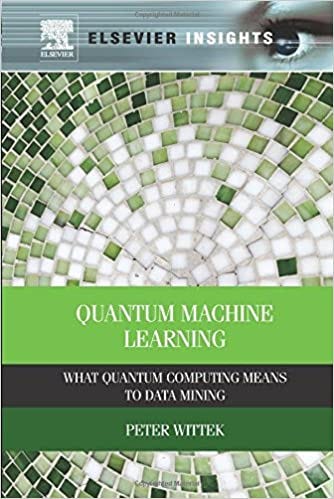
“Quantum Machine Learning: What Quantum Computing Means to Data Mining” edited by Elsevier. It is a text written by Peter Wittek (which we mentioned before about his video course on quantum machine learning). This is a text which is introducing you both to quantum computing and machine learning. It is a good move if you do not know them both. However, I would generally discourage a text which is trying to accomplish everything (and in the end for obvious reasons remain introductive). Indeed, the applications on quantum machine learning are really vaguely mentioned. I was a bit disappointed considering who is the author, but I guess this was his intention, and if you are a total newbie in both fields, why not?
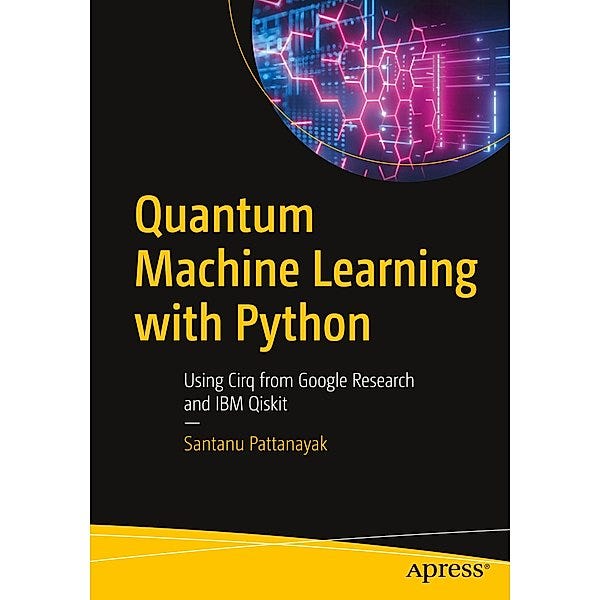
Quantum Machine Learning with Python by Santanu Pattanayak edited by Apress.
More recent compared to the other 2 and definitely on the practical side of the spectrum. Recommended for computer scientists who want to go straight to the point.
As the title says, it is mostly focused on coding. It starts with some introduction to quantum computing, quantum Fourier transform and towards the end quantum neural networks and quantum Tensorflow and PyTorch. There are several pseudo code transcripts and some guided scripts in Cirq and Qiskit as the title says. You can sneak on the explained code on the related Github repo:
If you need an overview of practical texts about quantum computing check
Conclusions
Quantum computing and machine learning are among the buzz words of our days, partially for true reasons and partially for hype. There might be some advantages in combining them, but it is yet to be demonstrated that those gains are just slight increments. On the other end, quantum computing is still in its infancy and in the future will be more ubiquitous. Therefore, I would expect we will have machine learning algorithms that run on optic hardwares. Quantum machine learning is not going to be the next revolution, but rather a normal way of designing algorithms as quantum computing will be more common.
Connect if you want