
5 Powerful Questions to Self Coach Yourself to Success
You need to dig deeper than you think.

As a startup mentor and a coach, I witnessed so many entrepreneurs going through the trenches of selling their idea to the investors, creating momentum in their business, and finally “making it”. Some made it, so many didn’t.
As for why so many can’t make it, I knew the usual reasons such as product-market fit, the team experience and dynamics, timing, and luck, etc. But, connecting deeper with entrepreneurs, now as an entrepreneur myself, I’ve become fascinated by the internal process that strongly influences whether we can achieve our goals.
The internal process consists of constant self-awareness to cultivate the right thoughts and behaviors for success. It is also repeatedly choosing to embody the characteristics and actions of a successful person. Coaching dozens of people, and self-coaching on a daily basis, I noticed that there five major questions to help us master this internal process:
1. Am I following my bliss?
Joseph Campbell poses this question in the Power of Myth to urge us to question whether we are in touch with our inner calling. I say inner calling because I want to stay away from overused and highly interpreted words like “passion”.
What Campbell was talking about is simple yet deep, it is closer to creating a purpose. His argument is that every human being is born with a unique set of interests and capabilities. If they own and follow what makes them curious and have fun at the same time, they get to create immense value for themselves and others.
The reason following your bliss is important is because this is how you can shine the most. The purpose fulfills you so that it feels natural to explore, dive deeper, and work on it for hours. As a result, it is much more sustainable to work on your bliss as opposed to feeling depleted while working on something to make money only.
2. What is driving and hindering me?
Success mindset requires knowing yourself. If you are in this mindset, you know that the quality of your actions will depend on your decisions. You understand that your decisions are crafted by your beliefs and self-perceptions.
A lot of people dismiss or neglect self inquiry, thinking that circumstances they deal with are more important. Yet, it is not uncommon to see, so many people set goals over and over again to fail at them. The reason for that is that they never go deeper into the “why” they have a hard time aligning their intentions with their actions.
Think about it this way: If you want to launch a business, yet you hold a strong belief system about how much you suck at business, you will likely to self sabotage, procrastinate, and have a hard time to build your business. Even if you succeed, it will be hard to make your business highly successful. In this case, it doesn’t matter if you try to change the business idea, or create deadlines etc., because external circumstances aren’t the core reasons why you are failing to take action, but rather the internal dialog causing the destructive behaviors.
Self-awareness is truly a power; a power to know yourself and consciously choose the characteristics that serve you and deliberately let go of the ones that harm you and others.
3. Who I need to become?
Successful people understand that getting to a success level will require expanding their current identity. They know that our ego always is trying to preserve the current sense of self, including all its negative behaviors.
That is why both fears of failure and success feel like a threat to the ego: Instead of staying the same, you open to the risk of being someone who is wildly successful or who fails. In both cases, the ego perceives as your identity has to change.
Anything threatening your identity to change creates the loudest fear.
Fear of failure is obvious; new ventures require you to be/do new things. Because this whole process is new to you, you have to take the chance to suck at it, learn through trial and error, and accept that the outcome may not be what you hope for. Of course, this is scary; you don’t want to look bad, disappoint yourself or others. Most importantly, you don’t want to be “someone who fails.”
Sometimes that loudest fear is a success. When you look at people at the success level you envision yourself at, you may feel overwhelmed by the amount of work they needed to do to get there, and continue to do. It may feel like an enormous responsibility to be exceptionally successful. You can see the edges of your current identity and how much stretching it would need to transform into an identity of a truly powerful person.
At that point, if you choose to embody a wildly successful person’s identity, you no longer entertain the low vibe thoughts and behaviors. You know the fear of failure will be there as long as you have an ego. Rather than being stopped by it, you choose to move through it.
As for the fear of success, you know it is about being ready for it. You understand that big dreams, big creations take a lot of energy. You make peace with the fact that building your success will be consistent intention and action for an unpredictable amount of time.
4. What keeps me going when things are hard?
I recently saw Don Kelley and Daryl Conner’s model, The Emotional Cycle of Change describing the path to success as a U-shaped journey.
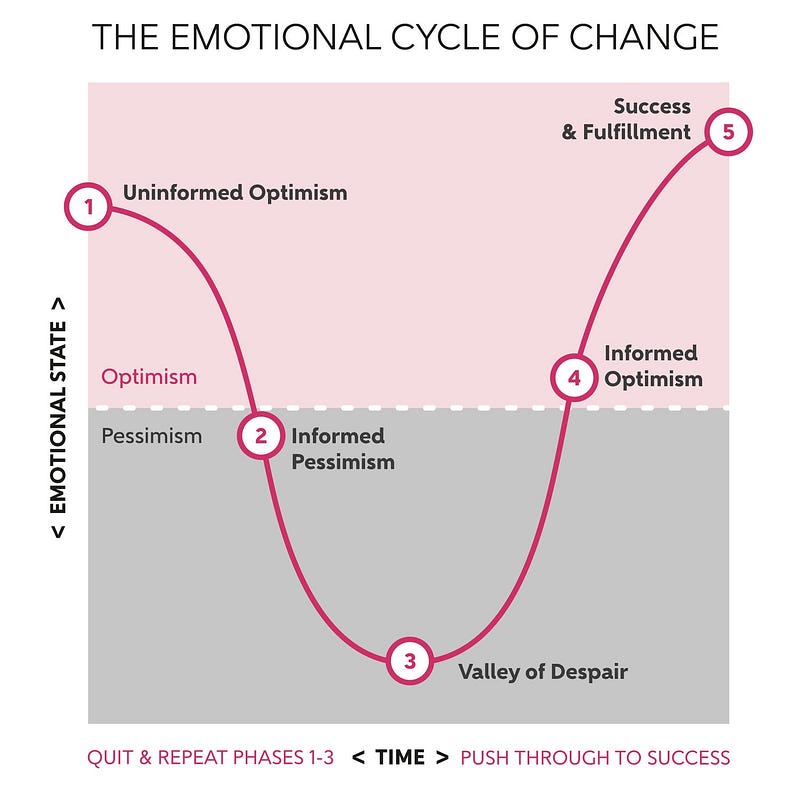
When you start at stage one (Uninformed Optimism) you have an idea, you are excited and hopeful. You believe you can do it. Then you start working on the idea, and you get to stage two, Informed Pessimism, and realize it isn’t as easy as you thought. You start to lose hope. You continue but feel overwhelmed, less and less hopeful until you hit the Valley of Despair.
At that point, a lot of people quit or repeat the same journey up to this point. Only a small percentage of people choose to continue regardless of the difficulty. They first get to the Informed Optimism feeling that it is difficult but they can do it. As they continue their progress, their work pays off and they achieve success.
So, what’s special about the people who push through the Valley of Despair and eventually become successful? When things are hard and they can’t see the light at the end of the tunnel, they go back to their “why”. Quitting perhaps feels the most tempting and justifiable next step, but they choose to ground themselves into their values.
As an example, they may keep going because their impact can be crucial for so many people that they need to continue for them. This is true for so many social entrepreneurs. Or they may want to be an example for their kids to teach them they can create their dreams. They decide that their values are more important than the relief that comes from quitting.
Knowing your values is key to persevering on a difficult journey. This is why people who are success-minded, spend enough time getting to know themselves. Again, self-awareness is power.
5. How am I supported?
Successful people are not martyrs. They know that persevering doesn’t have to be painful. They seek support to lessen the intensity of their journey. Their success definition is grounded in having healthy relationships. They spend time creating relationships that support them along the way. They have nourishing and uplifting relationships with their partners, friends, and communities. They also have that connection within themselves; being connected to their spirituality or philosophy to make life more meaningful.
As they grow their success, they keep asking the same question. They hire people for the task they don’t excel at, they invest in themselves, and they delegate. They know that their wellbeing is the source of success, therefore the number one priority.
Overall, what sets successful people apart from the rest is knowing themselves; their purpose, values, inner obstacles, and needs as well as acting consistently to transform themselves into successful people. If you consistently ask yourself similar questions and coach yourself into taking aligned action, you will also transform into your version of a successful person. You got this!