
5 Powerful Life Changes After 100 Days Without Social Media
Magic happens when you free 1000 [unproductive] yearly hours.

I have been obsessed with Instagram for 5 years. I used to upload gorgeous pictures — of food, of me travelling across the world, and of my lovely life.
If you’re looking for me to admit it was all fake, unfortunately, it wasn’t. I truly believe if you have an account with a large number of followers (or even 10 followers) there’s a responsibility you carry.
I perceived it to be my responsibility that nobody should leave upset, angry, or jealous if they see my page.
But enough about me, let’s talk about you. Do you associate with any of the following situations?
- Do you reach out to your phone as the first thing in the morning and the last thing at night? (40% of us do)
- Do you reach out to your phone several times a day to check for notifications?
- Do you have the urge to upload and/or watch ‘stories’ of numerous people every day?
If you said yes to any of these options, then I completely understand you, my friend.
And you don’t have to feel guilty. It’s not your fault if you spend hours on social media because social media is designed to make us spend hours of our time on their product.
Every time you get a like, your heart smiles a little as your brain releases a shot of dopamine (the feel-good hormone). The same hormone which gets released every time you feel good after smoking, sex, or midnight-dessert cravings.
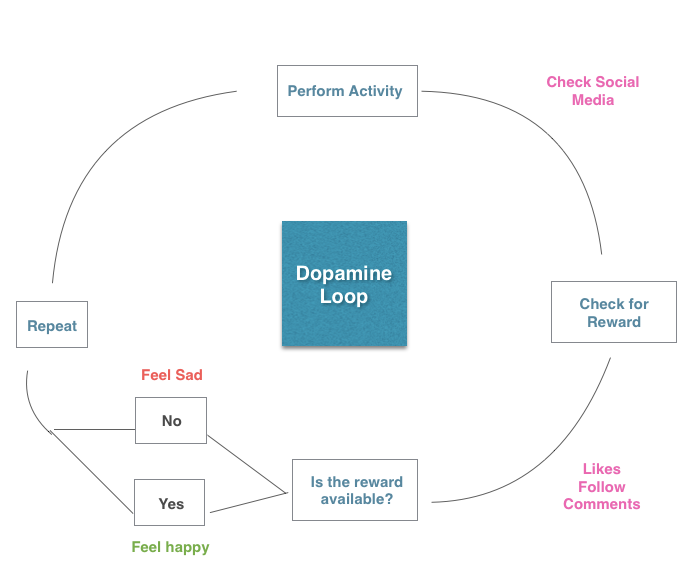
Dopamine creates a loop where you constantly perform an activity (open social media) to attain your reward (likes), and repeat this because every time you do this you feel good.
Which also means every time you do it and there are lesser likes and comments than you expected, your dopamine doesn’t get released as much and you feel low.
Today, I have been without Instagram for 100 days.
When I checked my screen time, I spent 90 minutes on weekdays and upwards of 2 hours on weekends — only on this app.
“An addiction to distraction is the end of your creative production.” — Robin Sharma
100 days later, I am shocked at how different I feel. I discovered things about myself I didn’t know existed.
Here are the 5 things which completely transformed me in just 100 days.
1. Internal and external awareness dramatically shoots up.
“The age in which we live, this non-stop distraction, is making it more impossible for the young generation to ever have the curiosity or discipline because you need to be alone to find out anything.” — Vivienne Westwood
I found myself being aware of the things I never noticed earlier, such as:
- Eating delicious food — noticing how it tastes with every bite and not gulping it down while I scroll
- Spending time with friends and family and giving them my 100% focus, no clicking pictures or checking any apps
- Becoming more aware of time, instead of minutes to hours vanishing with my eyes glued to my phone
- Posture — I want you to notice this right now. Are your shoulders drooping forward as you read this?
It’s surprising how many things you become aware of and feel when you’re not spending hours of your precious time staring into your phone screen for unproductive activities.
From becoming more intuitive about how you feel, breathe, and eat to how the air feels on your skin and how beautiful your partner’s laugh is.
A lot of these things which make living so joyful unfortunately go unnoticed because our eyes (and minds) are always somewhere else.
2. Focus enhances like never before.
“The secret of success is learning how to use pain and pleasure instead of having pain and pleasure use you. If you do that, you’re in control of your life. If you don’t, life controls you.” — Tony Robbins
Do you check your phone every time a notification pops, even if you’re in the middle of work?
Okay, you may have your notifications off during working hours. Or you probably use an app to turn down notifications when you’re doing something important.
In that case, do you have an urge to take a small break to check your texts or email?
What about multitasking — what's the big deal between looking at an app every now and then just for a little cognitive vacation, after all.
We’ve got this all wrong.
Our brains aren’t wired to multitask because doing so weakens our cognitive strength and focus.
Author and academician Cal Newport explains that when you jump from one task to another, a whole new set of neurons work while the others get suppressed. So you're not mastering multiple tasks at the same time because your body is designed to focus on only one task at a time.
With distraction being available on our fingertips, we constantly let our distractions weaken our ability to focus.
According to a 2015 report from Microsoft Canada, our collective attention spans have decreased from 12 seconds in 2000 to just seven or eight seconds today. Social media was cited as one of the key drivers.
3. You feel extremely content with everything in life.
“When a person can’t find a deep sense of meaning, they distract themselves with pleasure.” — Viktor Frankl
Reversing the quote above, ‘distracting yourself with pleasure constantly also omits you from finding a deep sense of meaning’.
Some of you may be thinking that you are already so happy, with occasional ups and downs. And I want nothing but that for you!
I thought that too because I’m the person who writes a gratitude journal and stays optimistic about life.
So if you think you’re happy and in content with life, this practice is even better for you. It will awe you with the extent to which you feel even happier and more satisfied than ever before.
You will constantly feel good about things, and there’s an underlying reason for this.
Studies show that the people who take a break from social media experience big jumps in life satisfaction and positive emotions.
You start to live for yourself.
Some activities which you eliminate and make you happier are:
- no more looking at what the world is up to
And I listed two more but I want you to think about how things which change for you if you just stop watching what others are up to all the damn time.
There’s no pressure to buy certain things, look a certain way and care about what others think.
There’s so much freedom to just be you.
The freedom we’ve always had to live our life by, but we constantly let everybody else determine how and how we should be and what we should do.
Think about it, are a lot of your decisions influenced by looking at what others are up to?
I feel you, I’ve been there. And I promise you’re in for a joy ride when you detach from this feeling.
4. You indulge in awesome stuff outside of a 6-inch screen.
“Don’t let mediocrity distract you from greatness.”
— Asad Meah
Let’s take a look at American phone users and their behaviour in 2019:
- A smartphone user spends an average of 3 hours 10 minutes per day on their phone
- 16 to 24-year-olds spend a median of 3 hours on social media every day
- Snapchat reached 90% of all 13–24 year-olds and 75% of all 13–34-year-olds in the US
We spend roughly 1000 hours per year glued to our phone.
What happens when these 3 hours a day become 1 hour instead? You get so much free time. Free time with no distraction.
This is when you become more aware, and think.
Think of the hobbies you indulged in when you were younger but stopped now because of lack of time. Honestly, you did have the time to pursue them all this while but unknowingly spent that time on brain-numbing activities (and apps) instead.
Humans are meant to thrive on growth. We all enjoy challenges in fields that excite us, we want to become better, we want to do things which make us feel closer to our purpose.
We just let this potential go because a major chunk of our time goes into our screens, which gives us no value in return.
This is where there is finally space for your creative energies to flow out.
I wouldn’t have been here writing this if I didn’t practice what I’m preaching. I completely let go of writing, until a month ago when I allocated at least an hour a day to write. It was like getting back to school because that was the last time I wrote every single day.
This might just be the time to unleash an inner potential. Give yourself this time because you deserve it.
5. You discover embarrassing traits about yourself.
“You can’t heal what you don’t acknowledge.”
— Jack Canfield

Do you ever take part in the following when you scroll?
- Make fun of other (known or unknown) people
- Like an outfit and search for it to put it in your cart
- Wish you had those abs you see online
I’m guilty of all three! If you’re embarrassed, please allow me to share that feeling with you here.
While we may not want to admit it, social media does spike a somewhat fire of jealousy inside us because it gives us multiple chances to feel ‘I wish I had this too.’
While this thought lasts for a second because we scroll on thereafter, the mere frequency of this thought is problematic.
We have underlying negative emotions such as jealousy, frustration and sadness which get triggered by social media. This often makes us anxious.
I kid you not, I perceived myself to be a Zen nugget until I realised the presence of these underlying emotions. It was normal for me to feel anxious till a certain level that I didn’t even know it was anxiety, it was just the usual.
Only when I stopped feeling that way did I realise that it wasn’t normal, after all, to feel anxious that often.
A study out of the UK surveyed 1500 Facebook and Twitter users, finding that 62% of the group reported feeling inadequate and 60% reported feelings of jealousy from comparing themselves to other users.
Are you aware of your goals?
And I mean really aware where you have them written and a plan on how to achieve them? I know we read about it often, but reading and spending hours with yourself to think and work on it is different.
If your answer is no, I too didn’t until a few weeks ago.
Yes, I am 24 years old without any concrete goals written and a game-plan to follow.
Until now.
A good time to have thought of this was years ago and the best time to do it is now.
While all this is embarrassing to find out it's also a moment of epiphany.
Recognition is the initial step towards changing something and when you recognise something you’re embarrassed about, you’ll run even faster to change.
What are you doing today for your future self to be grateful for?
“Work is hard. Distractions are plentiful. And time is short.” — Adam Hochschild
If you’ve made it this far, I want you to know that
- Technology isn’t bad
- I am not writing this for you to quit social media
Consuming isn’t bad, but what you consume matters. Social media isn’t bad, but how you handle it matters so you don’t let it handle you.
All I want you to do is do something that your future self will be grateful for. Our generation has so much potential with epic technology around us, but we’re letting it die unintentionally.
Slow down. Pause. Look inside, and look outside.
What do you see?
What do you feel?
Where does this take you?
Your journey is for you to experience. You just need to make some tweaks to get on the right path in this fast-paced and distracted world.


