
The Anti-Hustle Movement: Why Breaking These 5 Rules Will Make You More Productive
Why follow rules that weren’t made for you?

As a (recovering) perfectionist, I feel like I’m an expert in productivity hacks.
Every perfectionist is.
Or at least, we’ve memorised the same five hacks every generic productivity article shouts about. It’s in our DNA. The pursuit of perfection leads us down the rabbit hole of seductive productivity content.
We’re hamsters running around the same wheel, going nowhere fast.
We constantly feel like we’re not good enough, so we Google how to be more productive. We try to implement the advice, but we give up because we didn’t do it perfectly. As a result, our productivity suffers, making us feel like we aren’t good enough.
I call it the self-inflicted cycle of painful self-sabotage… or SICOPSS for short.
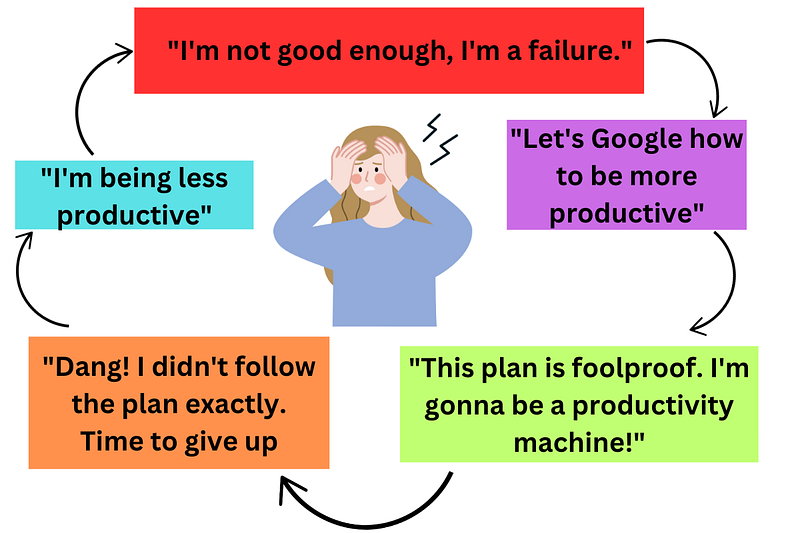
Ironically, for most perfectionists, normal productivity advice doesn’t really work. Perfectionists aren’t wired to manage their self-expectations in the same way other people are.
This means most productivity advice turns from “This will help you achieve your goals” to “This advice is going to make you feel inferior about your ability to be productive and succeed.”
Over the years, I’ve been left bruised and broken, thinking that my inability to find success in productivity advice was because there was something fundamentally wrong with me. It never occurred to me that my issues with productivity were actually a result of trying to follow the rules someone else set. Rules that don’t take into account my personal situation. Because that’s my job.
And so, I’ve compiled a list of all the productivity rules I’ve tried to follow over the years that I’ve since learnt don’t work. In other words…
Productivity rules all perfectionists should break
Spoiler: This list is going to really challenge your core beliefs about productivity…embrace it!
1. “You need to have a plan in place before you start”
We’re obsessed with having every piece of the puzzle in place before we start work.
On pretty much everything.
Completing a client project, tidying the house…even sending a quick thank you email. It’s a productivity rule we use as a crutch to justify procrastination. Because when we start doing the work, we open ourselves to the possibility we might not do it perfectly. And that hurts more than anything.
We already believe we’re not good enough… we don’t need it proven through our work!
But relying on having a plan in place means you constantly struggle to get started with anything. And if you don’t start, sure you won’t disappoint yourself… but you also won’t prove to yourself that actually, you are good enough. You can do it.
Learning to start a project without a plan will help you let go of the need for control over every variable and allow you to let a project flow. That’s usually when you do your best work, anyway (even if you won’t admit it to yourself, because… THE PLAN!).
2. If you want a productive mind, you need a clean space
There’s a strong belief in the productivity community that having a clean, organised space enhances your ability to get work done. And there is merit to this train of thought.
According to an article in the Harvard Business Review, cluttered desks increase stress and anxiety, stopping your brain working at optimal levels.
The problem, once again, is that for perfectionists, good enough is never good enough. Your workspace will always have something that needs cleaning and your desk will always need organising. This serves as yet another excuse for you to procrastinate on your work. And while procrastination isn’t always unproductive, using cleaning as an excuse to avoid getting down to work isn’t helpful.
Most people do benefit from an organised space though, so if you find yourself regularly cleaning before settling down to work, why not invest in a clutter storage bin instead that you can put everything in to clear your space so you can concentrate. You can then dedicate a specific amount of time to deal with it later in the day (ten minutes is usually a good amount of time… much more and you’re probably being a perfectionist about it… old habits die hard, am I right?).
3. Everything you do has to serve a purpose towards your goal
The common misconception about what it means to be productive is that you need to fill your day with “quality over quantity.” People speak about tasks as “high-value” and “low-value,” with low-value tasks not really pushing your goals and projects along as quickly.
This is one of the biggest perfectionist traps to fall into.
You spend so much time worrying if you’re doing the “right” tasks to reach your goals that you do something much worse. You do no tasks.
Nada. Zilch. Rien.
You become so obsessed with whether or not your tasks are the perfect ones that you become paralysed into inaction. In the time you spend worrying if you’ve picked the right task to do, you could have already done five other tasks. And even if they were low value, at least they would still help you progress. Without the added stress headache you always get when you’re trying to get it right.
So don’t worry about picking the best tasks for the goals and projects you have… showing up matters far more for your self-worth than getting it perfect.
4. You have to follow the plan exactly as written
We’ve already discussed why you don’t need a plan to get started. But let’s be honest, you’ve probably still snuck a plan in there somewhere. That’s ok. Plans are good, as long as they don’t act as procrastination tools.
That said, planning can trigger some serious perfectionist tendencies, such as perfectionism paralysis. See, when you give a perfectionist a plan (or they give themselves one) there is an unspoken rule in a perfectionist’s mind that they have to follow the plan to the letter. And the reason why is similar to the reason people have pre-game superstitions they have to repeat.
If you try something and it doesn’t go perfectly, it’s more than frustrating. For a perfectionist, it’s a knife to the heart. And the first thing you blame yourself for is the fact you didn’t follow the plan properly. If you had followed the plan exactly as it was written, you would have succeeded. It’s your fault.
That’s a lot of pressure to put on yourself, don’t you think?
Usually, the reality is the opposite. You were destined to fail to begin with because you didn’t allow yourself the grace to adjust the plan to your needs and circumstances.
The lie is that you aren’t good enough to succeed, the truth is you didn’t allow yourself the space to succeed by changing the plan.
So please, throw this rule out the window and adapt your plans as many times as you need to until they work for you.
5. Don’t make the same mistake twice
This is one of the worst productivity rules for perfectionists. The intention behind it is innocent enough. Learn from your mistakes so you can evolve instead of living on repeat.
Thing is, for a perfectionist, this is more of a threat than a rule. You probably feel like you’re always making mistakes as it is. Because your mind registers everything less than perfect as a failure. (Seriously, I got 96% on a hard science exam at school once and ran home crying because I “failed”… perfectionism is a cruel beast.) So if you’re worried about repeating mistakes, you often retreat back into your comfort zone — perfectionism paralysis. If you don’t try, you can’t make a mistake.
But mistakes are there as a learning tool, not a whip to hit yourself with. So repeat the freaking mistakes as many times as you have to until you learn the lesson. It doesn’t make you any less worthy to repeat the same mistakes. I promise! The lesson lands when it needs to.
Say goodbye to the productivity rule book
Perfectionists severely limit their opportunities for happiness in life by imposing too many rules aimed at productivity. Because productivity has been sold to the world as the holy grail of success. But when you’re too wrapped in the rules to get over the fear and do the work, the rules become worthless.
So take your productivity rulebook and throw it out the window.
Break the rules.
Because you deserve to give yourself the freedom to break past your fear and start living a life you enjoy!


