
5 Pieces of Wisdom I Learned From Studying Philosophy
That will stick with me forever
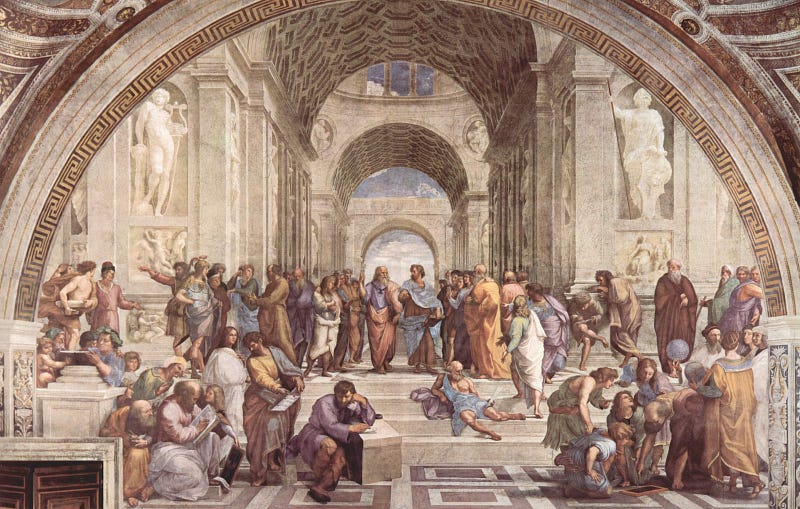
I studied philosophy in my undergrad. For those that do not know, philosophy stands for the “love of wisdom.”
As you can imagine, throughout my degree, I was exposed to some sage ideas. In engaging in dialogue with dead and alive philosophers (mostly dead), I learned some very unconventional, yet super practical ideas.
These ideas deserve exposure beyond the confines of philosophy seminars. After all, wisdom is practical in its orient and nature.
Here are five pieces of wisdom, as promised.
1. Seneca: Time is more valuable than money.
Stoic philosopher Seneca writes time is more valuable than money since we can get cash back when we spend it, but we can’t get time back.
We can always make more money, but we can’t “make” any more time.
When the money runs out, we can always find ways to earn. But once the time is gone, it is gone for good.
This is why Seneca believes we should be stingy about the way we spend our time. It astonishes him how we are frugal regarding how we spend our money, but we are careless about the way we spend our time.
The amount of time we have is uncertain and finite. Because it can’t be earned or made, Seneca argues it’s more valuable than money.
2. Robert Nozick: A life of only pleasure would be meaningless.
Robert Nozick has us imagine a hypothetical scenario. Imagine you can plug yourself into a machine that gives you only experiences of pleasure for the rest of your life. The device would be set up so that you would not be able to distinguish reality from the experiences it gives. It would mirror reality, but only give you experiences of the ups of life and never the downs.
Would you plug in, or not?
Nozick says that if you answer no, then we can agree there is more to life than solely chasing after pleasurable things.
The pleasurable things in life are only pleasure-inducing because we have the painful things in life to compare them with.
There is beauty to the “up and down” nature of life. Life is given meaning because of its duality: the good and the bad, the pleasure and the pain, the yin and yang.
3. Harry Frankfurt: The problem with global economic inequality is that some don’t have enough.
Most of us think that the problem with the way the world is is that a small percentage of people have most of the money. To fix this, we believe we should aim for economic equality or seek to reduce economic inequality.
But Frankfurt argues that the problem is not that some people have most of the money, but that some don’t have enough. As such, he claims our moral obligation should be to eliminate poverty.
For Frankfurt, trying to achieve equality or reduce inequality distract us from this goal.
Our primary focus should be to ensure everyone has enough so they can lead decent lives. Inequality might be reduced as a side effect of our efforts to eliminate poverty, but reducing inequality should not be the main goal.
By shifting the narrative on the most pressing circumstance that we find ourselves in, Frankfurt wakes us up to the hard truth of global poverty. The problem is simply that some don’t have enough.
4. John Stuart Mill: Social progress depends on cultivating individuality.
Mill believes people should pursue their individuality. He advocates for people to experiment with their living, do the things that make them happy, and figure out their good life concept.
He believed individuals leading unique and eccentric lives is essential for social progress. Without such experiments of living, he thought society would be stagnant.
By asserting individuality, Mill reminds us that when we do the things we love, we contribute to society with our fullest potential. And when each individual does this is when society truly progresses.
5. Epictetus: Focus only on the things you can control.
I wanted to end with the stoic, Epictetus, given the current state of the world. With COVID-19, I believe this lesson will hit home.
Epictetus claims that what’s in our control is in our doing, and what’s not in our control is whatever isn’t.
He claims that if we try to control things that are not in our control, then we are going to be hindered. We are going to be disturbed, and we are going to suffer.
Epictetus argues that by focusing only on the things in our control, we achieve happiness and freedom. Focusing on anything outside our control is a road to misery and slavery.
In this unprecedented time of COVID-19, I think that the stoic philosophy of Epictetus is crucial.
With so much going on in the world that we have no control over, it is essential to focus our energy inward. This way, we can focus on the things we do have control over, even if it is such little.
We can take care of our minds and our bodily health, set goals and work towards them, and learn not to be slaves to others’ opinions. We can all aspire to be stoics.
Takeaway
I have learned many wise things in studying philosophy, and continue to learn philosophy even outside of academia. These ideas are truly timeless, and I hope that you have learned something from them.
Below is a recap of the five pieces of wisdom:
- Time is more valuable than money. Money can be earned after it’s spent, but time is gone for good once it’s gone. — Seneca
- A life of only pleasure would be meaningless. Life is meaningful because there exists both pleasure and pain. There is beauty to the “up and down” nature of life. — Robert Nozick
- The problem with global economic inequality is that some don’t have enough. Eliminating global poverty should be our primary goal. We need to ensure everyone can lead decent lives. — Harry Frankfurt
- Social progress depends on cultivating individuality. Individuals pursuing eccentric and unique lives is essential for social progress. Or else, society would be stagnant. — J.S. Mill
- Focus only on the things you can control. If we focus only on the things we can control, we will achieve happiness and freedom. If we focus on anything outside our control, we will be slaves and miserable. — Epictetus