
5 Pieces of Business Advice That Will Instantly Boost Your Startup (and Life)
Absolute essentials of entrepreneurship.
Most business advice is useless.
After all, entrepreneurship can’t be taught. It’s learning by doing.
But what’s the most minimal amount of theory every entrepreneur needs to know?
I have thought about this question a lot.
Eventually, I have identified 5 timeless knowledge nuggets that, in my opinion, belong to the daily toolbox of every entrepreneur.
The following ideas will help you to kickstart your business and daily life as well.
1. Lean Startup
Building a business is extremely risky if you do it in the wrong way.
In 2006, startup founder Eric Ries published his book “The Lean Startup” and revolutionized the startup scene.
a) Lean Startup in one sentence
Get out there, fail and learn fast, keep iterating.
b) How it works
Every (business) idea is based on risky assumptions that need to be verified in the real world.
Let’s take Instagram for example — it looks like a harmless idea.
But beneath the surface, Instagram is based on various assumptions that “luckily ” turned out to be true.
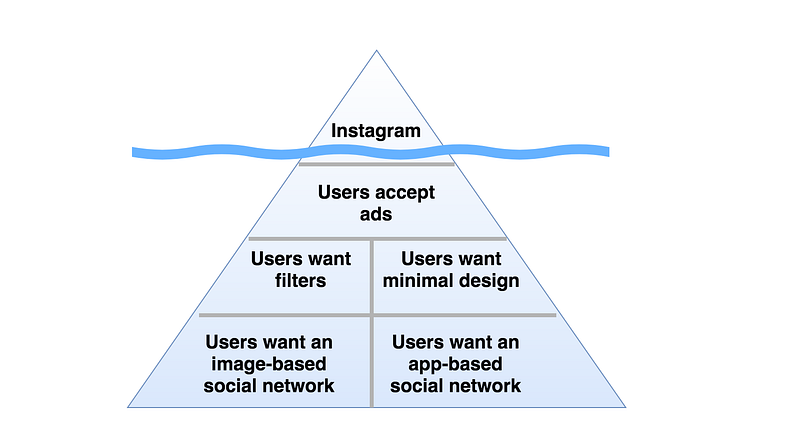
Successful entrepreneurs behave like scientists. They acknowledge the fact that they know nothing. Then, they perform small experiments to verify their riskiest business assumptions.
c) Real-world examples
A few years ago, software engineer Joel Gascoigne had an idea for a Twitter scheduling app. According to the Lean Startup methodology, he built a simple landing page that highlighted 3 main features of his app. That’s it.
After hundreds of people signed up, Joel knew he was onto something and started to code his app.
Today, Buffer has evolved into a multi-million dollar business.
d) Further resources
- Steve Blank’s Blog
- Ash Maurya’s Blog
- Eric Ries’ Blog
- Related concepts: Lean canvas, MVP, Build-Measure-Learn cycle
2. Systems Over Goals
We’re living in a goal-addicted society.
But when it comes to achieving these goals, most of us neglect the core principles of taking action.
Author Scott Adams famously stated:
“Goals are for losers and passion is overrated.” — Scott Adams
Instead of obsessing about goals, he focuses on building systems.
a) Systems over goals in one sentence
Don’t focus on your goals, but on the systems that get you there.
b) How it works
Every good system translates lofty goals into clear and repeatable steps.
On a practical level, a system could be a simple checklist, a sophisticated workflow diagram, or software automation.
On an abstract level, a system consists of 4 components. It needs input, runs a process, and finally produces an output within a certain environment.
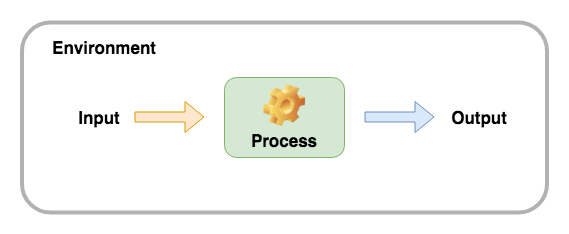
Once these 4 components are broken down, it’s possible to build or redesign any system to save time, money, and energy, or just to produce better results.
A writer, for example, can improve his writing system like this:
- Create a more comfortable workplace (improve the environment)
- Read more books or do more research (improve the input)
- Write better headlines or use a Grammar tool (improve the process)
- Write 3 weekly articles instead of 1 (improve the output)
A rule of thumb for creating systems: every time an activity takes more than 15 minutes and needs to be performed more than 3 times, it’s probably time to build a system.
c) Real-world examples
Tim Denning wrote an excellent article called “These Micro-Habits Gave Me 1 Hour per Day Back”. He identified recurring processes in his daily life and improved them step-by-step. Systems thinking at its best.
In a similar way, I execute a simple marketing-system every time I publish a new article.
d) Resources
- Into to Systems Thinking
- The 6 fundamental concepts of systems thinking
- Systems over Goals
- Systems Thinking: How Billionaires Think
- Related concepts: Iceberg model, leverage points, feedback loops, the theory of constraints.
3. 1000 True Fans
When we think of entrepreneurial success, we imagine millions of dollars, followers, and clients.
But thankfully it doesn’t have to be that way.
Kevin Kelly, author, and founder of the Wired magazine developed the idea of 1000 true fans:
“To make a living as a craftsperson, photographer, musician, designer, author, animator, app maker, entrepreneur, or inventor you need only thousands of true fans.” — Kevin Kelly
a) 1000 True Fans in one sentence
Don’t appeal to millions of people, just find 1000 fans that truly support you.
b) How it works
How to define a true fan?
“A true fan is defined as a fan that will buy anything you produce. These diehard fans will drive 200 miles to see you sing; they will buy the hardback and paperback and audible versions of your book; they will purchase your next figurine sight unseen; they will pay for the “best-of” DVD version of your free youtube channel; they will come to your chef’s table once a month.” — Kevin Kelly
Your 1000 true fans will do the heavy lifting for you. They will buy your products, spread your message, and will do most of the marketing for you.
An average American knows around 600 people. By having 1000 true fans, you’re only one person away from over half a million people.
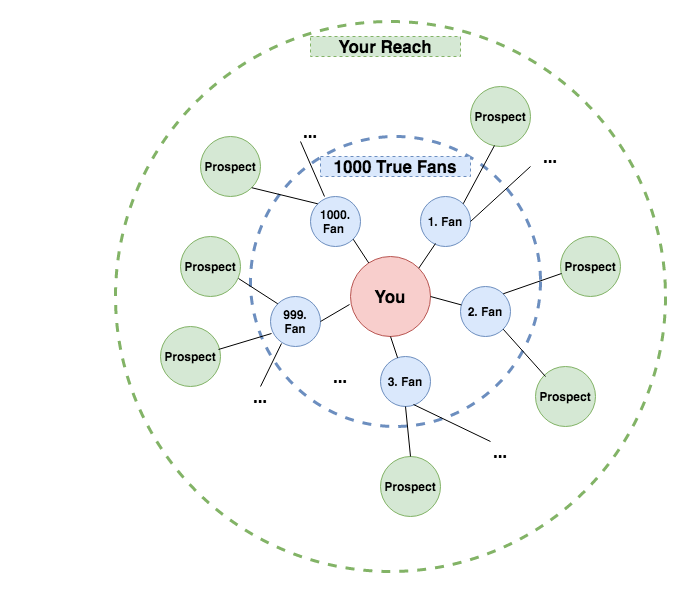
Almost every successful company started within a tiny, well-defined niche:
- ConvertKit focused on professional bloggers first.
- Facebook grew rapidly because of Harvard’s college students.
- Pinterest started with middle-aged women from the Midwest.
Who are your 1000 true fans? Where do they hang out? What are their biggest pain points?
c) Real-world examples
Zat Rana is one of the most popular writers on Medium and has over 40.000 email subscribers. In 2020, he left Medium and started a paid Substack newsletter. Looking at the number of his Substack comments, it’s pretty safe to say that he has around 1000 true fans, and makes a very good living from his Substack newsletter.
d) Resources
- 1000 True Fans
- How To Make $100,000 Per Year
- How to Build an Audience of 1000 True Fans in a Noisy World
4. Inversion
Inversion is one of the most powerful concepts you’ve ever heard of.
German mathematician Carl Jacobi used this technique to solve complex mathematical problems.
Instead of addressing the given problem, Jacobi was known for inverting his problem formulation.
“Invert, always invert” — Carl Jacobi
Inversion can also be used in life and business to develop resilient strategies and gain new perspectives on hard problems.
a) Inversion In one sentence
Define the opposite of your problem or goal, and start working from there.
b) How it works
Inversion is all about changing perspective.
An entrepreneur could start like this:
- Instead of finding solutions, avoid problems.
- Don’t innovate all the time, remove existing errors in your product first.
- Don’t try to be right all the time, try to be less wrong.
- Don’t plan for the ideal scenario, but for the worst that can happen.
Oftentimes, it’s very hard to define clear goals and target-oriented strategies because we don’t know what we don’t know. Therefore, entrepreneurs tend to neglect possible risks along the way.
Inversion helps to build solid solutions by concentrating on problems first and aiming for the low-hanging fruits.
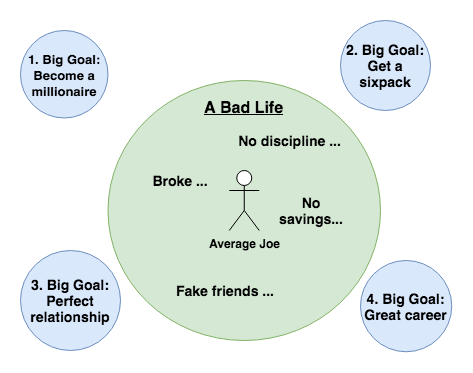
For example, it’s very hard for an unhappy person to envision a perfect life. Oftentimes, removing the bad stuff in life is a better success strategy.
c) Real-world examples
Floyd Mayweather is one of the best boxers of all time.
His boxing strategy is to keep his opponents at distance. This way, he makes them tired until they eventually neglect their defense.
That’s perfect inversion. Instead of asking “how can I beat my opponent?”, he redefines his problem by asking “how can I make my enemies beat themselves?”.
d) Further resources
- Inversion: The Crucial Thinking Skill Nobody Ever Taught You
- Inversion and The Power of Avoiding Stupidity
- A Dozen Things I’ve Learned from Charlie Munger about Inversion
- Inversion: Mental Model To Uncover New Possibilities
5. The Unfair Advantage
Life is fundamentally unfair.
Everyone has a unique mixture of genes, skills, experiences, starting conditions, and social contacts.
A successful entrepreneur knows his unfair advantage and uses it to succeed on the path of least resistance.
a) 1000 True Fans in one sentence
Focus on your unfair advantage, and delegate everything else.
b) How it works
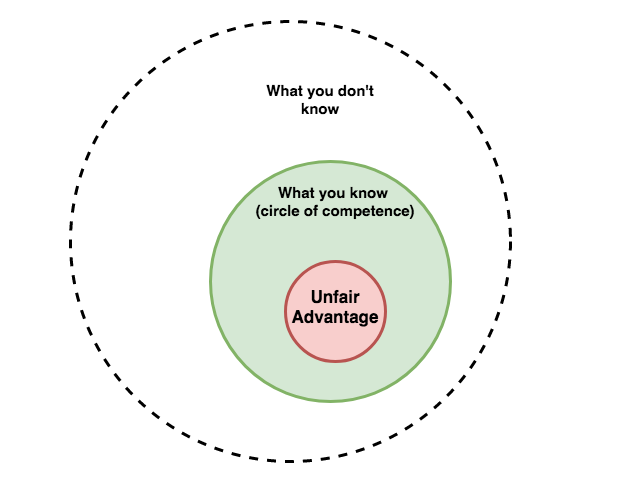
Warren Buffett’s legendary investment strategy is heavily based on a mental model called “circle of competence”.
Buffett only invests in companies and business models he truly understands.
To do so, he needs to be aware of what he knows and what he doesn’t know.
According to Buffett’s model, mistakes usually happen when someone leaves his circle of competence. Success doesn’t depend on the size of your circle of competence, but on exactly knowing the boundaries between the things you know and the things you don’t know.
Then, there’s a small subset inside the circle of competence that I call the unfair advantage.
Where’s the difference between both?
Oftentimes, the circle of competence can be acquired by simply reading or learning by doing. The unfair advantage, however, is often predetermined by previous experiences, geographical locations, or even genetics.
For example, Mark Zuckerberg is a good programmer. Building software is inside his circle of competence — like many other tech entrepreneurs.
However, there are only a few people on this planet who understand the dynamics of social networks as he does. That’s his unfair advantage.
c) Real-world examples
Tristan Jass is a YouTuber who became famous for his incredible Basketball trick shots — a tiny niche within the world of Basketball. That’s his unfair advantage.
Today, Tristan is interviewing NBA stars, traveling through the United States, and has over 2 million YouTube followers.
d) Resources
- Circle of competence: How Warren Buffet Avoids Failure
- Warren Buffett & Charlie Munger on How to develop ‘Circle of Competence’?
- What makes people successful?
Takeaway
Building a business is more than simply understanding diagrams and theoretical concepts.
Nevertheless, models are a great starting point for aspiring entrepreneurs.
Learning about the lean startup, systems thinking, 1000 true fans, inversion, and the unfair advantage will help you to build a solid theoretical foundation to kickstart your business and life.
Which one of the 5 entrepreneur types are you? My free 2-minute quiz will give you the answer.


