
5 Nuggets of Writing Wisdom From Stephen King
A highlighted version of his memoir was waiting for me at the “Little Free Library.”
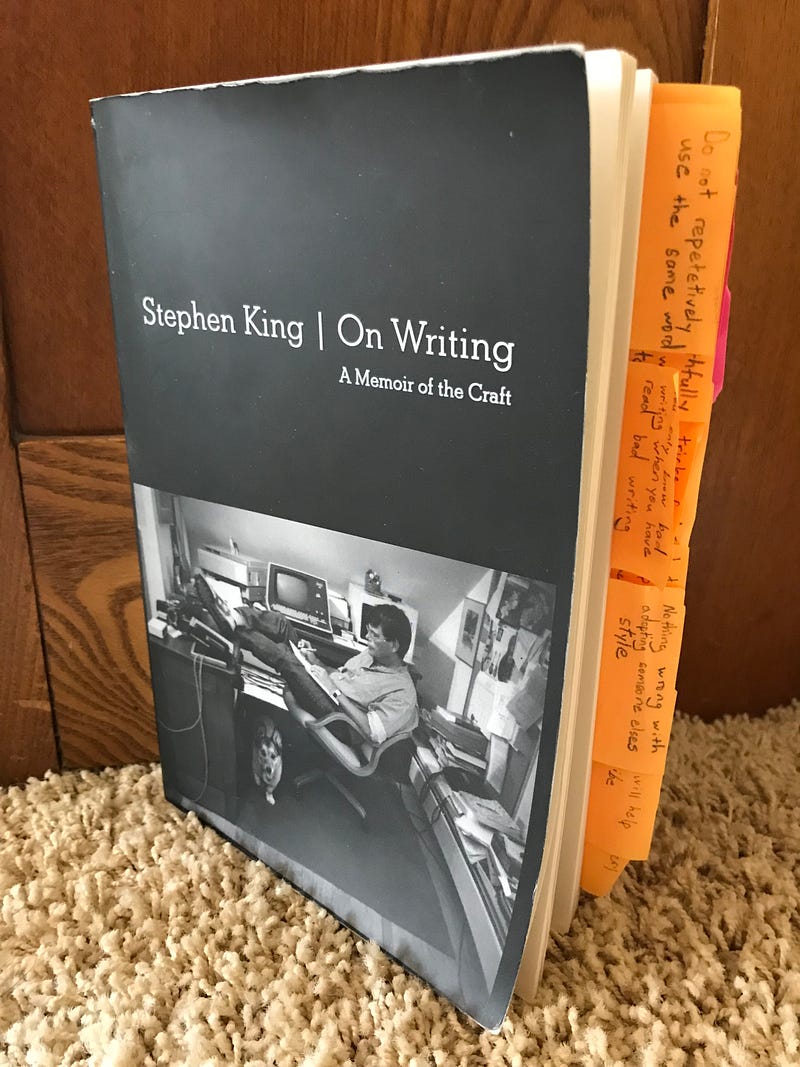
Stephen King must have been visiting my town recently because he left his memoir in the Little Free Library near my house. It was tucked between Magic Treehouse books and could have only been placed there by Mr. King himself. A message from him to me. How else can I explain its sudden appearance?
I would have been excited with any copy, but this specific one had key points highlighted and tabbed with colorful Post-It notes. Mr. King went to great effort to ensure I would find all the useful tidbits in his book.
On Writing: A Memoir of the Craft is a fabulous read. It includes background information — his childhood adventures, fascination with horror movies (no surprise there), early rejections, and struggles with addiction — as well as insights about his popular books and helpful writing tips. One fun fact is that Mr. King briefly worked as a janitor at a high school, and he got the idea for Carrie while cleaning the girl’s locker room. You never know where you will find your next great idea!
There are numerous pearls of wisdom in this book, and here are five quotes from Mr. King that especially resonated with me.
“If you don’t have time to read, you don’t have the time (or the tools) to write.”
Competitive athletes train, successful musicians listen, and great writers read. We recognize bad writing when we see it, so to grow our skills, we need to read.
King recalls reading a novel in high school by a science fiction author that was “terrible.” In addition to a weak plot and poor character development, the author used “zestful” so many times that King developed an aversion to the word and has never used it to this day.
I like historical fiction and enjoy reading a variety of authors from this genre. Often, I start a book and become completely immersed in the story, but there are a few that I start and cannot finish. Although these stories don’t turn out to be good reading for me, they are excellent writing guides. I make note of what doesn’t work and why, and try to use these insights to improve my writing.
We have all read authors that we want to emulate, and others that we want to edit. All of this reading time is valuable.
“Don’t stop a piece of work because it’s hard.”
Mr. King’s first published novel was Carrie, a relatively short book that ignited his career. He initially threw away his rough draft because he didn’t like the main character (Carrie White), and he questioned his ability to develop the story into a book.
Mr. King’s wife, Tabby, found the crumpled pages in the trash, read them, and encouraged him to continue working on the draft. Although Mr. King writes that he never grew to like the character Carrie, he persevered with the story and eventually found his rhythm, creating a novel that has been read by millions.
I have numerous unfinished drafts — articles I abandoned because the storyline kept branching in different directions or the underlying analysis became too challenging to summarize. Many of them will stay unfinished, but maybe there is a pearl mixed in with the rubbish. I’ll work a little harder to find that gem.
“One of the really bad things you can do to your writing is to dress up the vocabulary, looking for long words because you’re maybe a little bit ashamed of your short ones.”
My spouse enjoys reading books that challenge him— he doesn’t mind stopping to look up words. I do. I want a story that flows easily without requiring a dictionary. My rule of thumb is that if I don’t use the word when speaking, I won’t use it in my writing.
In addition to carefully selecting your words, Mr. King also advises limiting the use of adverbs (for example, change “quickly ran” to “sprinted” and “very large” to “huge”). I immediately started to implement this advice because I know I’m an adverb abuser.
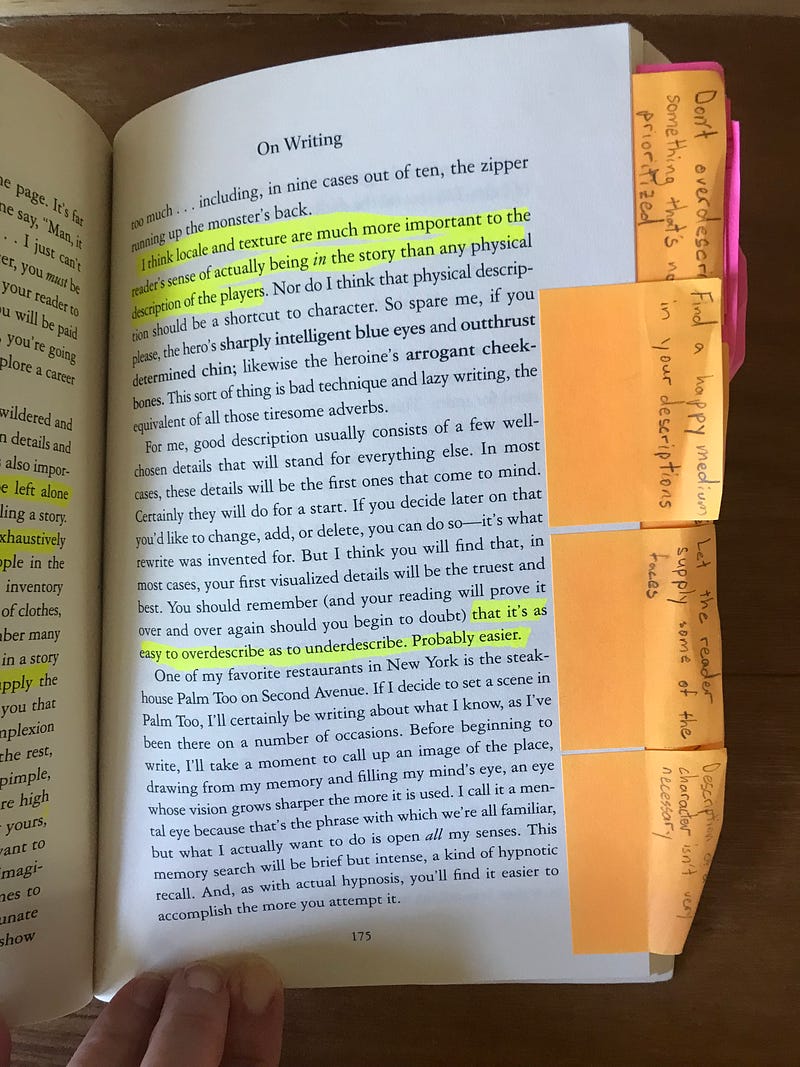
“Description begins in the writer’s imagination, but should finish in the reader’s.”
Mr. King cautions writers about being too descriptive, especially when introducing characters. He recommends providing a general framework and allowing the reader to supply familiar details. We become more invested in the story when we have a role in creating the characters.
How many times have you watched a movie based on a novel and questioned the director’s choice of actors? Perhaps you thought to yourself, “That is not at all how I pictured ____.” The casting of Peeta Mellark from The Hunger Games is one such example for me. The character looked so different in my mind’s eye, and I had difficulty connecting with the actor in the film.
Thankfully, as a writer, we don’t have to describe the perfect character. Readers will fill in the details that are relevant to them.
“I believe large numbers of people have at least some talent as writers and storytellers, and that those talents can be strengthened and sharpened.”
Stephen King was not an overnight success. He had a “spike” in his bedroom to hold his rejection notices, and he eventually had to add another one when the first became full. Mr. King shares that he rarely got personalized feedback with his rejection slips, but one time he received this handwritten note: “Don’t staple manuscripts. Loose pages plus paperclip equal correct way to submit copy.” Although that wasn’t life-changing feedback, it is what he got, so he made a mental note and stopped stapling his manuscripts. All feedback can be helpful in some capacity.
Through reading, practice, and incorporating feedback, we develop our skills and become better writers. Everyone has some talent, but it takes work to refine our voice.
Stephen King has achieved phenomenal success in his field, yet he is quick to say that he doesn’t have the magic formula for fame. It doesn’t exist. He knows what works for him — writing 2,000 words every day (about 10 pages) with loud hard rock music playing in the background.
Although I can’t imagine thinking creatively with Metallic blaring nearby, I do try to write daily in the same workspace. I write better when I write regularly.
I found Mr. King’s memoir fascinating, and I’m thrilled that he cares enough about my writing journey to leave me his book. I hope he is still in town because I left a note in the library box asking him for an autographed copy of Salem’s Lot. I’ll be strolling zestfully back tomorrow to get it.
What have you learned from your favorite author?
Join Medium and enjoy thousands of articles from independent writers such as myself. If you use my referral link, I will receive a small commission. Thank you for your support.
Jill is a clinical psychologist, blogger, and Stephen King fan. She shares behavioral health tips every Sunday on her blog.