
5 Non-Gendered Greetings to Help People Feel Welcome
Inclusive second-person pronouns that honour those who identify as non-binary
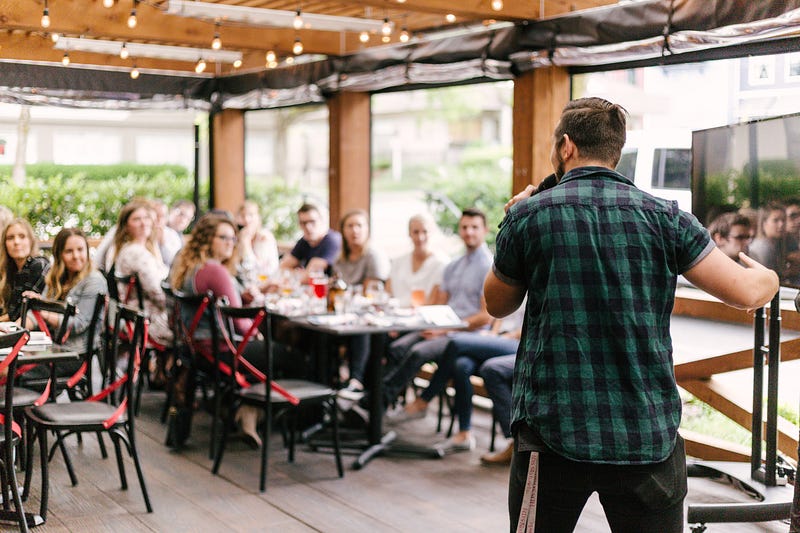
Welcome, everyone! I’ll start with a disclaimer: I don’t identify as non-binary. But have non-binary friends and I care a whole bunch about helping people feel welcome. And language is a great place to start, because it is an area each of us has control over.
A lot of attention has been given to third-person pronouns — he/him, she/her, they/them. But little attention goes to second-person pronouns used when speaking directly to someone.
“You” is the classic second-person pronoun. But it doesn’t work well in the plural unless you use “you guys” (think Chunk from the Goonies, but still gender-problematic) or “youse guys” if you’re from Philadelphia.
“Ladies and gentleman” is inherently flawed because of its binary nature. When I hear MCs use it now, I cringe for all the gender-fluid people in the audience and for the speaker’s lack of social awareness.
The challenge is to find a greeting that works for you and the situation. Some occasions may call for a level of formality that the traditional “ladies and gentleman” once fitted.
There are other occasions where informality — or even humour — may be better. So let’s look at a bunch.
1. “Hey folks”
I met the president of an international organisation that used “folks” very effectively as early as the 1980s — long before people started thinking this way.
He used it in formal settings, but it gave him a guy-next-door vibe. He recognised, over three decades ago that “ladies and gentleman” was both stilted and problematic for people.
“Folks” also gets over the age hurdle — you can have children and young people in the room who are included in this greeting.
2. “All y’all”
Anyone who has traveled through the American South will have been greeted by “y’all.” And in some places, you’ll be met by “all y’all.”
To locals, “Y’all” without the all is singular, used when speaking one-to-one. To make it a plural second-person greeting, add all to the front to make it “all y’all.”
This delightful greeting carries warmth and friendliness. And even though, on the surface it may feel informal, that indeed is the key. The American South is by nature informal.
I found it carries pretty well to other parts of the United States, but something is lost in translation in other parts of the world. People assume that “y’all” is shorthand for you all, making it problematic as a singular second-person greeting.
3. “G’day mate”
As an Australian this is the most natural greeting for anyone. And although mateship was historically caught up in the masculine national identity, it is a gender-neutral salutation these days.
Women call me mate, and I refer to women as mate. Like all y’all, there is a natural informality and warmth that is communicated when calling someone a mate. But equally, it would not be uncommon for someone to refer to the Prime Minister or a celebrity as mate.
This is reflective of what researchers see as a defining quality in the Australian culture — we have what is known as a low power distance. This means that the cultural gap (not economic gap) between people in high positions of power and low power positions is negligible. People perceive that everyone is inherently equal.
While it is common to use mate and mates as singular and plural in the third-person, “These are my mates,” it would be odd to use it as a greeting the second-person, “Hello, mates.”
4. “Theydies and Gentlethems”
I love this one. Challenging the cultural norm of “ladies and gentleman,” theydies and gentlethems works well with younger audiences and where it is known there are people who identify as queer.
Because of the inbuilt humour, it may not work for a formal setting, but by my estimation, inclusivity beats formality any day.
5. “People of Earth” or “My fellow humans”
At risk of tilting to the humorous end and undermining the genuine importance of this article, I included this anyway.
“People of Earth” has a distinctly science-fiction vibe to it, so probably ideal for Comic Con or if you are living in Sedona, Arizona or Roswell, New Mexico.
“My fellow humans” also sounds a little science-fiction, but isn’t inclusive of animals. Be aware of when animals are in attendance at an event; otherwise you should be fine.
All humour aside, the way we greet people is important. It has the power of helping people feel welcome and also shows awareness of thinking beyond the binary.
And whichever you use needs to feel comfortable coming out of your mouth. Most often it is “Welcome, everyone” for me. But I am trying to think more creatively about this.
What greetings have you come across that work for you?