
5 Myths About Alcohol Most People Believe
#1: Wine is good for your heart… not

I’ve recently given up the sauce, and to be a more informed member of the elective sobriety movement, I’ve been researching the latest of what science has to say about alcohol. I’ve learned a few shocking things.
Myth: A glass of wine with dinner is good for your heart health
Reality: Wine is bad for your heart (and every other organ)
In nutritional science, there’s a question called the French Paradox: why do French people have relatively low rates of heart disease when their diet consists of lots of things that, at the time, were thought to cause coronary heart disease, like wine and saturated fats?
This question inspired a spate of studies into French people’s diets and lifestyles, and one of these studies suggested a glass of red wine with an otherwise risky dinner would lower your risk for coronary heart disease. The two main theories as to why are that red wine has antioxidants and that red wine has a chemical called resveratrol which, for various nutritional science reasons I don’t understand, may reduce your risk of developing coronary heart disease.
Popular science journalists, doing what they do, spun this information into the claim “Red wine is good for you in moderation! It helps your heart health!”
First of all, the evidence for these claims is pretty weak. Some alternate studies demonstrate no link between red wine and heart health. Also, according to the above source, you would need to drink nearly 10,000 glasses of red wine to get enough resveratrol to truly help your heart.
But even if it is true that red wine has some minor positive effect on heart health because it contains antioxidants and whatnot, it’s also true that it contains ethanol, which is used to cut gasoline. There are better ways to get antioxidants — like eating a fruit, for god’s sake. Claiming red wine is good for you because it contains antioxidants and/or resveratrol is like claiming doughnuts are good for you because sugar gives you energy.
Actually, it’s worse, because alcohol has well-understood negative health consequences that far outstrip any junk food. Alcohol consumption drastically increases your risk for six different types of cancers, causes hypoglycemia, fucks with your hormones, reduces the efficacy of any medication you may be on,¹ and ruins your skin to boot. That’s only a small sample of all the terrible things alcohol does to your body.
Myth: Alcohol can help you sleep
Reality: Alcohol makes you sleep worse — you just think you’re sleeping better because you’re unconscious
I have met a non-inconsequential number of people in my life who claim one of the reasons they like alcohol is that it helps them sleep.
I’ve been binge drunk once or twice in my life. I know what it feels like to drunkenly crash into bed and fall into a 10-hour sleep deeper than the sleep of the dead. I know what it feels like for that deep sleep to be a welcome relief after many listless, stress-filled nights. But it is a mirage.
Alcohol is a sedative, but that does not mean it helps you sleep well. You may be more deeply unconscious after drinking and stay unconscious for longer, but this unconsciousness is not the same as healthy sleep. Healthy sleep involves five cycles of REM phase sleep, but binge-drunk sleep often involves two or fewer. Your alcohol-induced sleep never makes you feel truly rested because you never truly rested.
Alcohol can also induce episodes of sleep apnea, that fun condition where your body forgets how to breathe while you sleep. As you can imagine, struggling to breathe during sleep has all kinds of negative effects on the quality of your sleep. Alcohol increases your risk of sleep apnea by 25%.
So restful.
Myth: Alcohol can be used to relieve stress and anxious feelings
Reality: Alcohol makes stress, anxiety, and that sort of thing much worse
There is truth to the statement that alcohol is a depressant and a sedative and can calm you down. That’s what sedatives and depressants do. But using drugs to biochemically force inactivity on yourself is not the same thing as truly relaxing.
Before I knew how to handle anxiety in myself, I thought the feeling you get when you drink alcohol was what relaxation was. But after I went to therapy, read self-help books about managing anxiety, learned good coping skills, and incorporated self-care into my life, I learned what relaxation really felt like, and it wasn’t the feeling of being buzzed. What they say is true; alcohol really is just a mask.
True relaxation is having no worries, cares, tensions, stress, or pain. It is impossible to feel truly relaxed, or anything else for that matter, if you have been rendered senseless. If you think being inebriated is relaxing, then you must think being knocked out is relaxing. It achieves exactly the same effect much quicker and with far less aggravation. — Allen Carr, The Easy Way to Control Alcohol
And, of course, once the alcohol wears off, the stress and anxiety return even stronger than before. For any drug, there is a withdrawal, and withdrawal always feels like the opposite of the drug. If alcohol makes you feel loose and relaxed, your withdrawal will make you even more tense and stressed. The medical reason has to do with neurotransmitters and hormone levels, but the reality is that alcohol will make it temporarily less painful but permanently more so. In many people, this kicks off a vicious cycle, where the drinker wants ever-increasing amounts of alcohol to treat their ever-increasing stress.
Myth: Different kinds of alcohol have different effects (“I am so weird when I drink tequila”)
Reality: Ethanol is ethanol, no matter what drink it’s in
It’s common to hear drinkers talk about different kinds of alcohol and their personal relationships to them. “Whenever I’m whiskey drunk, I always hit on strangers!” “Ugh, my tequila hangovers are so bad.”
We tell ourselves stories about the alcohol we drink, but the reality is that there is only one kind of alcohol in our alcoholic drinks, and it’s ethanol. There are no special variations.
It’s possible you react differently to some drinks because of the other ingredients. For instance, I can’t have a beer because I am gluten-sensitive, and drinking a beer would cause me the mother of all food poisoning before I even got buzzed. Mixed drinks often make me nauseous because of the corn syrupy fillers they use. But these are digestive symptoms, not personality changes. There is no difference between a Pabst, a mixed drink, and a tequila shot that would make you a “different kind” of drunk.
Myth: Alcohol is not a drug
Reality: Alcohol is definitely a drug
Our culture treats alcohol like it’s something other than a drug. When people say “I don’t do drugs,” they typically mean “I don’t do drugs but I do drink alcohol.” When doctors ask us about drug use, they ask “Do you use any drugs or alcohol?” as if drugs and alcohol were separate things. But alcohol is definitely a drug.
Alcohol, sometimes referred to by the chemical name ethanol, is a psychoactive drug that is the active ingredient in drinks such as beer, wine, and distilled spirits (hard liquor). It is one of the oldest and most common recreational substances, causing the characteristic effects of alcohol intoxication (“drunkenness”).
— Alcohol (drug), Wikipedia
In fact, it’s one of the most dangerous drugs available to mankind.
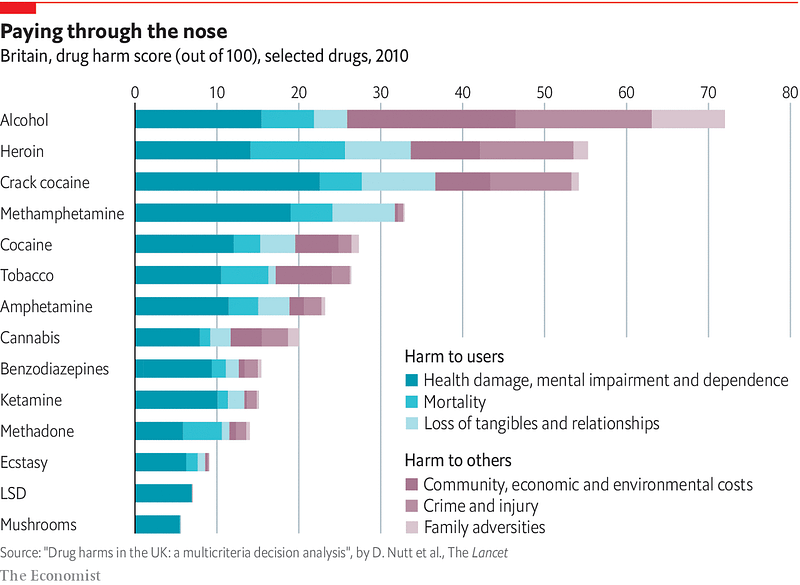
- Many drugs have medicinal properties and can be incorporated into various kinds of pharmaceuticals, or even used on their own, as medical treatments, but not alcohol. While alcohol is useful in a lot of ways (it’s a great surface cleaner, solvent, and fuel), it’s not useful as a medication in any way. Sometimes it’s used in other medication (think NyQuil), but alcohol is never itself the medication.
- Many drugs are not fatal until either ridiculously high doses or are not fatal at all, but alcohol is fatally dangerous in low and accessible quantities. We all know of (or personally know) someone who’s been hospitalized for outright alcohol poisoning.
- Many drugs only affect certain regions of the brain, but alcohol affects every organ and cell in your body through dehydration and denaturation. The reason you feel like you’re dying when you have a really bad hangover is that you are sort of dying.
We live in a culture that requires food labels on everything and values gluten-free, dairy-free, nut-free, whole30, fresh, organic, wellness, and health — so we ought to know about all the negative effects of alcohol. But we don’t. As a society, we tend to look past and bury this information. In such a health-conscious culture, doesn’t that seem strange?
I’m not here to make anyone give up drinking. As if a random writer on the internet could make you do anything, anyway. I just want to make sure we know what we’re putting in our bodies. When we have knowledge on our side, the choice is truly ours.
Want to Read More?
If you want more thought-provoking articles like this one, my newsletter Seeking Truth was made for you.
Click to sign up for Seeking Truth here!
1: My citation for this is experiential: I’ve been on a lot of different medications and without fail, every time I google “can I drink alcohol with x medication,” the results are “you won’t die but you will get less of the medication in your bloodstream.” Alcohol affects the way you metabolize food, so it doesn’t surprise me that it disrupts medication metabolization too.
If you need help to cope, you’re not alone.
Get inspiration and reality checks about staying sober at beautiful hangover. Do whatever it takes to stay sober for 30 days: go to your doctor, try Smart or AA or Hip Sobriety or Soberistas. Listen to Recovery Elevator and SHAIR podcasts. Read This Naked Mind. Try Moderation Management.
There is a whole community of people waiting to help you. Reach out. Something better is waiting.


