
5 Money Rules to Transform Your Financial Life Within 10 Years
Building wealth takes time, only you can make the right decisions

A lot of people stay in the same financial situation for their entire life, whether they make good money or not. If you work a regular 9–5 job, you’ll probably get a raise every few years, but it will usually barely make up for inflation, so it won’t change your lifestyle. At the end of your career, your salary will be higher than when you started, but you won’t have much to show for it.
If you’re an entrepreneur/freelancer, the numbers are not in your favor either. Research shows that you’re more likely to go broke than to make it big, but only those who try will ever succeed. Most businesses fail within their first 5 years.
Regardless of your financial situation now, there are some basic, simple money rules you can follow that can literally change your life 10 or 20 years down the line. This may seem like a long time, but if you’re still young, at the beginning of your career, these tips can make or break your financial stability over time. If you’re in your mid-forties and think that it’s too late, then think again, because retirement is still more than 20 years away, and lots can happen until then. Rome wasn’t built in one day, and if there was one sure way to become rich in a matter of months, everyone would do it.
Building wealth takes time, and it’s all about realizing that you and only you can make the necessary changes to build it for yourself. In this article, we’ll go over 5 basic money rules that I guarantee will better your financial situation if you stick to them in the long term.
Understand the concept of guilt-free spending
The first step in understanding how to save money is usually to look at your spending, which can feel like a conundrum. But if you think about it for a minute, it makes total sense: to understand how to take more in, you need to look at what’s going out. Take an hour to look at your bank account over a 1-year timeline and add up all the expenses that could have been avoided or were plain rubbish. You’ll be amazed at how much money you could have saved.
The problem with most people is not that they spend on stupid things, it’s that they do it too much. Those people are guilty as charged. In order to better your financial situation, you need to develop a “guilt-free” spending habit.
Set aside a tiny portion of your income every month (2% to 5%) for stupid purchases we all like to make. If 5% every month is not enough to cover something stupid you want to buy, no problem. Open a guilt-free checking account, set up automatic transfers to it every month, and wait for the account to have enough on it for your guilt-free purchase.
To clarify, this is not about canceling your 5-dollar latte on your way to work. Nobody ever got rich by depriving themselves of coffee, and people who say Starbucks tastes bad are just haters. But by limiting the amount of unnecessary expenses you make every year, you will not only develop stronger financial habits, you’ll also free up a good chunk of change you can put to better use, as we’re about to see.
Invest 10% of your net income in the S&P 500
If you’ve read money advice before, you’ve probably heard this one a lot, and for a good reason: it works crazy. Again, you won’t become a millionaire overnight by investing a little bit in the S&P 500 every month, but you’ll thank yourself 10 or 20 years down the line.
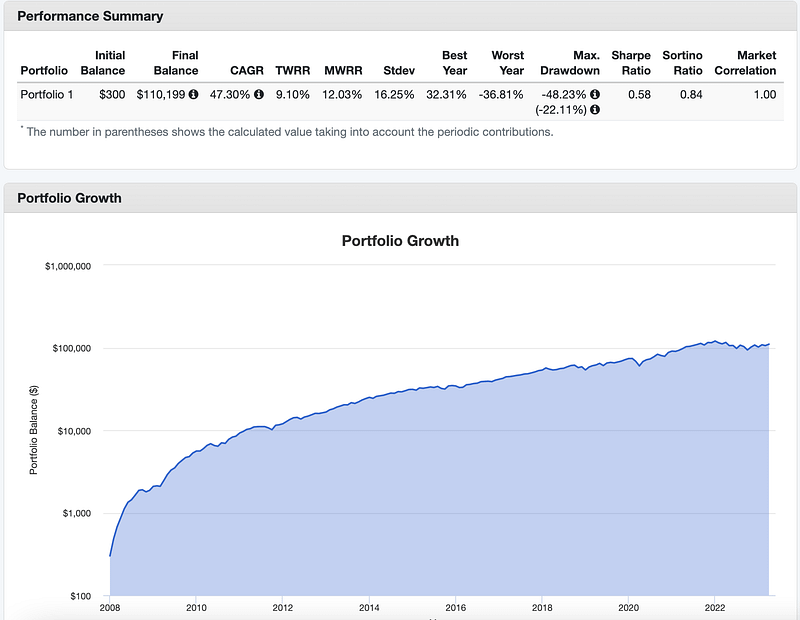
Investing a fixed amount in an index fund every month is a strategy called Dollar Cost Averaging, and it has almost only upsides:
- Most ETF funds (which track the S&P 500) have very low fees (charged by your broker)
- Like with investing in regular stocks, you can write your losses off your taxes on a negative year (which doesn’t happen often)
- You’ll make 3% to 5% in a normal year (usually enough to beat inflation), and 10% to 20% in a good year, almost risk-free (because as long as you wait you will recover your money)
- Your monthly contribution will help fill the gap during negative months and will create exponential returns on positive ones.
The most important point is the last one here, and here is how to put it in perspective. Consider this scenario:
- You invest $300 in the first month and lose 5%. You’re down $15.
- The next month, you add $300 again, greatly covering up your losses. You’re at $585.
- At the end of the second month, the index gains 3%. You’re now at $602.
In the beginning, this balancing system will seem irrelevant and the gains and losses will be minor. But they will be a game changer 5 or 10 years down the line, when that 3% gain turns into a $600 profit for your account. Plus, the longer you contribute and the more you invest, the less you will feel the economic downturns.
As a business owner/entrepreneur, investing a portion of your income in the S&P 500 is a great way to create a financial cushion you can rely on, completely separate from your company. It’s also a great way to develop strong financial habits that can transpire in the way you manage your business on a day-to-day basis.
Here are a few index funds you can start investing in today to build your future wealth (in Europe):
Splurge 50% of unexpected windfalls
Sometimes, money comes our way when we expect it the least. An inheritance, an insurance settlement, a tax refund, a lottery ticket… Most people like to treat themselves and spend the money in those cases, and again that’s completely fine. But the planning and discipline you build around your spending and investing are more important than the things you buy and invest in. That’s why it’s crucial to cap your spending from unexpected windfalls and maximize your investment opportunity.
It’s also important to note here that “investment opportunity” doesn’t always mean putting your money in the stock market. You can also invest in yourself by making some reasonable purchases, or by fixing your car, improving your home… If you get a $1,000 tax refund, you don’t have to invest $500 in the S&P 500 right away. But if you have nothing better to do with the money, then don’t think twice about it and transfer that cash to your brokerage account.
Learn about your credit card perks
Especially when you’re short on money, it’s always better to stick to debit cards, because they prevent you from spending money you don’t have, they have no interest charges, and they link directly to your checking and money market accounts. You see the money go out when you spend it, and that’s a great incentive to manage your money better.
Many people use credit cards the wrong way: to spend money they don’t have, and to accrue interest on late payments. The crazy part about it is that credit cards usually come with a lot of decent perks (to make up for their terrible interest rates) most people are unaware of. If you have strong financial discipline and manage to stay in the green with a credit card, you should take advantage of those because they can help you save even more money. And if you’re always in the red with your credit card, those perks could help you climb your way back up to a little more financial stability:
- Travel rewards: many credit cards offer cash back or travel points for travel purchases.
- Cashback rewards: you can get a certain cashback percentage in select shopping locations.
- Warranty on purchases: one of the least known perks. If you accidentally spill coffee on a laptop you bought with a credit card, call your credit card company. They will cover the damages and send you your money back.
- Fraud Liability Guarantee: with most credit cards you’re never responsible for unauthorized purchases on your card, bringing you more peace of mind.
Again, it’s better to stay away from credit in most cases. But if you can’t do without it, at least make sure to learn about all the positive perks it can bring you rather than the negative balance it’s giving you.
Trading is not investing
During the pandemic, I had a colleague who was up $10,000 on his Robin Hood trading account. Then the world somewhat went back to normal, and his account lost $7,000. Robin Hood is designed to make you place as many trades as possible because that’s how they make money (through fees and commissions). The problem with that model is that most people have no idea what they’re doing, they’re just betting on this one sock going up, or this one company going viral because they read about it on Techcrunch. As a result, more than 90% of day traders lose money over time, they never make a dime.
Here’s a simple tip: stay away from trading apps that look like a marketplace, where buying and selling shares looks as easy as ordering a pizza with a click of a button. Trading is not investing, you need to be an expert to make money with this approach. Most people don’t have the time and/or motivation to learn about all this, and they see trading as a get-rich-quick opportunity as long as they invest in Tech and companies their Uber driver told them about.
Investing should be boring
A true investing strategy that builds wealth over time is almost always boring and dead simple: invest a fixed amount every month in one or a few instruments, and always stick to it.
- Don’t hand-pick stocks
- Don’t withdraw your winnings
- You don’t even have to look at how much you made/lost this month.
Like with every other tip mentioned in this article, just stick to the plan, and you’ll thank yourself 10 years from now.
Happy wealth-building, and enjoy the journey you’re on.
I made this ➝ 50 interviews on productivity, 150+ pages of content, 100% free.