
5 Mind-Blowing Space Images from 2022 That Will Leave You Stunned
Unforgettable shots of cosmic wonders.
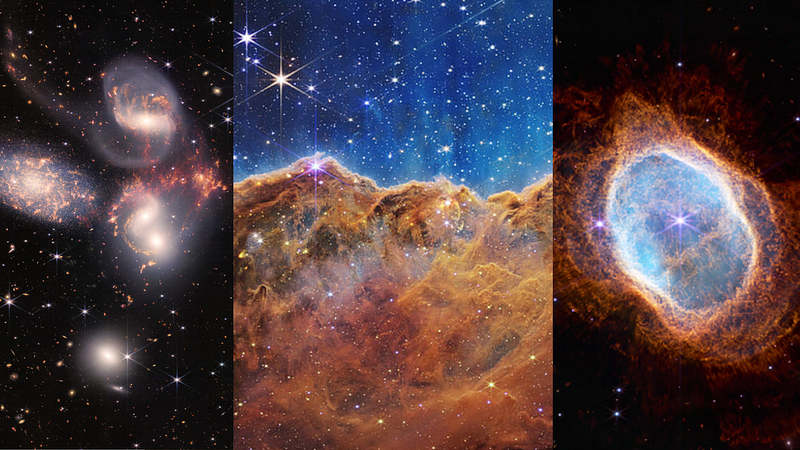
You better be ready — because your mind is about to be blown!
When it comes to space exploration and discovery, last year was a true game.
Some of the most astonishing visuals and fascinating information about the cosmos that we have ever seen were presented to us.
I am talking about black hole discoveries that will leave your head spinning, as well as pictures of galaxies that are so far away that we thought never existed.
It’s safe to say that compared to other recent years, the past one provided us with the most knowledge and insights about space.
So take your favourite spot and get ready to travel through some of the most amazing space exploration moments of the year 2022.
1. Sagittarius A* — The Heart Of Our Galaxy
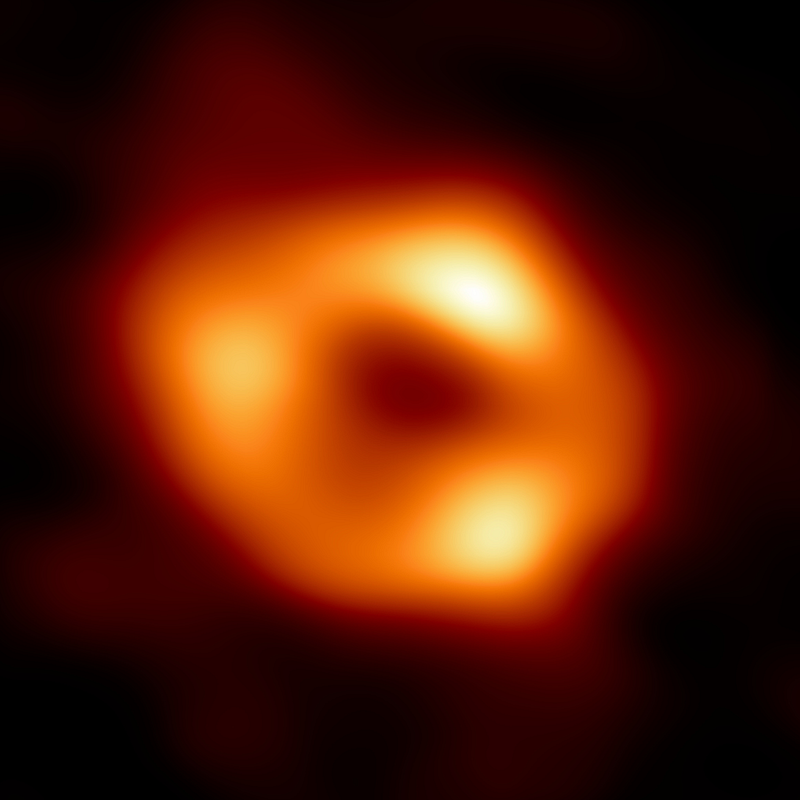

This super-massive oblivion of gravity is Sagittarius A* and it is located at the heart of our galaxy.
another characteristic worth noting is that it is much larger than the average black hole, and finally it is approximately 26,000 light-years away from Earth which is about 245,978,992,287,081,120 km.
It is surrounded by a spinning disc of gas and dust that is constantly spiralling down into its gravitational pull and has a mass equivalent to nearly 4 million suns.
The famous image released in 2022 of a super-massive Black Hole is of extreme importance for us in the field of space exploration.
Why? Because it provides us with a unique and in-depth look at our galaxy and at the power that is keeping it all together — imagine looking into an eye of a beast with unimaginable proportions.
We can learn more about the evolution and formation of not only our own galaxy but also gain crucial knowledge about other galaxies and learn more about Black Holes and their surroundings.
The Event Horizon Telescope team collected and processed data over many years to create this beautiful image of Sagittarius A*.
The Event Horizon Telescope, often known as E.H.T., is a network of several telescopes spread out over the planet, making it essentially a telescope the size of Earth.
2. Cosmic Cliff — The Birthplace Of A New Star
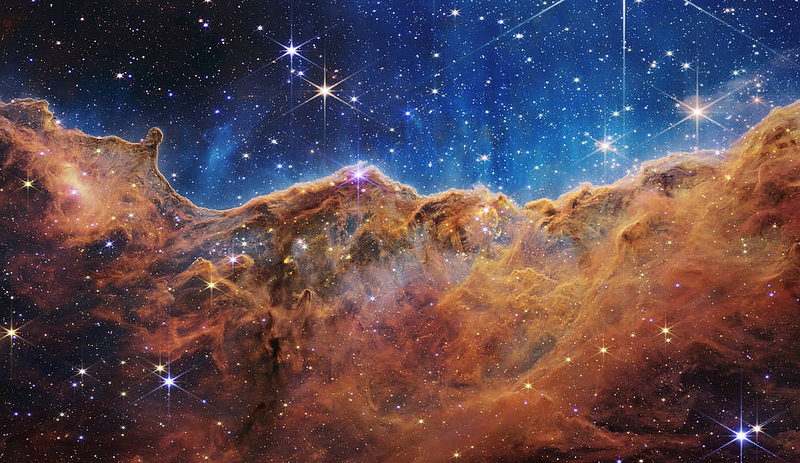

The famous James Web Space Telescope have been capturing many breathtaking images since it was first launched; however, space enthusiasts were left in awe when the image a new star forming in the Carina Nebula was revealed.
Known as the Cosmic Cliffs,the supposedly three-dimensional image is actually the border of a massive, gaseous hole within star-forming region, and the tallest peaks you see are around 7 light-years in height.
The ultraviolet radiations from the young stars are slowly eroding the nebula’s wall, while stunning pillars tower above the glowing gas, resisting this radiation.
The youngest source of energy appear as red dots in the dark and dusty region of the cloud, while the protostellar jets shoot out from some of these young stars.
Webb’s extreme sensitivity, spatial resolution, and imaging capability can chronicle these elusive events, shedding light on the process of star formation and answering open questions of modern astrophysics.
The impact of star formation on the evolution of gigantic clouds of gas and dust is also revealed, including the influence of low-mass stars, which create opposing jets and reduce the fraction of nebular material that seeds new stars.
With Webb, scientists will be able to obtain a full census of their number and impact throughout the nebula.
3. The Stunning Southern Ring Nebula
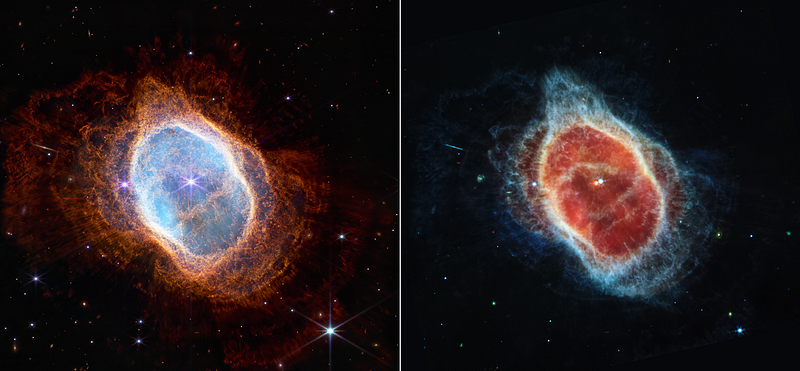

The Southern Ring Nebula, or the Hourglass Nebula as it is sometimes called, is a stunning celestial object located in the southern constellation of Musca.
This majestic nebula was first spotted by astronomer C.R. O’Dellin in 1987, who was fascinated by the infrared properties of planetary nebulae.
At the heart of this magnificent nebula lies a white dwarf star, which was just like our Sun during its days but now it is a Star that it has reached the end of its life — all that remains is its core — which is one of the heaviest thing out there and surrounded by extreme magnetic field.
The nebula we see today was formed when the massive star shed its outer layers into space in an awe-inspiring manner, creating the intricate and colorful shapes that we can admire till date.
The hourglass shape of the Southern Ring Nebula is perhaps its most appealing feature.
This is due to the dead star’s core being surrounded by an unfathomable-sized disk of debris and gas, which acts as a barrier and drives the gas to flow outward in opposing directions.
Many other remarkable aspects of the nebula include complicated filaments, brilliant patches, and knots.
Despite years of research, astronomers are still trying to fully comprehend these intricate patterns.
Because of its peculiar and breathtaking shape, the Southern Ring Nebula has become a popular subject for both professional and amateur astronomers.
Southern Ring Nebuala surely does remind us of the incredible complexity and splendour of our cosmos.
4. Stephan’s Quintet — The Group Of Galaxies
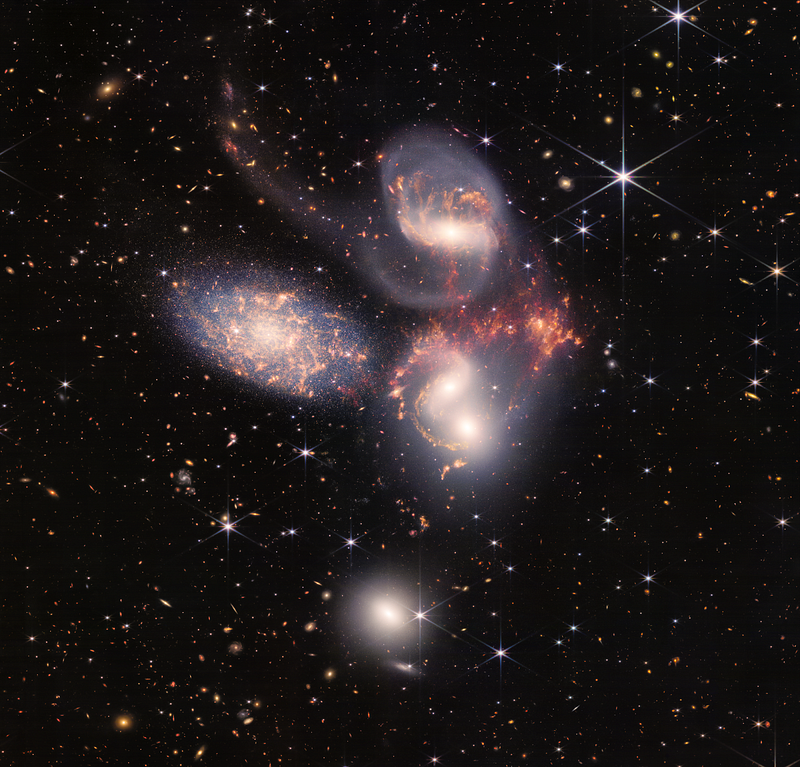
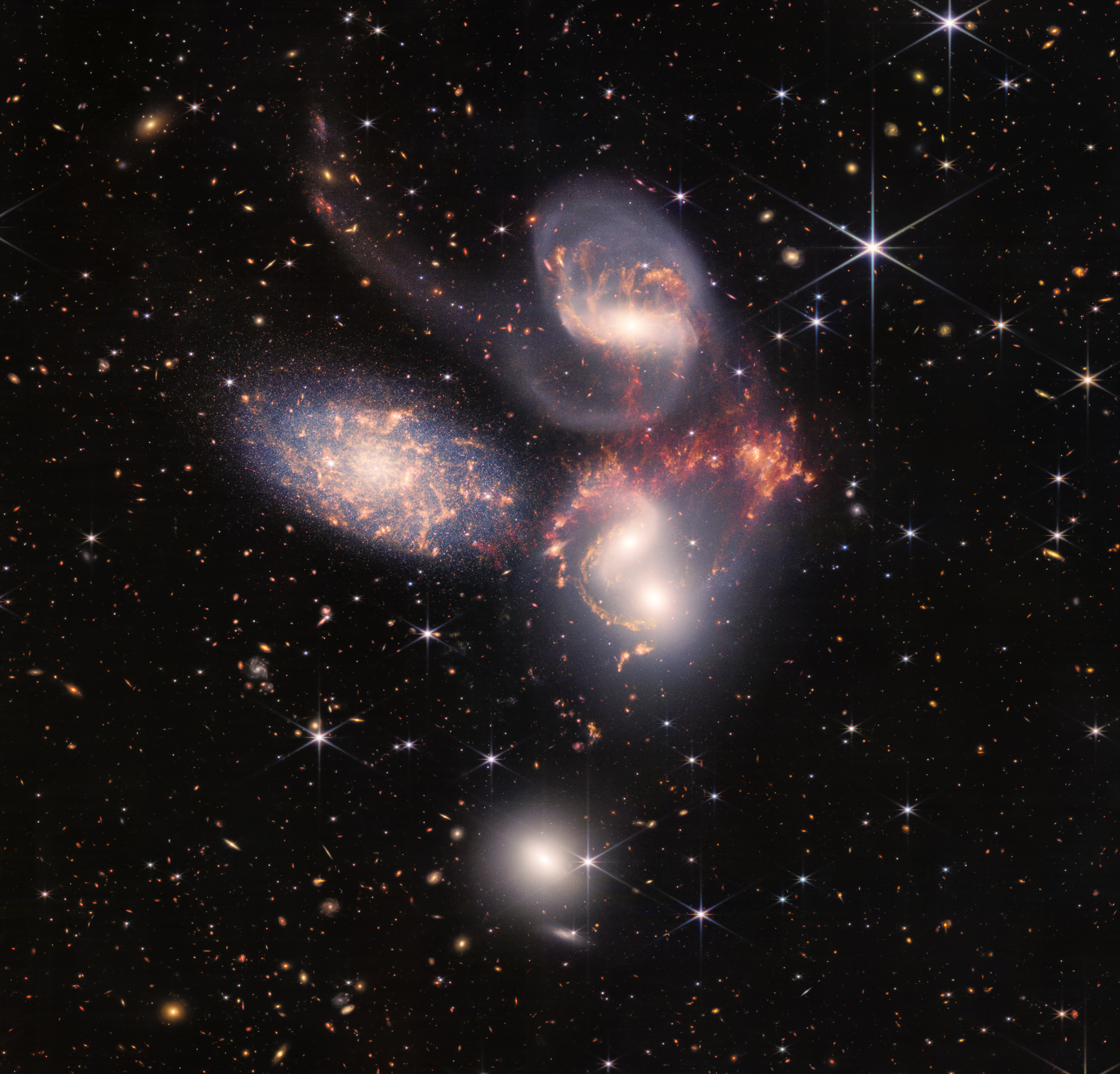
Stephan’s Quintet is an intriguing collection of five galaxies that appear to be crowded together when viewed from Earth.
As we look closely, we can see that the well-formed spiral galaxy in the foreground is much closer to the observer (US), and they are not interacting with the other galaxies.
The galaxies that appear behind it, on the other hand, have changed shape due to the gravitational fields generated by their reciprocal interactions
This can be observed quite clearly in the warped shapes of the galaxies in Stephan’s Quintet.
Interacting galaxies can create some truly bizarre shapes and structures that may be temporary, or they can lead to the merging of small galaxies.
One particularly interesting outcome of these galactic interactions is the collision of gas and other materials.
These collisions often trigger intense bursts of star formation, resulting in beautiful and bright cosmic displays.
5. Some Other Fascinating Images
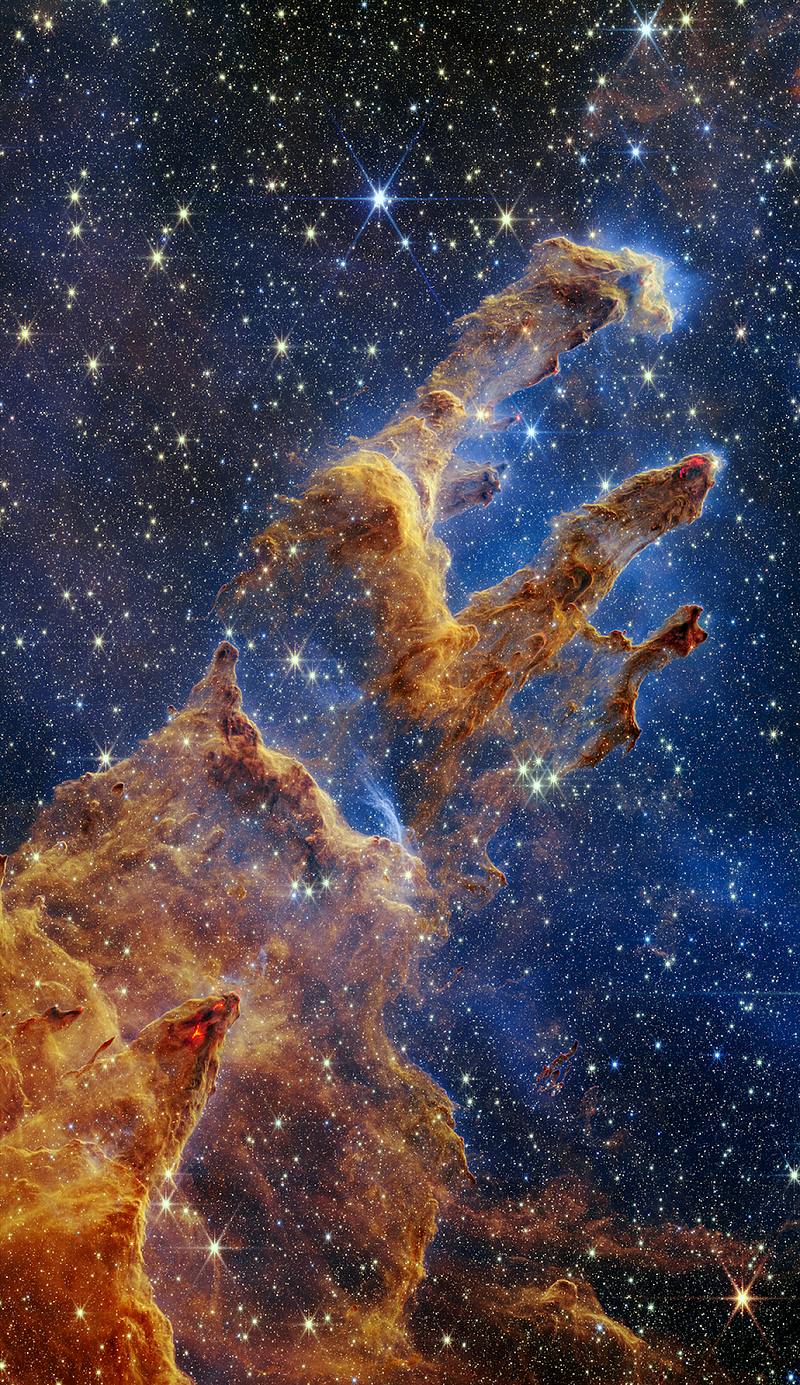
Pillars of Creation: The Eagle Nebula’s striking Pillars of Creation have long captivated astronomers and stargazers alike.
Comprised of intricately sculpted gas and dust, these towering formations have become an iconic landmark of the — Milky Way galaxy.

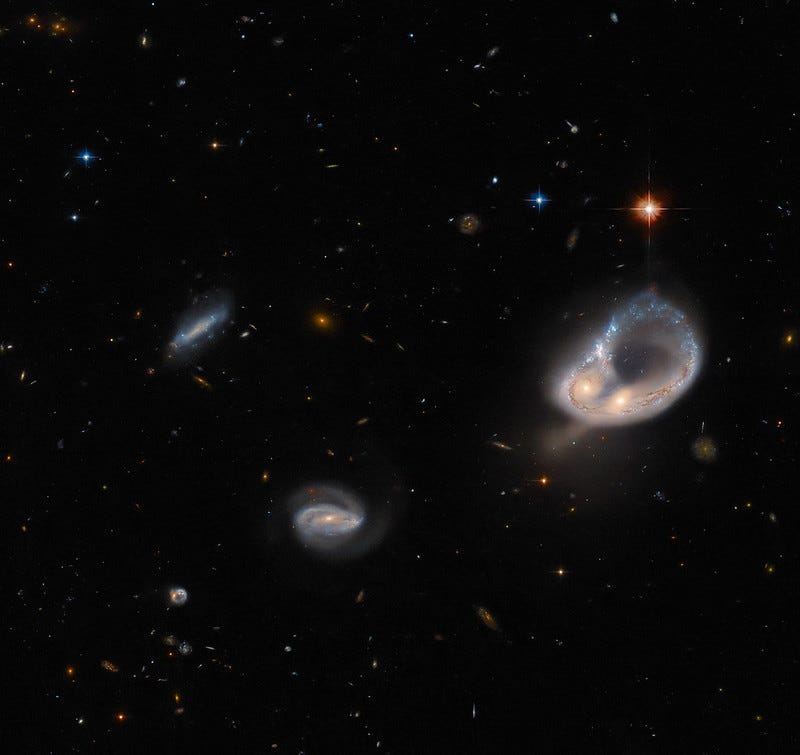
The Galaxy Merger: Hubble Space Telescope photographed two galaxies, named Arp-Madore 417–391, in a cosmic dance of merging in the Eridanus constellation.
The gravitational pull of the merging galaxies is causing a distortion in the stars, creating beautiful and intricate patterns.
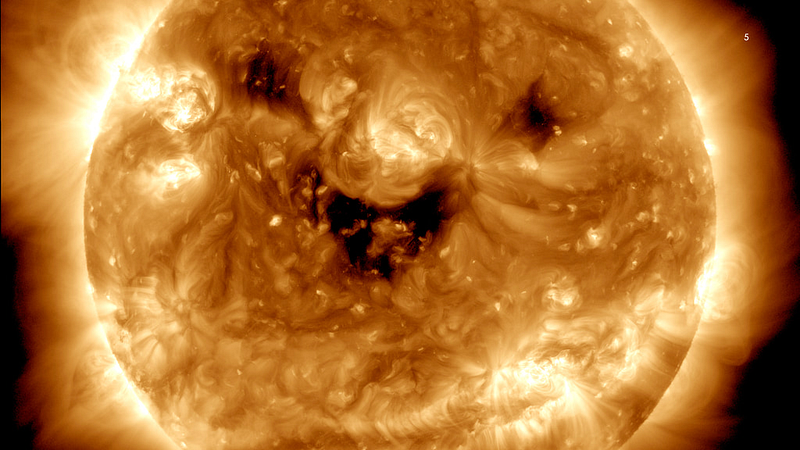
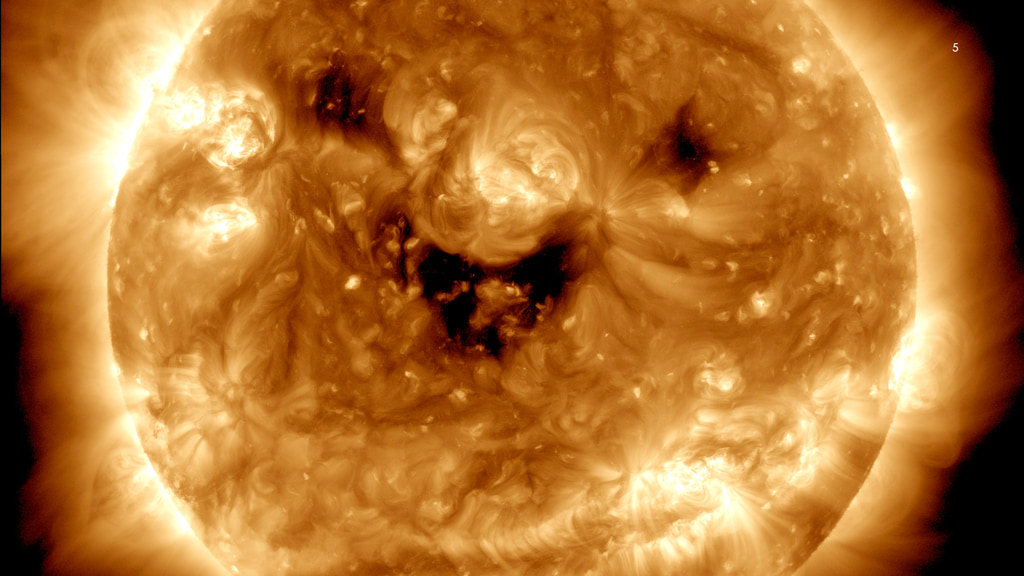
The Smiling Sun: In 2022 the Sun was caught smiling by NASA’s Solar Dynamic Oservatory.
The dark patches which are on the Sun are called coronal Holes and they are the regions from where the solar winds are forced into space.
Conclusion
The images taken in recent years and especially after the launch of James Webb Space Telescope are nothing short of breathtaking.
These images demonstrate that no matter how much we believe to know about the universe — something new always tend to pop up and often takes us back to square one.
However, one thing is certain these images are just the thing we need to continue researching and striving for greater clarity of the unknown.
More from the author: