
5 Lessons Learned From the Spanish Flu
Is history doomed to repeat itself?
Covid-19 is not the first pandemic the world has experienced. In Shakespeare’s time, theatres were often closed to reduce the spread of the bubonic plague. In the 14th century, the Black Death ripped through Europe, killing 60% of the population of Florence during the space of a few months.
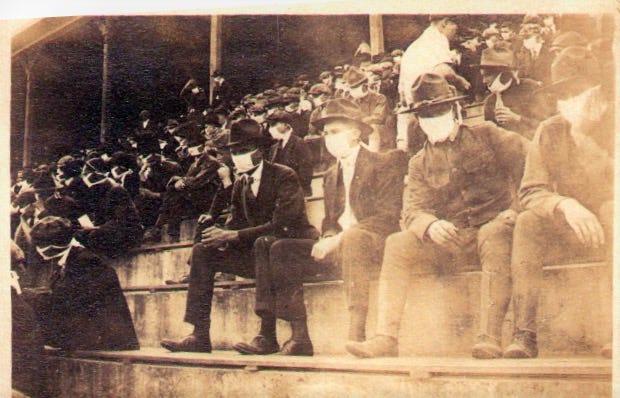
And more recently the Spanish flu of 1918–1919 infected 500 million people across the globe. Attempts to control the Spanish flu pandemic share some similarities with the issues we are experiencing with Covid-19 today.
People balked at wearing masks, leaders tried to downplay the risks in the beginning, and areas that embraced mitigation efforts from the start had fewer infections and deaths. Sound familiar?
Although coronavirus is not the flu, there are lessons we can learn by looking back at the worldwide pandemic of the early 20th century.
Lesson #1: Pretending the disease doesn’t exist won’t stop it from spreading
In the beginning, leaders tried to downplay the seriousness of the flu outbreak. The reason the Spanish flu is named “Spanish flu” has nothing to do with where it originated.
Spain happened to be one of the few neutral countries during World War I. And Spain’s journalists were allowed to report on the outbreak. War-time censors in other countries (including America) blocked mention of the flu to avoid low morale. So the public mistakenly believed the flu began in Spain, when in fact, the first known case of the flu came from a military base in Kansas.
In 1918, the US passed the Sedition Act which made it a crime to make “false statements” about the US. We don’t know if the Sedition Act was used to stop information on the flu pandemic from being made public, but we do know that newspaper editors were afraid to run stories on the seriousness of the flu.
Doctors that tried to warn the public through letters to the editor were thwarted. Without any warning to the public, the flu was allowed to spread rampantly. US troops sent to Europe spread the disease far and wide.
Lesson #2: Social distancing worked, we have proof
If anyone wonders if social distancing helps stop the spread of disease during a pandemic, we can look to the past for answers. We’ve been through it before and the data shows, yes, social distancing worked.
American cities that made early efforts to stop large gatherings and close schools had much lower death rates than cities that either waited too long or relaxed measures too early.
St. Louis responded to their rising death rates quickly, reducing transmission rates by 30 to 50%. New York City was particularly strict and they experienced the lowest death rate on the East Coast. Philadelphia waited to take any measures, holding a 200,000 person parade after their death rates had already been going up. Philadelphia was hit hard from the virus with a death peak of 748 out of 100,000 after 24 weeks.
Lesson #3: It’s tough convincing Americans to wear masks
During the war, wearing a mask became a civic duty that one did to protect the troops from catching the flu. But once the war ended, this patriotic feeling disappeared, and people began to fight mandates to wear masks.
People complained that masks were hard to wear and impeded their civic rights. Much like today, there were protests. The “Anti-Mask League” was formed in San Fransisco.
Officials did what they could to get the public to wear masks, even allowing gauze and chiffon fabric. Doctors tried to warn people that porous masks were not effective, but officials let their rules stay lax in the hopes of raising compliance. There were even reports of people poking holes in their masks to fit a cigarette in their mouth.
Lesson #4: Be wary of drugs that don’t help
Today, hydroxychloroquine has been touted by some as a Covid-19 preventative, even though there is little evidence to suggest it does anything at all. In fact, just the opposite, it’s a drug with many dangerous side effects.
In 1918, there was aspirin. High doses of aspirin were recommended for flu symptoms. While the maximum dose today is 4 grams, in treating the Spanish flu, people were told to take 30 grams. This led to serious side effects and possibly aspirin poisoning.
Lesson #5: Herd immunity with no vaccine or reliable medication means many deaths
Herd immunity happens when enough of the community becomes immune to a disease, either through a vaccine or from getting ill and recovering. Once a high percentage of people become immune, the entire community is protected.
What is this percentage? It varies depending on the disease. For example, measles requires a high percentage (92–94%) for herd immunity.
During the Spanish flu, there was no hope of a vaccine. Doctors didn’t even understand that the flu was a virus, not a bacterium. Experts agree the pandemic ended in 1920 when enough people contracted the disease and recovered, creating herd immunity.
Sadly, many did not recover, resulting in 50 million deaths globally. And it never truly went away. Traces of the Spanish flu can be found in H1N1, which still circulates the globe annually.
What will they say about us 100 years from now?
It’s easy to look back at history and see where things went wrong. It’s much harder when you’re in the middle of the quagmire to see clearly.
We have an advantage over the people of 100 years ago. We have advanced medicine. Unlike in the past, with Covid-19, there is hope for a vaccine. And scientists are searching to find a drug that works effectively.
Many questions remain. Can we make sacrifices now in our wait for treatments? Will we be able to see that simple measures like wearing masks and keeping a distance from others will save lives? How high must the death toll reach for Covid-19 before this ends?
Although the future is impossible to predict, there is much to learn from the past.


