
5 Lessons in Leadership through Laughter: Archbishop Desmond Tutu’s Legacy of Humor
How a Nobel Laureate Leveraged Laughter for World Peace
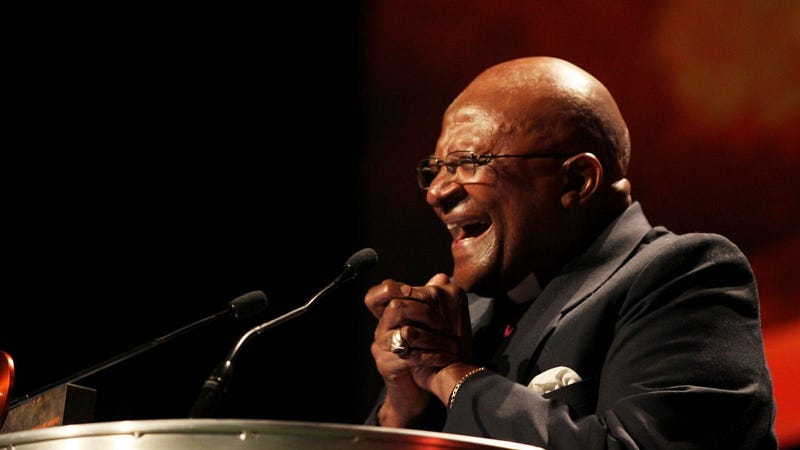
A diminutive man, standing only 5 foot 5 inches, Archbishop Emeritus Desmond Tutu was a towering force who spoke out against social injustice. Political and spiritual leaders from around the world are sharing their condolences, remembering him not only for his humanitarian work, but also for his tremendous sense of humor.
“Archbishop Desmond Tutu was a mentor, a friend and a moral compass for me and so many others,” former President Barack Obama said. “He never lost his impish sense of humor and willingness to find humanity in his adversaries.”
“His legacy is moral strength, moral courage and clarity,” said Anglican Archbishop of Cape Town Thabo Makgoba.
“He felt with the people. In public and alone, he cried because he felt people’s pain. And he laughed — no, not just laughed, he cackled with delight — when he shared their joy.”
While he was known for his distinct laugh (see video “Desmond Tutu Just Can’t Stop Laughing”), Archbishop Desmond Tutu was no fool. He understood how the power of humor could strengthen bonds, break down resistance and defuse conflict.
Journalist Anli Serfontein recalls Tutu’s ability to use humor to defuse difficult situations. She described an incident in 1988, “the darkest of Apartheid years” when the headquarters of the South African churches had been destroyed by a car bomb. She said Tutu silently inspected the scene of destruction and then said to his successors,
“What did you do to the place? It was intact when I left!”
Serfontein says the group laughed — it totally broke the ice.
Quick with a smile and laugh, Tutu infused many of his speeches with jokes. In one presentation he shared a hilarious version of the nativity story.
“Joseph rushed up to the innkeeper, ‘Please help me! Please help me! Please help me! My wife is about to have a baby!’
The innkeeper says, ‘Sorry, it’s not my fault.’
And Joseph says, ‘It’s not mine, either!’”
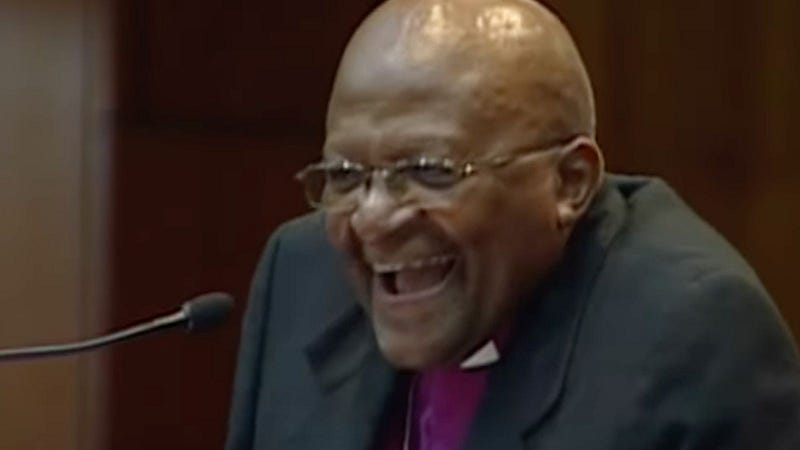
Tutu also recognized that self-effacing humor could increase his likability and endear him to his audience.
“Archbishop Desmond Tutu died and went to the gates of Heaven to seek admission. Peter denied him and sent him down — to the warmer place. In a few days, Peter heard a loud banging at the gates of Heaven. ‘Who’s that?’ he demanded. The answer came, ‘It’s me, the Devil. You sent that Archbishop Desmond Tutu to me, remember? Well, he’s caused so much trouble that I have come to seek political asylum in yours!’”
We can learn so much from Archbishop Emeritus Desmond Tutu’s masterful use of humor:
1. Laugh with others when experiencing their joy, connecting at a deeper level.
2. Use humor to lower resistance and defuse conflict, when appropriate.
3. Use humor to enhance our likability — to create bonds with those who don’t know us, and to strengthen bonds with those who do.
4. Infuse humor into our storytelling to open people’s minds and make our message more memorable.
5. Leave the world a bit better — leave a legacy through our humor and laughter.
Asked once by the Associated Press how he wanted to be remembered, Archbishop Emeritus Desmond Tutu replied: “He loved. He laughed. He cried. He was forgiven. He forgave. Greatly privileged.” Mission accomplished.

Would you like to read unlimited articles on Medium? It costs $5 per month and supports your favorite writers (like me!). Use my referral link to sign up, and you’ll support Medium authors directly with a portion of your fee, at no extra cost to yourself. Thanks!