
5 Lessons I Learned As a Dancer
#3: Your partner is your world
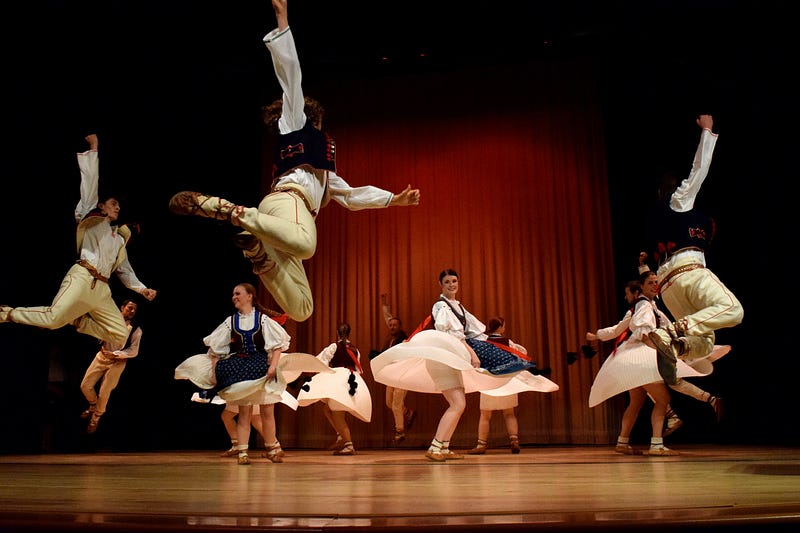
I am a dancer.
I danced in front of five thousand cheering people at one of the biggest folklore festivals in Europe, on The New Stage of The Czech National Theatre, but also in the remote village for a bunch of apathetic adolescents.
I performed in a three-hour concert in a luxurious theatre in Patras, Greece, on a slippery concrete surface at the zoo in Gaziantep, Turkey, or drunk and embarrassed of myself at the prestigious festival in Slovakia.
It is safe to say dancing is a part of my fabric, an inseparable element of my soul. Many of my pivotal moments are linked to dance and the community around it.
I’m eternally grateful to my parents for their decision to make me dance in a folklore group. I was nine. For my entire “career”, which lasted twenty years, I was loyal to the one ensemble. They are my family.
Here are five profound life lessons I learned during those two decades.
1. Repetition is King
You don’t perform in front of the public until you know the choreography by heart.
Unless your group severely lacks the dancers, which means you are rushed to the podium to make up the numbers, you have to earn your place in the spotlight.
You earn it by spending dozens of hours practicing.
When you are learning a new dance, the choreographer dissects it to the tiniest of fractions. Every step, expression, and change of posture is explained, and then gradually put together as the piece slowly blossoms in front of the entire collective.
When you are familiar with the basics, the intact show is drilled until exhaustion.
Some old choreographies in time turned to warm-up dances. I am sure I repeated those up to a thousand times.
Does it sound familiar?
The well-known “10 000 hours rule” immediately springs to mind. Or the concept used by Robert Green in his classic Mastery — the apprenticeship phase.
It is simple.
Before you claim your place in the spotlight, you have to hone your craft. Don’t complain your project hasn’t succeeded, or the respected publication didn’t accept your piece if you didn’t hit the ground exhausted at least a couple of times during your apprenticeship.
Instead, focus all your energy on the practice and make it count.
2. You Stand in Your Way
This lesson directly follows the previous one.
When the apprenticeship phase ends, it is time to trust your intuition. You have rehearsed everything and it has been tattooed on your mind.
Don’t let our innate urge to be always in control and constant overthinking to dictate the tempo.
Whenever you start thinking about what you should do in your next step or even the step after that, you make a mistake. The endless possibilities will overwhelm you and you’ll get lost.
Either in training or worse during the performance, this happened so many times to me.
I vividly remember an occasion, when we opened the concert with a dance I performed countless times. Once I stepped on the stage my mind went blank and I didn’t know what to do next. I desperately started digging into my memory, trying to figure out what should I do.
At that second I could either panic or relax and let my intuition do the work. I chose the second option.
When the moment of doubt arrives, the only viable option is to immerse yourself in it and trust the process and your intuition.
You have trained hard, you put the effort in. Your body and mind know best what to do.
Don’t stand in their way.
3. Your Partner is Your World
You can be the greatest dancer in the world, but if you don’t vibe with your partner, your shine won’t even reach the first row.
With your dancing partner, you form a unit, a single entity. You cover each other’s backs, balance the strengths and weaknesses.
When you aim to draw all the attention to yourself, you just disturb the equilibrium and hurt your partner and yourself.
To better describe the concept, I will use an analogy of a dance move when the couple rotates around its axis by quickly treading on the spot. To go as fast as possible, you have to firmly hug and hold each other, while you gracefully whirl around.
The more trust there is, the quicker you can go. If one of you tries to dominate the rotation, you both collapse.
This applies to all of our relationships — romantic, friendship, or business. In any given moment, the person you interact with is everything that matters.
Always give them your undivided attention. It is for mutual benefit.
As in dance, also in life, we are not solitaries living in a vacuum. Every day we interact with plenty of people — our love partners, colleagues, random strangers.
If we act in their best interest, we both thrive.
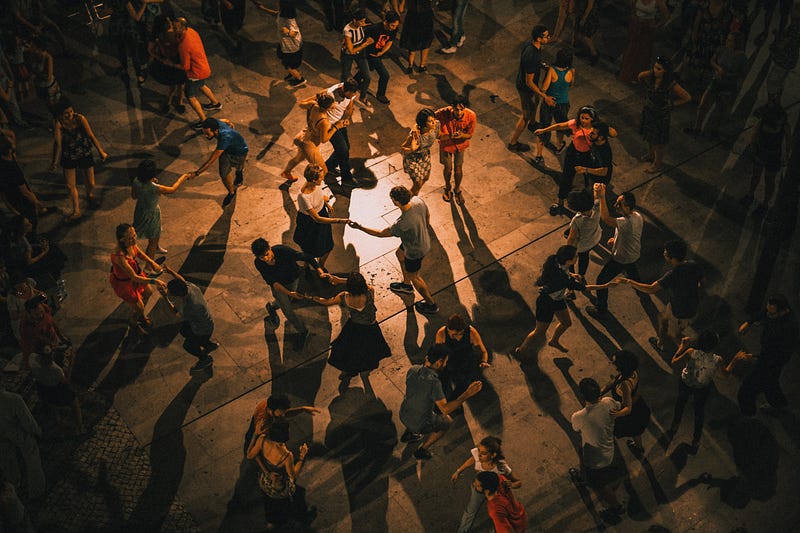
4. Act Like You Know What You’re Doing Even If You Don’t
In every dancer’s life, there are numerous occasions when we messed up on the stage. You turn to the other side, go a second earlier or completely mix your step.
The mistake itself isn’t that significant, but our reaction is essential. The seasoned professional won’t be bothered by their error, regardless of its seriousness.
They know mistakes and successes come in the same life package.
The masters among us will continue to dance as nothing happened, they put even more energy into their performance.
Did you screw at a local performance? Be glad it didn’t happen in the National Theatre. Did you stumble and fell during that rapid rotation? Next time trust your partner and lean into them.
The worst thing you can do is react theatrically. To let everybody on the stage and in the audience know you just screwed up. Maybe the audience didn’t even notice your error before you gladly reminded them. Also, you just made your partner even more nervous.
Own your mistakes.
Always keep going forward and make sure to finish the day on a high note. Assure your partner that you are in control of your emotions.
The mistakes will come at all the stages — love life, friendships, career. Owning them is the safest way to minimize their reoccurrence.
But that doesn’t mean acting cocky and arrogant.
On the contrary, it means to admit your fault, analyze it, and learn from it. Maybe you were too hasty, distracted or you simply didn’t prepare as responsibly as you should have.
But you proved your durability by finishing the dance with a smile on your face.
5. Everything is About People
In the end, the sold-out concert halls, solo performances, and the feelings of immense pride; it’s all irrelevant.
People are the only thing that matters.
Don’t get me wrong, I’m honored to experience so many splendid moments with dancing. It is an art of movement and the feeling of creative self-realization is priceless.
But most of all I’m grateful for the community.
All those stage lights fade away when compared to the company of people from all corners of the world.
I cordially remember the international festivals, which turned out to be the melting pots of cultures and traditions. These were the best times.
When I close my eyes, I see the cheerful Mexicans in their colorful and rich costumes, the bouncing Congolese with energy to spare, the Haka-performing majestic Maoris from New Zealand, mystical Indians gracefully flowing through the air, or lively Italians, who never stop singing.
And of course people from my group, lifelong friends with whom I share memories for the rest of my life.
What have twenty years of dancing taught me?
That dance is only a medium, same as other forms of art or sports. It is only a means to a much more relevant end.
People are and always will be that end.
People are the only things that matter.