
5 Lessons For AI Enthusiasts To Successfully Launch Your Own GPT App
Developing a custom-made tool for making smart decisions when buying a car
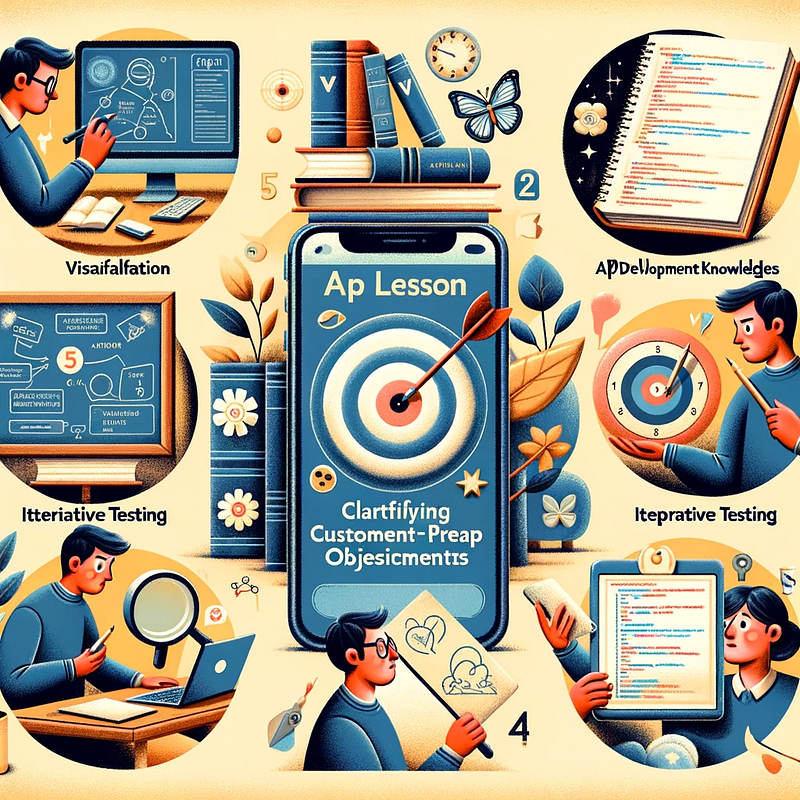
Creating GPT apps just got easier thanks to Open AI’s announcement that custom GPTs can be built using only language.
I’ve been in car sales for over a decade, and I wanna pour all that experience into an app that could be your personal assistant.
This app will help people make smarter buying decisions.
The biggest problem I’ve seen is that people struggle to figure out what they really want. And car salespeople, man, they have a bad reputation.
But don’t worry, this app will solve that problem by using data and programming to give you the most appropriate advice. I’ve seen every possible car buying scenario, and just like a GPT, I can predict the outcome quickly.
These are the five lessons I’ve learned from building my first ten apps.
Lesson One: Visualization
The importance of visualization cannot be stressed enough.
I found that envisioning my interactions with customers made it significantly easier to instruct the GPT on how to guide users. It’s like painting a picture of the customer journey. The clearer it is in your mind, the better GPT can emulate it.
Let’s consider an example. Imagine two developers: Entrepreneur A doesn’t pay much attention to visualization, whereas Entrepreneur B incorporates visualization into their strategy from the outset.
The first may create functional systems, but they often struggle with user-friendliness and intuitiveness, leading to frustrated customers and continuous iterations.
On the other hand, visualizing the user’s journey anticipates user needs and wants, creating a system that isn’t just functional but is user-friendly and intuitive.
For me this is the first step because it also helps me to put my expertise on the paper
Lesson two: The Power of App Development Knowledge
Understanding the fundamentals of app development, even without delving into coding, can be a game-changer.
It significantly streamlines your approach to creating non-coded apps and equips you with a deeper understanding of the process, making troubleshooting and optimization easier.
Making an app without any app development knowledge is a long, frustrating process reliant on trial and error.
I spent countless hours for nothing.
However, using a blueprint is easier. Elon Musk didn’t build rockets from scratch; he took existing technology and adjusted it. When I did my first GPT, I relied primarily on experimentation, which proved to be a lengthy process.
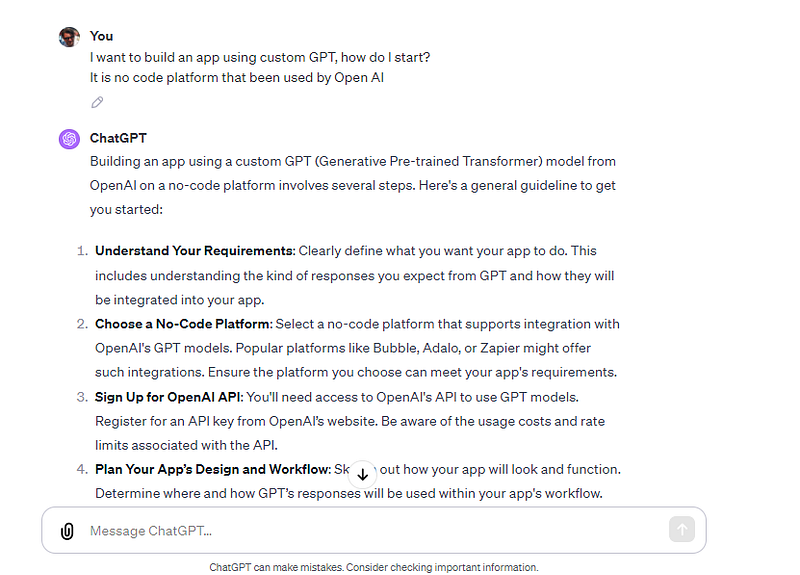
Then I pondered and asked myself, “How would an app developer build it?” I consulted with GPT in a chat and posed this question. It provided a series of steps, some weren’t relevant to me, but others were incredibly useful. This guidance helped me progress faster.
In the end, trial and error is possible, but it is often a long and arduous process that is prone to unforeseen problems and setbacks, so using someone else’s path is easier
Lesson three: The Significance of Clarifying App Objectives
Understanding the fundamental purpose of your application is not just a recommended step, but an essential one in the journey of GPT development.
Having a clear purpose for the app influences how you build the rest of it. For example, the app I am currently developing features a conversational interface with the ability to answer queries like, “Should I upgrade my three-year-old car in good condition or keep it for a while longer?”
It acts as a virtual coach, engaging in a conversation with the user and providing guidance through specific questions. Now, let’s consider two scenarios to further illustrate this point.
Developer A builds an app without a clearly defined purpose. This results in an app that tries to do everything but excels at nothing, ultimately leading to user dissatisfaction.
In contrast, Developer B precisely defines the app’s goal and creates a specialized tool that efficiently addresses users’ queries, resulting in a high user retention rate.
Remember, if people find your app useful, they will use it. And with usage comes the potential to monetize it. In essence, the difference between defining the app’s purpose and not doing so is the difference between creating an app that merely exists and an app that excels.
Lesson Four: The Significance of Iterative Testing
As a newcomer to app design, I initially underestimated the importance of testing apps.
However, I soon realized that testing plays a crucial role in app development. It allows you to observe GPT responses and make necessary adjustments along the way.
Testing an app is like cooking: you always want to ensure the recipe works before serving it as the final meal.
By testing and refining, you can identify any potential issues and improve your app’s overall quality. Testing also provides valuable insights into the user’s perspective, enabling immediate adjustments to your approach.
During app development, evaluation offers several key advantages that contribute to application success:
1. Early Bug Identification: Testing helps detect and address bugs and issues in the early stages of development, making them easier and less costly to resolve.
2. Enhanced User Experience: By thoroughly testing user interfaces and interactions, developers can ensure a seamless and intuitive user experience, which is crucial for user retention and popularity.
3. Documentation Support: Testing involves creating comprehensive documentation of how the app functions in various scenarios. This documentation proves invaluable for future development and maintenance.
4. Continuous Improvement: Testing provides valuable feedback for continuous enhancement. By refining the app based on real-world usage and feedback over time, developers can continuously improve its performance and features.
Lesson Five: Understanding the Significance of Grasping Customer Predicaments
If you aim to create an app that feels authentic and relatable, it is crucial to have a deep understanding of your clients’ problems.
Recognizing and addressing your customers’ concerns isn’t merely an option when developing a conversational app; it is an absolute necessity.
By gaining a clear comprehension of your customers’ needs and challenges, you have the power to revolutionize their app experience. As Brian Tracy aptly puts it, the customer’s favorite radio station is WIFM (What’s In It For Me). If individuals fail to see the benefits that an app offers, they are unlikely to use it.
This valuable insight empowers you to guide your customers towards suitable solutions or honestly communicate when their needs cannot be met. Building trust and reliability hinges on addressing their concerns effectively.
Understanding your customers’ problems also fosters authenticity and personalization.
It creates an environment where users feel they are talking to a close friend who genuinely listens and understands them. Without this crucial step, an app becomes nothing more than a collection of information, lacking the personalized touch that truly makes it a solution for you.
Final Thoughts
If you’re interested in leveraging your unique expertise through technology, there has never been a better time or an easier way to do so.
In today’s information economy, people are increasingly drawn towards app usage rather than traditional reading or learning methods.
Here are two options:
You can either delve into a book that teaches you how to make intelligent car buying decisions, or I can provide you with an app that accomplishes the same in just a few minutes. The choice seems obvious, doesn’t it?
Furthermore, this approach serves as the simplest means to promote your product or idea. It represents an innovative-old medium that is accessible to anyone proficient in a language.
Embrace this opportunity and unleash your potential
Nikita
Here is a link to my latest free app: Car choice adviser


