
5 Keys To Becoming a Successful Writer
Some useful bits of advice I wish I had heard sooner.
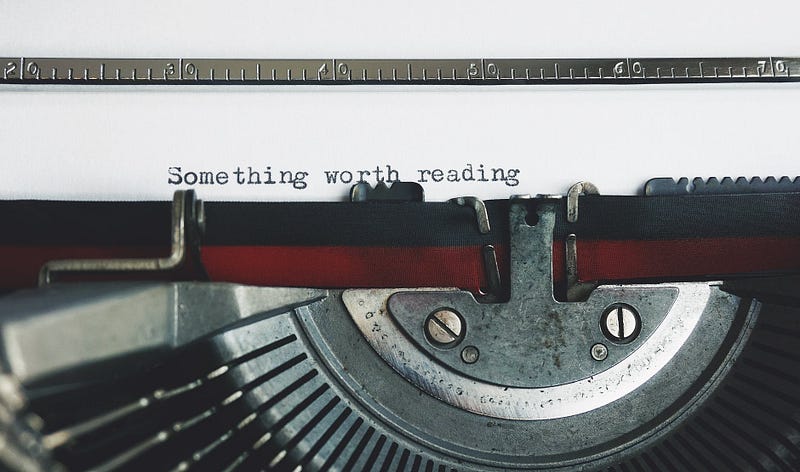
Everybody wants to be a writer.
What? They don’t?
Why the hell not? It’s a great life!
Ah. I get it. Okay, maybe it’s not for everyone, but it might be the right thing for you — just as it turns out, it was the right thing for me. Mind you, it wasn’t easy. It took time. It took practice. It took faith and a couple of other things.
Here are five crucial bits of advice you should consider if you want to succeed as a writer.
Be a writer
Something I’ve seen appear lately in books on personal and professional development is the idea that acting as if you are something helps you become that something. Seth Godin talks about it. Jen Sincero talks about it. Mel Robbins talks about it.
It sounds simple, and there is something to be said about adopting that kind of positive approach.
But it’s not the whole of it.
You can wake up tomorrow and say, “I’m a writer!” but it won’t mean much if you then spend the entire day playing Xbox. But if you wake up tomorrow and declare, “I’m a writer!” and sit down to write — then you’re creating a self-fulfilling sort of prophecy that has the potential to build on itself and make a statement a reality.
You just need to put the work in. When you claim to be a writer, you then have to act like a writer. You may be full of doubt at first. You may (will) make some mistakes. But if you put action to your words, you’ve made the whole journey a lot simpler.
It’s a mindset thing. Once you’ve got it into your head that you’re a writer — not wanting to be a writer or trying to be a writer, but being a writer — then you’re well on your way to finding some success at it.

Keep to a daily writing goal
Many writers you talk to recommend at least 500 words a day at a minimum. Some recommend 1,000. And some don’t believe in minimums at all. 10 words are okay with them.
I’m in the 500 to 1,000-word camps. I don’t always require it to be a completed piece with a beginning, middle, or end, but it’s nice to finish a short but complete piece.
By now, writing a thousand words a day is more of a habit than a goal. It was hard at first — most worthwhile things are. Commitment to a daily target of 500 words become 1,000 words within a few weeks.
It’s a rare day when I stop at just a thousand words, but if I don’t get at least a thousand words down, I feel like a slacker.
Consider this: If you write a thousand words every day, you’ll end up with 365,000 words after a year. That’s the equivalent of nearly two full drafts of American Gods by Neil Gaiman or one The Brothers Karamazov by Fyodor Dostoyevsky (in translation).
Many successful novels clock in at much less. The Hunger Games by Suzanne Collins comes in at just under 100,000 words. Paulo Coelho’s The Alchemist is one of the best selling books in modern history. Guess how many words?
Approximately 45,000.
Theoretically, you can have a world-famous novel drafted in a month and a half.
Of course, this doesn’t take into account numerous factors such as editing time and the book market. I’m just trying to give you some context as to what 500 words or 1,000 words can add up to within a reasonably short amount of time.
Consistently positioning your butt in the chair and hitting a daily writing goal is not only a great exercise but a skill that could pay off sooner than you think.

Write honestly
A number of years ago, I got it into my head that instead of painting abstract landscapes, as I had been for a while, I should be painting oceanscapes. That’s where the money was — especially for that summer crowd that visits Rhode Island every year.
Do you know how many oceanscapes I sold that year?
None.
Zip. Nada.
My abstract landscapes sold. My weird tree paintings sold. Even my crappy watercolors of folk instruments sold.
Somehow, my audience knew I wasn’t that into oceanscapes and that it was nothing more than a cynical attempt to dishonestly market myself as a painter I wasn’t. When I stuck with the subject matter that actually interested me or appealed to me, my work sold more successfully.
Painting isn’t really a vocation for me, but it’s a hobby that paid for itself and then some during the summer art festival season.
Applied to writing — I’ve tried imitating others’ styles. I tried to write for what I thought was the market. I tried to be the writer I thought people wanted rather than be the writer I actually was.
Much like my experience as a painter, I learned how wrong I was.
I may not be a great or perfect writer, but I’m more honest now. I write in my own style. Even as a freelancer who often gets assigned all sorts of topics, my writing style is my own.
For the most part, my clients seem more than fine with that.
Sure, study “the masters” if you wish. I even encourage it. But don’t try to imitate them. Write in your voice.
You’ll find a lot more success that way.

Learn to write anywhere
I’ve written while sitting in my car in the parking lot of a doctor’s office. I’ve written at my kitchen table. I’ve written on the Amtrak train from Washington, DC to Chicago and back again. I’ve written while sitting on my back porch. I’ve written while on the deck of the Long Island Ferry. I’ve written while sitting on the toilet.
While a lot of my writing is done on laptops, tablets, and smartphones — thanks to all that great technology people have been talking about lately — I’ve also been known to scribble down words in a nice, old-fashioned notebook using a nice, old-fashioned pen.
I once even dictated a short story, but the experience made me too self-conscious to want to do it that way again.
The point is, if you can convince yourself that you don’t need a specific writing spot or environment but can, instead, write anywhere at any time, you’re not going to have any trouble hitting your word count goals.
And it means that when inspiration hits, you’re ready to hit the ground running.
Keep the faith, and keep the practice
I’ve always been confused by the claim that one has to have a natural talent for any artistic endeavor. I did not have a natural talent for art or music, but I’ve had fun and made a little cash doing both. I’ve been writing for much longer, but I can promise you that many of my early writings are absolutely awful. I mean… burn the originals, bury the ashes, salt the land, and dispose of any witnesses level of bad.
But I kept the faith that I would improve over time.
Not just over time, but with practice.
I once was unable to draw a picture of a cat that didn’t make young children cry at the sight of it. I’ve since sold a respectable number of paintings. I once couldn’t pick up a guitar without the strings breaking spontaneously just to avoid being plucked by me. I’ve been part of two professional recordings and am a regular player at a weekly traditional Irish music session for several years.
My writing was once so bad that my brain wants to strangle itself rather than recall those tortured words once put to paper.
But today, I make a living through writing.
Beat that with a stick.
A wise dog once said, “Sucking at something is the first step towards being sort of good at something.”
It doesn’t matter how bad you think your writing might be today. Give it time and practice, and you’ll get better. There will be fits and starts. And progress may not come as quickly as you’d like, but it will come.
Keep the faith.

There’s a lot of advice out there
It’s true. I’m not suggesting my advice is all you need to soak in as you work to improve your craft, but it’s important enough. Just the same, never dismiss advice without considering it first. Not all advice will be equal, surely, but there are legions of writers who have all had to start somewhere and ended up enjoying some success.
I hear Charles Dickens wasn’t always a writer. Look at him now. He did pretty well for himself. Stephen King, too.
Something to ponder, isn’t it?
Thank you for reading. I’d love to share more with you via my Bi-Weekly Word Roundup newsletter sent to subscribers every other Sunday. It will feature news, productivity tips, life hacks, and links to top stories making the rounds on the Internet. You can unsubscribe at any time.