
5 Key Differences Between Agile Adoption & Agile Transformation
People frequently mix the terms Agile Adoption and Agile Transformation. Explore the 5 key differences and decide which you should pursue.
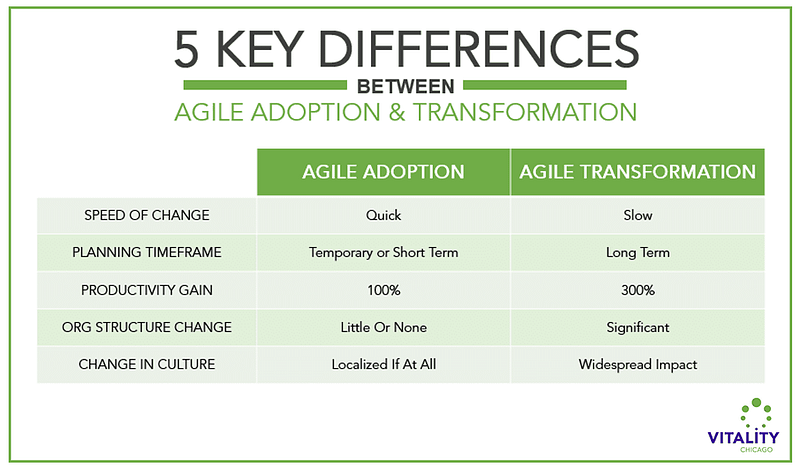
A common question that participants ask me during my Agile training courses is what is the difference between Agile Transformation and Adoption. It’s a great question. I see five key differences between the two worth talking about.
But first, let’s agree on our terminology. People frequently mix the terms Agile Adoption and Agile Transformation and use them inconsistently. These are my working definitions for these two terms.
Agile Adoption Defined
The generally accepted definition of Agile Adoption is “a change in process to one that is consistent with the 4 Agile Values and 12 Agile Principles”.
The focus during Agile Adoption is on process change. You can view Agile Adoption as moving from one process, such as waterfall or SDLC, to an Agile process or framework. This might also be called an Agile transition.
The most common change in process is to implement the Scrum Framework (more below). The change in process could also mean implementing Kanban, Lean Software Development, eXtreme Programming (XP) or some other agile approach.
Most organizations first experience Agile in this way. When an organization runs an “agile pilot” they are generally referring to Agile Adoption. I’ve been through a lot of these Agile Adoptions and they are often a great first step.
Agile Adoption Frequently Means Using Scrum
Frequently a company with a legacy of using traditional, plan-driven approaches wants to experiment with Agile. So they decide they want to ‘Adopt Agile‘ by transitioning to the Scrum Framework. You can read more about transitioning from Waterfall to Scrum in this related post.

A Scrum Transition involves forming one or more dedicated and cross-functional teams. In Scrum, those teams are supported by a Scrum Master who serves as a process coach and impediment remover. The team organizes all their work into a backlog of features. There is a Product Owner who is the key business stakeholder and takes responsibility for prioritizing the work and making business decisions.
Rather than work in phases, the Scrum team works in timeboxed iterations called Sprints. Within each 1 to 4-week sprint, the team plans their work and delivers small chunks of fully developed solutions.
Statistics on Agile Adoption
A popular annual report on Agile from Version One cites “barriers to further adoption”, “reasons for adopting agile” and “benefits of agile adoption”. All of these refer to Agile adoption and provide some insights for others who are in the process or planning for agile adoption. The report doesn’t use the term transformation anywhere.
Agile Transformation Defined
Agile Transformation may be defined as “the process of transforming an organization’s culture and nature to one of agility”. Transformation is about a fundamental change in the way people think and feel. Some people distinguish this from adoption by calling adoption “doing agile” and transformation “being agile”.
Agile is a Vehicle for Transformation
Agile methods and frameworks are tools or enablers in an Agile transformation. In other words, Agile frameworks are the vehicle, but not the destination. The destination will vary from one organization to another, but for most organizations, it is about attaining true business agility — the ability to be flexible and to be responsive to change.
Agility also means that organizations can make changes quickly and at a low cost. And it frequently implies a culture where people are empowered and enabled to do their best work.
Agile Transformation Challenges
An agile transformation is anything but easy. They are disruptive, disturbing and potentially very disappointing. The risks of failure are high. It will take a long-term investment to change ingrained ways of thinking and working, and the company culture. But the payoffs can be tremendous, as we can see below.
5 Key Differences Between Agile Adoption and Transformation
1. Speed of Change
Agile Adoptions May be Quick
Agile adoptions are pretty fast. You can measure it in days or weeks. Training on Agile can take from one to three days. You can adopt Kanban in a day or less. I’ve seen teams begin practicing Scrum immediately, without training, under the guidance of an experienced Scrum Master or Agile Coach.
In one of the first Agile Adoptions I was involved in years ago, I arrived on the client site on a Monday and supported the team to begin using Scrum on Tuesday.
We used a lightweight training approach where the team got just in time and just enough training to do their work. We started with an overview of agile values and principles, then a quick review of the Scrum Roles, Artifacts and Meetings, and then Sprint Planning.
Then the team planned their first sprint and began work. It wasn’t pretty, and as I recall the team failed to deliver completed work in their first 2-week sprint. But they had adopted Agile.
Agile Transformation Take Years
On the other hand, an Agile Transformation can take a long time. You can measure an Agile Transformation in years. Some organizations begin an Agile journey with a goal of continuous improvement or culture change. Many organizations undergoing transformation feel that they will never arrive.
Whoa, by now you are probably thinking, my leaders and stakeholders won’t give me years to work on an Agile Transformation!
What can be done instead is to look at this longer program of change and break it up into reasonable milestones and smaller initiatives. That is where having an overall transformation roadmap spanning 12 to 24 months can be helpful.
2. Planning Timeframe
Another key difference between Adoption and transformation is the timeframe. And it frequently boils down to whether the organization is trying agile on one project or on the entire organization.
Many Agile Adoptions focus on completing one specific project. Projects are temporary in nature and so adoption may be viewed as a short-term, temporary way of working in order to complete that project.
People may see a choice between Agile and Waterfall being made on a project by project basis, and individuals may be on an agile project for a while and then back on a waterfall one later.
It is easy to see how this could undermine buy-in for Scrum or any kind of encouragement to live by the Agile Values and Principles.
In an Agile Transformation, organizations frequently set up long-standing, stable agile teams that are aligned with customers, products or applications. They are usually not aligned to projects and people don’t switch back and forth between Agile and Waterfall.
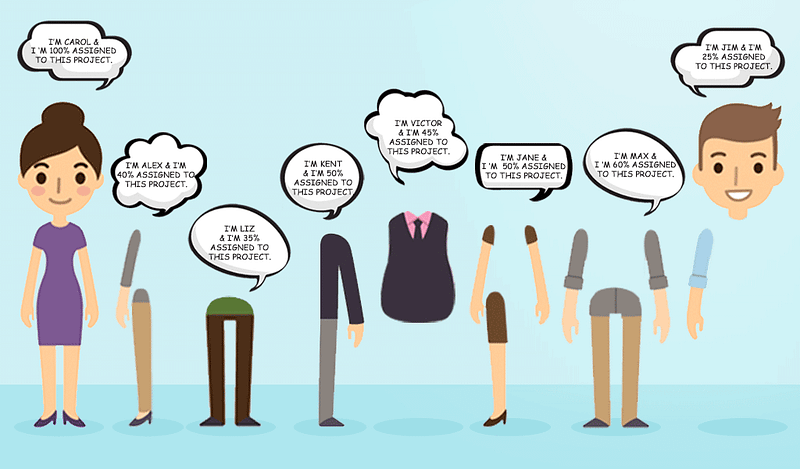
People are not assigned to multiple teams and movement between teams is minimized so that teams have a chance to gel, mature and achieve high-performance.
In fact, good agile leaders will actually let people choose what team they want to work on. You can read about an experience one of my colleagues had in running self-forming teams exercise here.
3. Productivity Gains
Productivity After Scrum Adoption
Teams can be very productive after Scrum Adoption. Scrum teams take some simple steps that can have a big impact on productivity for the average team:
- Establishing the Product Owner role to set priorities and make decisions
- The development team focuses on working together on the prioritized backlog as as their sole source of work
- Development teams plan their work together and collectively own their sprint goals
- The Scrum framework brings transparency and introduces short feedback loops
- Teams avoid the waste of detailed, up front planning, quality problems and rework
- Teams are able to define requirements on a just in time basis
To the extent that Scrum teams cross-train each other and build T-Shaped skills, they can reduce bottlenecks and increase flexibility. And teams use the Scrum retrospectives to learn and continuously improve.
My colleague Michael Sahota estimates that an Agile Adoption will boost a team’s productivity by about 20%. Perhaps the teams he was working with were already doing pretty well.
In my experience with helping over a hundred teams adopt agile, I see the improvement as more like 100% or a doubling of productivity. The biggest benefits came from helping teams work in focused and organized ways, eliminating changing requirements, rework and handoffs.
Productivity after Agile Transformation
While the benefits of Agile Adoption are great, the benefits of an Agile Transformation on an organization are significantly higher. I tend to agree with Michael Sahota who states that the benefits of an Agile Transformation are in the neighborhood of 300%. Some of the key benefits include:
- Employee Empowerment and engagement leading to joy at work
- More creativity and innovation
- Reductions in oversight and management layers
4. Impact on the Organization Structure
Agile Adoption Impact on the Organization Structure
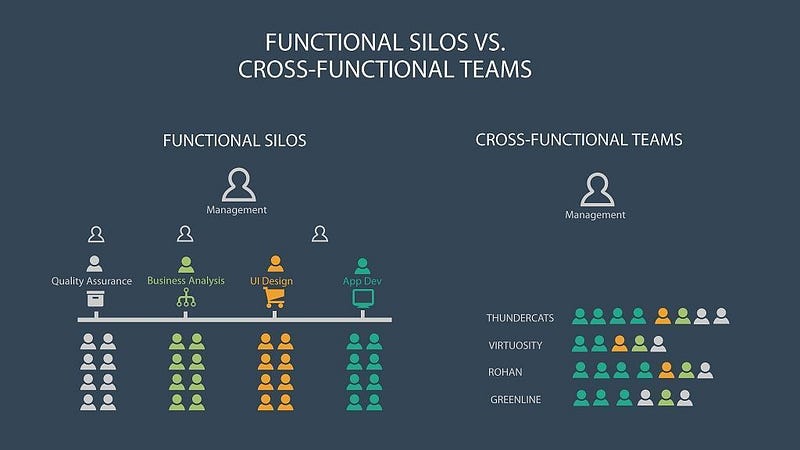
Agile Adoption rarely has a significant impact on the structure of an organization. We simply pull people from their various functional silos — front-end developers, QA, backend developers, DBAs and we temporarily assign them to a cross-functional development team.
In adoption, team members maintain their reporting relationship to their managers. The functional silos remain as shown in the left hand side of the diagram above.
Middle managers tend to favor hierarchies and strive to protect their turf, which contributes to silos, local optimizations, and significant inefficiencies. The functional silos that were designed for efficiency are now one of the main causes of lack of agility.
They slow down decisions and create power struggles while the broader organization misses out on market opportunities and loses market share to more nimble competitors. It’s easy to see the inefficiency but much harder to change.
Agile Transformation Impact on Organizational Structure
The answer to the inefficiencies of silos is to move away from silos and into long-standing, cross-functional teams. In a transformation, those functional organizations are replaced by groups of teams aligned with customers or internal products. The basic building block for this organization are those cross-functional and self-organizing teams.
This is one of the main reasons that Agile transformation is not for the faint of heart. Agile Transformations directly impact the balance of power and control in organizations. That tends to make people defensive. No one wants to give up the hard-fought turf and spoils of war. No one wants to give up the powerful feeling of commanding a large group of people.
For more details on changing the organization, see this great online training workshop from Gary Hamel on: Hacking the Bureaucracy.
5. Change in Culture
Culture Change in Adoption
In an agile adoption, the immediate team and stakeholders may feel like they’ve changed. They may feel more empowered and hopefully are being supported to self-organize. They may be striving to live to the Agile Values and principles.
Agile sub-communities can thrive in organizations who aren’t fully transformed. Great leaders can create a subculture of agility within their area. These managers need to actively protect their teams from the culture of the broader organization.
Unfortunately, I’ve also seen Scrum pilots where the culture is not any different from that of the broader organization. Scrum is used more like a weapon and the Agile Values and Principles are not valued or practiced. You can check this article on Dark Scrum by Ron Jeffries, one of the authors of the Agile Manifesto and a long time agile thought leader.
Culture Change in Transformation
In an Agile transformation, it is actually the culture that is being transformed. Agile is not the goal. Agile is the vehicle to achieve the goal of cultural transformation. Key aspects of this culture change could include:
- Primary focus on customer satisfaction
- Respect for people
- Investment in growing people’s skills
- Adopting a continuous improvement mindset
- Empowerment and distributed decision-making
Getting Started With Agile
Help with Your Agile Transformation
As you can tell from the above, an Agile Transformation is a big deal and a significant program of change in an organization. You may find some of these related articles helpful:
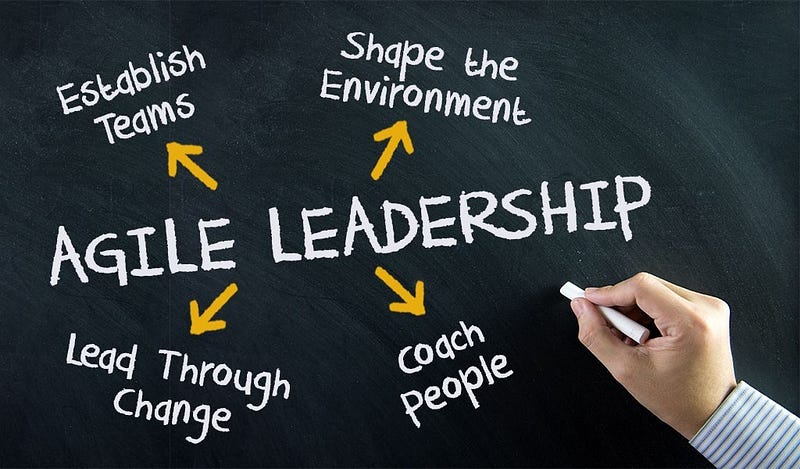
- Trying to understand the role of the Agile leader in a transformation? Check out What is the Leader’s Role in an Agile Transformation
- If you are looking for blueprints, guides, and agile transformation steps, please read How to Successfully Transition from Waterfall to Scrum.
I hope you found this topic helpful. Cheers!
⭐️Thank you for reading. If you enjoyed this article, feel free to hit that clap button 👏 to help others find it.
Let’s connect on Twitter or find me professionally in Linkedin.
Leave a comment below if you have any questions, and subscribe to receive the latest updates in Agile and Scrum.
Anthony Mersino is the founder of Vitality Chicago, an Agile Training and Coaching firm devoted to helping Teams THRIVE and Organizations TRANSFORM. He is also the author of two books, Agile Project Management, and Emotional Intelligence for Project Managers.