avatarPaddy Corry

Free AI web copilot to create summaries, insights and extended knowledge, download it at here

3556

Abstract

o above) if you can really connect to the ikigai of your team with a powerful vision, you will help unlock the power of intrinsic motivation in your team. This is achieved through explicitly working towards common values or a shared purpose. If you don’t have a shared ikigai with your team, you’re really just a bunch of folks who work together.</p><h1 id="1270">Wabi-Sabi</h1><blockquote id="5962"><p>Finding beauty in impermanence and transience</p></blockquote><p id="5d3d">Wabi-sabi does not translate easily into English. It relates to the ability to find beauty in impermanence, simplicity and transience. It relates quite well to two of the principles of the agile manifesto:</p><blockquote id="cc8a"><p>“Simplicity – the art of maximizing the amount of work not done – is essential.” (Agile Manifesto)</p></blockquote><p id="1d7d">Keeping things simple is very <i>wabi-sabi</i>.</p><figure id="5a59"><img src="https://cdn-images-1.readmedium.com/v2/resize:fit:800/0*Xhrx44wwPtW2ZVhv"><figcaption>Photo by <a href="https://unsplash.com/@anniespratt?utm_source=unsplash&amp;utm_medium=referral&amp;utm_content=creditCopyText">Annie Spratt</a> on <a href="https://unsplash.com/s/photos/wabi-sabi?utm_source=unsplash&amp;utm_medium=referral&amp;utm_content=creditCopyText">Unsplash</a></figcaption></figure><p id="be8c">What is the least we could do to deliver value right now? Answering that question needs a bit of <i>wabi-sabi</i>.</p><blockquote id="28b4"><p>“Welcome changing requirements, even late in development. Agile processes harness change for the customer’s competitive advantage.” (Agile Manifesto)</p></blockquote><p id="3dd1">Welcoming change is not easy! We might recognise that it happens, but there is a long way from not giving a f*** to actually embracing change. Wabi-sabi is about finding beauty in those changes.</p><p id="2100">In Scrum we use Empiricism to inspect and adapt, make small changes and improvements all the time. This involves putting ego aside and recognising the need to change and improve.</p><h1 id="b8c9">Kintsugi</h1><blockquote id="d220"><p>The beauty in imperfections</p></blockquote><p id="897f">Kintsugi is all about the beauty of imperfections. When broken Japanese pottery is repaired, the jagged lines of glue in a reconstructed vase are prized as improvements to the original version.</p><p id="fdf6">Kintsugi embraces elements that are repaired, imperfect or flawed. It is an attitude that strives not for perfection or to hide repairs, but to emphasise them as improvements, or beautiful variations on a prior idea.</p><figure id="f465"><img src="https://cdn-images-1.readmedium.com/v2/resize:fit:800/0*an8sycTHHwnhojU4"><figcaption><b>Kintsugi</b> (<a href="https://tomisnotaboy.wordpress.com/2016/03/24/2016323kintsugi/">Source</a>)</figcaption></figure><p id="899b">Scrum Teams deal with complex adaptive problems. We cannot know everything upfront about the product we are building: we must get value into the hands of our customers and learn from their interactions with the system and their feedback.</p><p id="42e2">In Scrum Teams, we should not strive to get everything right first time: rather we should cherish and celebrate those moments where we learned from customer feedback to improve our original idea! Moments of learning might highlight the imperfections in our original plan, but the new version is better. This attitude is future-facing and positive, as opposed to the alternative.</p><p id="3584">Our attitude to kintsugi will also be reflected in how we collaborate with our

Options

customers. Do we orchestrate a show of perfection to our customers, or do we acknowledge that we are working on complex problems, allowing the space for feedback and improvement on our original ideas?</p><h1 id="8a8e">Shoganai</h1><blockquote id="191d"><p>Acceptance of things that we cannot change.</p></blockquote><p id="c5fe">Niebuhr’s prayer is a favourite of mine:</p><blockquote id="ce4a"><p>“God, grant me the serenity to accept the things I cannot change, Courage to change the things I can, And wisdom to know the difference.”</p></blockquote><p id="74dd">Shoganai is about acceptance of the things you cannot change. Scrum teams work in complex environments. Some impediments are under a team’s control to change, while others are not. Recognising the difference can help remove stress and ease difficult interactions in a team or teams.</p><p id="9ccb">If you would like to work with a Scrum team on their Shoganai, and help them identify things that they actually can change, I can suggest a couple of retro formats for you:</p><ul><li><a href="https://readmedium.com/the-wisdom-retro-989c55b481f6?source=friends_link&amp;sk=2c158477a01046e09fd0783a85ea7374">The Wisdom Retro</a> facilitates a discussion on courage, wisdom and serenity.</li><li><a href="https://readmedium.com/adding-another-dimension-to-the-traditional-scrum-retrospective-format-6014d89ebebb?source=friends_link&amp;sk=6891d32ae0723a664a37c9dc784fb29b">The WADE Retro</a> helps teams see what is in their power to change.</li></ul><figure id="328d"><img src="https://cdn-images-1.readmedium.com/v2/resize:fit:800/1*A4-QHFs0OFeHeVcK72rWhA.jpeg"><figcaption>Photo by <a href="https://unsplash.com/@thenikyv?utm_source=unsplash&amp;utm_medium=referral&amp;utm_content=creditCopyText">Niketh Vellanki</a> on <a href="https://unsplash.com/s/photos/calligraphy?utm_source=unsplash&amp;utm_medium=referral&amp;utm_content=creditCopyText">Unsplash</a></figcaption></figure><h1 id="74e0">Shodo</h1><blockquote id="33a0"><p>The art of calligraphy and commitment to movement once the calligraphy pen hits the paper.</p></blockquote><p id="c3aa">This is about focus, and finishing something you start. Shodo is not just writing: it is completing the movement of the pen to the best of your ability before moving on to the next.</p><p id="8ff1">Shodo is as much about mindfulness and concentration as it is about the result or the output. Just like software craftsmanship, it connects to a deeper purpose for doing something. An attitude or a motivation. An ikigai perhaps.</p><p id="10a6">It also connects to that feeling of <a href="https://www.bookdepository.com/Flow-Mihaly-Csikszentmihalyi/9780061339202/">‘Flow’ as described excellently by Mihaly Csikszentmihalyi</a>. A feeling of disconnection from the awareness of time when we are immersed in doing something we love and want improve at. Shodo is a way to tap into flow, and Scrum Teams would benefit from more of it.</p><p id="3b26">Japanese words offer a small window into a culture that is rich and wide. These five words all tap into attitudes or values that any Scrum Team will benefit from.</p><p id="ea24">I hope that by learning or investigating these five words further, you develop your mindset and help your team be more successful with Scrum.</p><figure id="3bd0"><img src="https://cdn-images-1.readmedium.com/v2/resize:fit:800/0*Cn7Gthg1DlGUB9A0.png"><figcaption><a href="http://seriousscrum.com/invite">Do you want to write for Serious Scrum or seriously discuss Scrum?</a></figcaption></figure></article></body>

5 Japanese Words to enrich any Scrum Team’s Vocabulary
Photo by Conor Luddy on Unsplash

The five Japanese words in this post offer a small window into a culture that is rich and wide. The words tap into attitudes, values or a mindset that Teams can develop if they want to be more successful with Scrum.

I find language learning fascinating. When travelling, I always try to pick up a few local words, and I love how just a few ‘bons mots’ can provide a little window into another culture.

For example, I remember the first time someone translated the Mandarin ‘ni hao’ to me. It literally means: ‘you good?’ Terse simplicity. Brief and to the point. Why waste words?

In China the response is generally a simple ‘hao’ (meaning good) or perhaps ‘meng’ (busy). Again, simple.

I’m Irish, and the equivalent Irish greeting ‘how are you?’ looks like a more open question. At first glance, it seems to invite a deeper level of enquiry than ‘you good?’… Think again :)

In reality, most Irish people are actually looking for the same kind of brief response as a Chinese person wants from ‘ni hao’, and the typical response is just ‘grand.’ Anything else would be too much information!

Cultural similarities and differences can be found in the simplest phrases and exchanges.

This post is about 5 words in Japanese that come loaded with an outlook or a cultural view, and I believe they can offer some insight into the attitudes required for success with Scrum. See what you think!

Photo by Content Pixie on Unsplash

Ikigai

Purpose

‘Ikigai’ relates to higher-order goals or the reason we get up the morning. Do you know your purpose? Most of us need more than dollar bills for motivation, and in the excellent book ‘Drive’, Daniel Pink describes how organisations need to become ‘purpose-maximisers’ if they want to attract the best talent. In other words, organisations need to be fluent in their ‘ikigai’.

Every Scrum Team needs to understand why they do what they do. In Scrum there is mention of a ‘vision’ and also I believe that vision will be expanded upon in the next iteration of the Scrum Guide:

“An increment is a body of inspectable, done work that supports empiricism at the end of the Sprint. The increment is a step toward a vision or goal.” (Scrum Guide)

As Daniel Pink’s Drive illustrates (and I heartily recommend the linked video above) if you can really connect to the ikigai of your team with a powerful vision, you will help unlock the power of intrinsic motivation in your team. This is achieved through explicitly working towards common values or a shared purpose. If you don’t have a shared ikigai with your team, you’re really just a bunch of folks who work together.

Wabi-Sabi

Finding beauty in impermanence and transience

Wabi-sabi does not translate easily into English. It relates to the ability to find beauty in impermanence, simplicity and transience. It relates quite well to two of the principles of the agile manifesto:

“Simplicity – the art of maximizing the amount of work not done – is essential.” (Agile Manifesto)

Keeping things simple is very wabi-sabi.

Photo by Annie Spratt on Unsplash

What is the least we could do to deliver value right now? Answering that question needs a bit of wabi-sabi.

“Welcome changing requirements, even late in development. Agile processes harness change for the customer’s competitive advantage.” (Agile Manifesto)

Welcoming change is not easy! We might recognise that it happens, but there is a long way from not giving a f*** to actually embracing change. Wabi-sabi is about finding beauty in those changes.

In Scrum we use Empiricism to inspect and adapt, make small changes and improvements all the time. This involves putting ego aside and recognising the need to change and improve.

Kintsugi

The beauty in imperfections

Kintsugi is all about the beauty of imperfections. When broken Japanese pottery is repaired, the jagged lines of glue in a reconstructed vase are prized as improvements to the original version.

Kintsugi embraces elements that are repaired, imperfect or flawed. It is an attitude that strives not for perfection or to hide repairs, but to emphasise them as improvements, or beautiful variations on a prior idea.
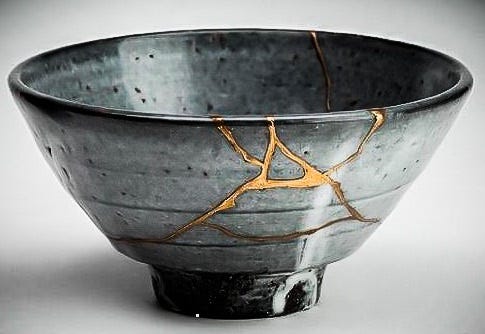
Kintsugi (Source)

Scrum Teams deal with complex adaptive problems. We cannot know everything upfront about the product we are building: we must get value into the hands of our customers and learn from their interactions with the system and their feedback.

In Scrum Teams, we should not strive to get everything right first time: rather we should cherish and celebrate those moments where we learned from customer feedback to improve our original idea! Moments of learning might highlight the imperfections in our original plan, but the new version is better. This attitude is future-facing and positive, as opposed to the alternative.

Our attitude to kintsugi will also be reflected in how we collaborate with our customers. Do we orchestrate a show of perfection to our customers, or do we acknowledge that we are working on complex problems, allowing the space for feedback and improvement on our original ideas?

Shoganai

Acceptance of things that we cannot change.

Niebuhr’s prayer is a favourite of mine:

“God, grant me the serenity to accept the things I cannot change, Courage to change the things I can, And wisdom to know the difference.”

Shoganai is about acceptance of the things you cannot change. Scrum teams work in complex environments. Some impediments are under a team’s control to change, while others are not. Recognising the difference can help remove stress and ease difficult interactions in a team or teams.

If you would like to work with a Scrum team on their Shoganai, and help them identify things that they actually can change, I can suggest a couple of retro formats for you:

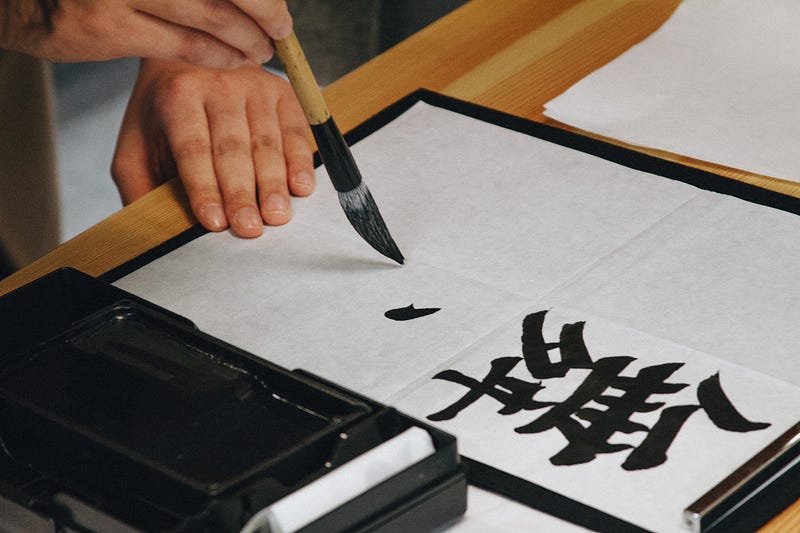
Photo by Niketh Vellanki on Unsplash

Shodo

The art of calligraphy and commitment to movement once the calligraphy pen hits the paper.

This is about focus, and finishing something you start. Shodo is not just writing: it is completing the movement of the pen to the best of your ability before moving on to the next.

Shodo is as much about mindfulness and concentration as it is about the result or the output. Just like software craftsmanship, it connects to a deeper purpose for doing something. An attitude or a motivation. An ikigai perhaps.

It also connects to that feeling of ‘Flow’ as described excellently by Mihaly Csikszentmihalyi. A feeling of disconnection from the awareness of time when we are immersed in doing something we love and want improve at. Shodo is a way to tap into flow, and Scrum Teams would benefit from more of it.

Japanese words offer a small window into a culture that is rich and wide. These five words all tap into attitudes or values that any Scrum Team will benefit from.

I hope that by learning or investigating these five words further, you develop your mindset and help your team be more successful with Scrum.

Do you want to write for Serious Scrum or seriously discuss Scrum?
Leadership
Software Development
Product Development
Work
Serious Scrum
Recommended from ReadMedium