
What We Can Learn From Satya Nadella
5 Lessons to live a better and happier life, from the CEO who turned around Microsoft’s fortunes

Among the tech leaders of today, Microsoft’s CEO Satya Nadella comes off as a breath of fresh air. The amount of care and empathy he emanates isn’t something you would generally expect from a business executive, let alone one that handles the largest business of today’s free market.
Ever since Nadella became Microsoft’s CEO, the market cap of the firm has increased by more than 250%. During the same time, he’s also earned the privilege of being one of the most likable CEOs, getting an employee approval rating of 98%.
I’ve been closely following Nadella’s progress for quite some time now. And I’ve realized is that there’s more to him than what meets the eye at first.
So without further ado, let’s see what each one of us can learn from him -
1. Making Mistakes is Okay
Nadella stared his tenure on a rough patch. In 2014, when questioned about the gender pay gap in the tech industry, he received backlash for stating how asking for a raise wasn’t the best way to get ahead and how women should trust the system.
What could have otherwise been a permanent dent to his public image, Nadella rose to the occasion and quickly accepted his folly, apologizing profusely for his comments. Later, he even sent an email to all Microsoft employees stating how he had “answered the question completely wrong”:
I believe men and women should get equal pay for equal work. And when it comes to career advice on getting a raise when you think it’s deserved, Maria’s advice was the right advice. If you think you deserve a raise, you should just ask.
With this action, Satya Nadella won many hearts as he openly accepted his mistake and worked to improve on it.
So the next time you make a mistake (which you will), question how you can be the bigger person, and own your mistakes instead of defending or making excuses. And then ask yourself how you could use this as an opportunity to make people like you even more; as Nadella did?
2. Find Meaning in What You Do

I truly believe that each one of us must find meaning in our work. The best work happens when you know that it’s not just work, but something that will improve other peoples’ lives.
Nadella convinced his employees how the work at Microsoft serves a higher calling: The Democratization of Computational Power for everyone’s welfare.
This philosophy of finding meaning in your work isn’t a new one. The widely-celebrated Japanese concept of “Ikigai” emphasizes the importance of finding a purpose to live a more satisfying and peaceful life.
Think about it. Does your work make you feel like you’re building something bigger than yourself? Do you lose a sense of time when you get engrossed in your work? Are you inspired by what you do?
Nothing is as important as passion. No matter what you want to do with your life, be passionate.
3. Turn Competitors into Allies
For a company that had been at war with Apple for as long as we can remember, Nadella’s first step when he took charge surprised many: launching an Office version for iOS. For years, Microsoft had feared such a move would speed up the decline of Windows PC sales. But guess what happened? Within the next 5 years, Microsoft surpassed Apple, Amazon, and Alphabet to stand at the top with the largest market value.
Under his watch, Microsoft got re-invented and became a company that embraced others’ ideas. When Nadella took the helm he let everyone know that Microsoft loves Linux, then made Microsoft a member of the Linux Foundation and spent $7.5 billion to acquire Github — the website where much of the content is designed to run on Linux-based systems.
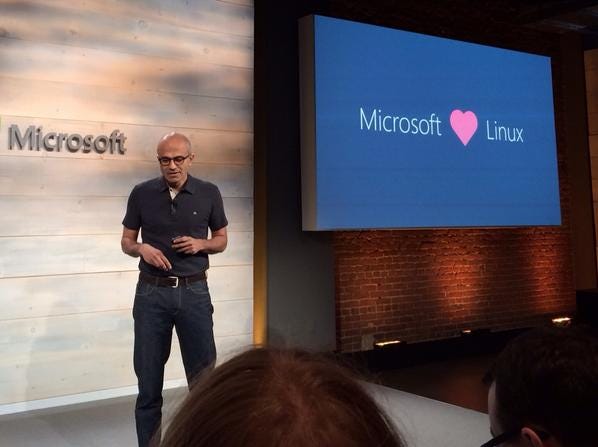
Satya realized that if we didn’t partner, we wouldn’t grow. The kinder, gentler Microsoft reflects a new era in technology. In this era, you can no longer go all alone. Making trustworthy partnerships has become more important than ever before.
4. Have a Growth Mindset
Nadella doesn’t believe in the concept of celebrating victories. He feels that declaring a victory would slip the company back into a fixed mindset.
Don’t be a Know-it-all, instead be a Learn-it-all
His opinions here match those of his contemporary Jeff Bezos who’s often said how it’s always Day 1 at Amazon. Such a philosophy keeps their companies agile and adaptive to the dynamic world of technology we see now.
No matter which industry you’re in, having a growth mindset is like having a superpower at your disposal. Believing that you can always improve is one of the most liberating feelings. It gives limitless scope to your ambitions.

A fixed mindset will make us all assume that our creative skills, intellectual abilities, and overall potential are fixed.
On the other hand, a Growth Mindset is an overwhelming sea of endless possibilities.
5. Learn to Empathize
Microsoft employees appreciate how they’ve never seen Nadella get upset, raise his voice, or fire off an angry email.
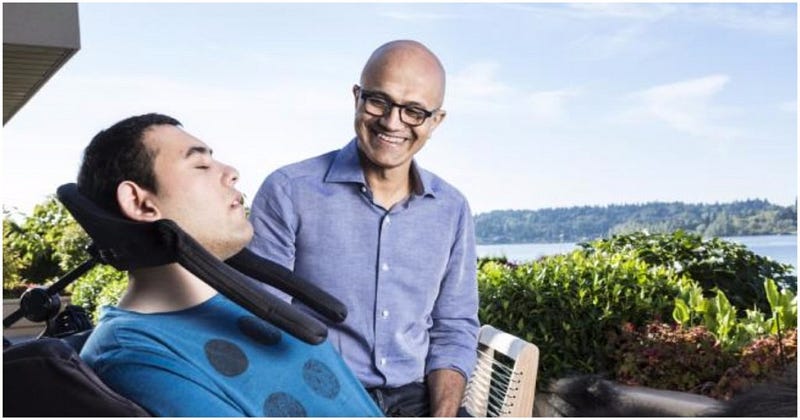
Satya Nadella attributes his behavior to the learning he got from his journey as a father while parenting his elder son, who has cerebral palsy. Talking about this on the David Rubenstein show he explained how this experience helped him learn the value of empathy and community. And channeling this empathy in turn towards his employees and customers helped him change the course of the company.
The empathy that Nadella eventually developed by facing his personal life’s difficulties transformed the way he would run his business. It helped him connect better with his employees to bring out the best in them. And it helped him connect better with his customers, and superior customer satisfaction once again became the heart and soul of Microsoft’s business.
Oh, and you know what? When Nadella was first interviewed for a job at Microsoft, the interviewer was disappointed with his apparent “lack of empathy”. Talk about self-improvement!
My wife’s empathy for others runs deep, and from her I have learned that when I infuse empathy into my every day actions it is powerful, whether they be in my role as a father or as a CEO.
In the ultra-competitive business world of today, Satya Nadella stands out as an example of what one can achieve by being more cooperative than competitive. His story helps us improve professionally, as well as personally.


